The post Viewing American history through the lens of religious innovation appeared first on The Immanent Frame.
]]>On a crisp Sunday morning, I passed through outsized wooden doors and stared down the nave. Long banners, tie-dyed in electric hues, swung from the ceiling. Beatles songs played and old people—to me, anyone over the age of 30—bobbed to the music. It was the counterculture’s heyday, and the church seemed to have swallowed the zeitgeist whole. I sat through a service curated to meet the current moment and decided I preferred my religion more old-timey.
During the intervening decades, I didn’t think much about religious innovation. But the post-millennium surge of cultural, political, and technological change made it impossible to ignore the institutional shifts upending daily life, including in my academic field and my private life. I was a historian of American religion who belonged to a post-denominational congregation. What adaptations was I experiencing at my shul and were these parallel to past shifts? Rather than read up on theoretical models, I opted for lived experience.
Innovation customarily refers to progress in science and technology, and connotes change for the better. It also can describe advances in the arts and education, but isn’t typically paired with religion, a domain associated with tradition and continuity. Yet, might that perspective owe more to coastal elites’ empirical skepticism than to observable reality? Cave drawings, 45,000 years old, instantiate a form of sense-making, reflecting the mysteries of the natural world. And, as that sense-making adapts to specific times and places, cultures and societies, it shifts. It innovates to remain relevant. Understanding how and why innovation occurs became my goal, and over the past two years I developed a course on American religious and spiritual innovation to test my ideas with students.
I hypothesized that from the early days of English colonial settlement to the present, Americans sought meaning, identity, and purpose within and beyond traditional religions. Therefore, the class would investigate the who, what, when, why and how of religious belief, behavior and belonging. I also surmised that these changes were impacted by developments outside of established religious institutions. To systematize the study for a 15-week semester, I chose five modalities that have entwined with American religion and spirituality: politics, familial systems, gender, emotion/affect, and technology. All good, I thought, but before beginning our investigation, the class needed to define spirituality and religion and to decide what constitutes innovation.
Defining spirituality is as challenging as agreeing on the meaning of religion, reminding me of Justice Potter Stewart’s “I know it when I see it” opinion about hardcore pornography. If pressed, I’d say that spirituality encompasses the search for meaning, purpose, and connection to something beyond oneself, such as nature, the universe, or the divine, or to something within oneself, such as an inner light. Spirituality is fundamental to the human experience, and religion is institutionalized spirituality. If we don’t have a sense of purpose, if we don’t have a sense of personal worth, and if we are not connected to anything outside ourselves, why get out of bed every morning?
Theologian Paul Tillich explicated a similar notion, calling it “ultimate concern” in several of his books, including Systematic Theology and Dynamics of Faith. And, although I would not, as Tillich does, identify the “true” ultimate concern as God, much less Jesus, I believe that some ultimate concerns are more effective than others at enabling human flourishing. Love, as an ultimate concern, is superior to money. World peace outranks a desire for power. And preserving the earth is more compelling than technological progress. Such judgments were sure to stir classroom debate.
Bottom line: spirituality is manifest in ultimate concerns, which we can discern through experience.
Innovation also needed to be problematized for the class. As noted above, it is typically defined as introducing new ideas, methods, products, or devices that create value, improve efficiency, or solve problems. From that perspective, one could argue that Buddhism was an innovation arising from Hinduism or that Christianity innovated Judaism. But what about teaching Zen meditation at a conservative, evangelical church? For many members, unfamiliar with Dharmic traditions, introducing Zen would surely count as an innovation. For others, it might even be a radical, groundbreaking intervention. But Zen is a 2,000-year-old practice: can we call it innovative if it is new to a different tradition?
Likewise, restorationist churches, from the Stone-Campbell movement of the nineteenth century to house churches today, seek a return to the purity and simplicity of New Testament gatherings. Is shedding the trappings of modern worship—such as musical instruments, creedal statements or ministerial garb—innovative? Can seeking to restore the past be called an innovation if ideas and practices, despite being 2,000 years old, are new in today’s context?
The students decided that religious innovation happens when external phenomena cause change, which could, depending on the circumstances, be disruptive or restorationist. Once again, we followed Justice Stewart, convinced that we would know it when we saw it.
Since the current paper cannot encompass all the examples of spiritual innovation that we studied, I have chosen to highlight one of the earliest and most significant American spiritual innovations: the development of the religious/spiritual marketplace. This, in turn, led to the democratization of religion, the ascension of female religious/spiritual leaders, and the development of new forms of religious community. Each of these innovations was mutually constitutive with contemporaneous social and cultural shifts, and it is unlikely that one would have occurred without the other. This statement may seem obvious to some readers, but my students were shocked to learn that religion is deeply implicated in society and social change, and that social and cultural change innovates religious/spiritual belief and practice.
We began the study of spiritual innovation with the Constitution (1787), the Bill of Rights (1789), and the Virginia Statute for Religious Freedom (1786). The Virginia Statute disestablished the Church of England and pledged that members of all religions would be free to practice their faith. When Congress wrote the Bill of Rights, the Virginia Statute was among the inspirations for the First Amendment, which forbade Congress from establishing any religion or forbidding the free exercise thereof.
Other than in the First Amendment, the founders intentionally left God and religion out of the U.S. Constitution, with a brief exception banning “religious tests” for elected offices. Aware that religious warfare had ravaged European countries from the sixteenth to the eighteenth centuries, they agreed that disestablishment would obviate the cause for such conflicts. The founders themselves were theologically diverse, ranging from devout Christians of various denominations to religious skeptics. Yet, despite these differences, they all affirmed religious liberty, the notion that belief was a matter of individual conscience not state control.
The founding fathers’ decision to keep religion out of government had long-ranging political consequences, many resonating today. But it also had spiritual/religious consequences. By putting all religions on an equal footing, it enabled the creation of a religious (and spiritual) marketplace in which citizens could join or even create a faith of their choosing—or follow no faith at all. Since religions now had to work for their membership, and for the sponsorship that had been intrinsic to European state-supported churches, they needed to market themselves. As a result, the American religious landscape developed a dynamism and drive that eluded its European counterparts. In today’s parlance, churches became brands and religious membership signaled not only personal theology but also distinctions in practice, belief, and even socioeconomic status. Those differences in the religious marketplace are still strong today.
Although the new republic was designed by and for white, male landowners, political developments of the early nineteenth century moved our governance closer to a democracy, which was mutually constitutive with a similar trajectory in American Protestantism. These Jacksonian currents, which privileged individual agency and autonomy, uplifted the “common man.” Politically, property requirements for voting were removed and the franchise extended to all white men. Religiously, the Second Great Awakening’s call for salvation through a personal commitment to Jesus overtook Calvinist belief in predestination. Men could not only pick their political leaders but also could effectuate their redemption.
Other nineteenth-century spiritual innovations had nothing to do with electoral politics. Without an established national church, newspapers became the arbiters of religious influence. While some publishers adopted a respectful stance to mainstream religious leaders; others saw that sensationalism sells. Many names, unfamiliar today, were ballyhooed in headlines about religious sex cults, communicating with the dead, and adulterous affairs. Among the results, and coinciding with the rise of secularism, was a diminution of public, religious authority and the concomitant rise of faith in science.
Around the same time, side effects of urbanization and industrialization empowered women’s work, frequently under religious aegis, outside the home. This dovetailed with the appearance of female pastors and prophets and, later in the century, women leading spiritual and religious denominations. New modes of transportation and communication made it possible to spread religious materials nationwide and to grow new traditions. Whether it is cars, radios, or the internet, technological innovations have had spiritual ramifications which, in turn, changed the tech’s impact on the secular world. Seeing how social and cultural shifts occurred in tandem with spiritual and religious innovations left no doubt in my students’ minds that religion and spirituality were more central to American history than they had ever imagined.
Are there other ways to think about spiritual innovation? Of course. Researchers from other disciplines will have their own perspectives on this emerging field. My contribution to ongoing research is to insist on the contextualization of innovation within specific eras and locations rather than treating it ahistorically or autonomously. We currently face one of the largest and potentially revolutionary spiritual innovations ever: the development of artificial intelligence and its trans-and-post humanism outcomes. If we wish to secure the continuity of human flourishing, we may need to draw on the lessons of the past to discern which ultimate concerns will best serve the future.
The post Viewing American history through the lens of religious innovation appeared first on The Immanent Frame.
]]>The post Reassembling the sacred appeared first on The Immanent Frame.
]]>When we encounter such unexpected reconfigurations of faith–efforts that cleverly dismantle and reassemble tradition at the same time–we confront a persistent linguistic challenge: what, exactly, should we call this kind of religious change? For now, I suggest these developments are best understood as religious innovation: strategic recombinations of tradition undertaken in response to perceived threats to religious legitimacy.
Any history of religion documents the recurring instances of significant changes. New theologies emerge, hierarchies overturn, and novel configurations of belief and practice take form. These shifts prompt observers to distinguish between natural variations, gradual modifications to newly stable structures, and more fundamental reorganizations. At what point does a sequence of accrued adjustments yield a new form of religious life? In short, how do we recognize when continuity gives way to reinvention?
Readily recognized change poses challenges to both insiders and outsiders of all religious orientations. Terms like translation and adaptation often become shorthand to describe these processes, yet the concept of innovation is analytically central. Innovation is commonly associated with engineering feats and technical efficiency, which implies a sharp divide between technological change and religious matters, as if innovation belongs to markets and machines while religion belongs to transcendence and timeless meaning. Treating innovation as exclusively material and mechanical–exclusively tied to electricity or pop culture trends–blinds us to how religious change actually unfolds, since such elision obscures how religious institutions also confront pressures of competition, relevance, and authority. Furthermore, we may ask to what extent these dynamics are uniquely tied to a Western and Christian context. Whether innovations take different forms–or encounter different barriers–outside of this cultural milieu is an open question and fertile ground for future research.
Innovation as strategic recombination
I propose religious innovation as a heuristic for the strategic restructuring of religious organizations, practices, and identities in response to social change. Innovation does not indicate creating something ex nihilo. Drawing on a classic insight from H. G. Barnett, innovation is a social process of recombination that works with inherited materials even as it redirects their meaning and use. New arrangements emerge through reinterpretation and reassembly of existing cultural elements.
Changes accrue, and unseen adaptations certainly occur. Yet religious innovation foregrounds agency. It names moments when actors revise goals, reorganize practices, and mobilize new participants in ways that reconfigure institutional life. Rather than being passive bearers of tradition subject to slow accretions of emphasis and priorities, innovators act intentionally. Religious leaders and communities are usefully approached as institutional entrepreneurs navigating tensions between continuity and change. The greater the perceived threat, the greater the motivation for invoking change through a mixture of skills, resources, and symbolic repertoires, although the extent of consequences are often unanticipated.
My research on the Emerging Church Movement illustrates this dynamic. The movement is fundamentally defined by a shared religious orientation built on a continual practice of deconstruction that intentionally resists pressures for religious conformity. These groups did not reject Christianity. In contention with the direction of mainstream churches and in reaction to their own experiences within them, they dismantled congregational faith practices and reframed them. Many relocated worship liturgies into pubs and coffeehouses and loosened inherited theological boundaries. In doing so, they altered institutional habits rather than inventing a new religion. Their innovation lay in reorganizing devotional life and revising assumptions about authority and spiritual belonging within the revised bounds of Christianity itself.
The Emerging Church Movement also points toward a broader conceptualization of religious institutional entrepreneurship. This captures how actors strategically leverage familiar resources to reshape institutions and remake religious life. Emerging Christians did not simply revive evangelicalism or adjust it at the margins; they dismantled forms they regarded as illegitimate and replaced them with hybrid practices. Their micropolitics of resistance fostered pluralistic communities in which belief was held loosely and rituals were assembled from multiple traditions. By negotiating tensions between religious and nonreligious commitments, they created spaces in which Christian piety could be individualized through deliberate institutional disruption.
It is the proactive orientation toward agency that distinguishes innovation from adaptation. Adaptation implies adjustment to external conditions for survival. Innovators do not merely cope with change; they attempt to restructure the environment in which religious life takes place. They seek to channel religion toward desired outcomes, asserting influence over how religious meaning is produced and recognized.
The multiethnic congregation Mosaic in Los Angeles demonstrates this distinction. To overcome traditional ethnic barriers, Mosaic intentionally co-opts the creative sensibilities of workers in the Hollywood industry to create an ecclesial culture driven by artistic expression and a shared global mission. If Mosaic were only adapting to demographic change, it might have diversified its music, hired more non-white staff, or refreshed its décor. Instead, it pursued sustained innovation by creating new roles and programs organized around what I call “havens”–arenas of participation that reframed ethnic differences into ministry groups with shared artistic and creative goals. The church successfully mirrored the entertainment industry’s project-driven work cycles and emphasis on interest-driven relational networks to organize its people. Additionally, by moving services across different rented venues, they leveraged the region’s infrastructure and transit patterns to draw a geographically scattered yet committed membership. These ministry arrangements are supported by a catalyzing theological framework focused on mission and change, producing new ecclesial arrangements rather than modifying inherited ones.
A parallel dynamic can be seen outside Christian contexts. Consider the Burmese pantheon of the “thirty-seven nats,” spirit figures whose worship predates Buddhism but has become formally intertwined with Theravada practice in Myanmar. Images depicting figures such as Thónban Hla (nat number five) and Taung-ngú Mingaung (nat number six, associated with a historical king) materialize a religious system that is neither purely indigenous spirit religion nor purely Buddhist orthodoxy. Instead, nat devotion represents a recombination of older ritual authority with Buddhist cosmology, producing a hybrid form that sustains legitimacy by embedding local spirits within an established religious framework. Here, religious innovation is not synonymous with rupture but works by reauthorizing existing traditions through strategic integration rather than replacement.
Because cross-cultural theorizing on organizational innovation is sparse, the vast majority of our current understanding is based on theories and practices developed in the United States and Europe. It is important to discuss innovation in non-Christian and non American contexts, yet an adequate discussion requires more thorough attention. Consequently, more research using an international lens is needed to explore whether innovative strategies generalize across borders, or if different cultures rely more on uniquely indigenous mechanisms for religious innovation.
Innovation and fragility
Deliberate innovation is seldom welcomed by those already deeply invested in existing arrangements. Although innovation strives for stability, in practice it is disruptive and therefore not inherently stable. Schuller’s mega-ministry exemplifies this paradox. Over five decades, he recombined business management, therapeutic psychology, and celebrity culture that revisioned congregational practices. Treating the church as an organization subject to market dynamics, he redefined pastoral success through metrics of growth, aiming for higher attendance, more buildings, greater fundraising, and expanded viewership.
While these innovations generated expansion, they also produced vulnerability for the Crystal Cathedral. Aggressive debt financing, reliance on spectacle, and dependence on a specific suburban constituency provoked criticism from his own denomination and concealed structural weaknesses from his own members. When economic and cultural conditions shifted–as they invariably do–the precarious balance among charisma, capital, and constituency collapsed.
Innovations are not defined solely by their relative success. Schuller’s ministry reinforces how innovation can generate short-term success while simultaneously embedding within itself long-term fragility. Thus, innovation is best understood not as a stable endpoint but as an ongoing process of institutional reconstruction. The revised arrangements religious actors build–whether architectural or theological–introduce new strains that require vigilant management. And since evidence suggests that social change is being accelerated, such management becomes more constant.
Analysis of innovation must therefore attend not only to what is newly emergent but also to the unanticipated vulnerabilities that accompany reorganization. Moreover, past innovations can often be traced to current circumstances, yielding the long-term influence of even those innovations that are deemed in hindsight to be failures. Especially notable are those religious innovations which, while initially rejected, become absorbed into even the most “traditional” of settings. This dynamic is characteristic of both the Schuller’s Church Growth philosophy and Emerging Christians’s negotiation of Christian authority.
The centrality of legitimacy
What drives religious innovation is largely the pursuit of legitimacy. Legitimacy, as classically defined by sociologist Max Weber, is the collective judgment that an institution’s practices and authority claims remain worthy of recognition, whether grounded in cultural expectations, sacred lineage, doctrinal coherence, or ritual continuity. Yet religious actors innovate when inherited forms of worship, governance, doctrine, or ritual authority no longer convincingly answer why an institution should matter within shifting moral and social worlds. In such moments, innovation becomes a form of institutional repair through efforts to establish, sustain, or restore recognition that a religious organization’s practices and authority claims are morally credible and socially meaningful.
For example, when leaders recombine tradition with contemporary idioms–colloquial language, managerial trends, aesthetic styles, or political sensibilities–they do so not because novelty is prized for its own sake but because these elements signal contemporary relevance and competence to new audiences.
Religious innovation is therefore less a departure from tradition and more a response to legitimacy crises that arise when authority loses its taken-for-granted character. As cultural expectations shift, gaps widen between what religious organizations do and what their constituencies recognize as authentic. Even so, the pursuit of legitimacy is inherently precarious.
Each recombination risks alienating existing members even as it attracts new ones, and every claim to renewed relevance invites scrutiny and contestation. Innovation can never entirely resolve the problem of legitimacy; it relocates it. Successful innovations redefine what counts as properly religious and generate new standards by which future practices will be judged. The resulting forms are hybrids that draw from multiple cultural repertoires, intertwining elements commonly marked as sacred and secular. Innovation thus becomes recursive: institutions innovate to regain legitimacy, and in doing so, they create criteria that will later be used to alternately affirm and question their adequacy.
Religious innovation as a heuristic
Religious innovation captures the strategic restructuring of religious organizations, practices, and identities, and is undertaken to manage tensions between inherited traditions and social change. As a heuristic, it shifts attention away from viewing religious actors as passive bearers of tradition and toward their role as active co-constructors of institutional life. Through recombination, religious institutional entrepreneurs–including clergy, ritual specialists, teachers, movement leaders, and ongoing participants–will mobilize doctrines, rituals, and moral repertoires to generate new forms of authority and belonging. When perceived as especially discontinuous with past religious forms or practices, institutional changes are viewed as more truly “innovative.”
In practice, innovation both responds to the ongoing disruptions of social change and produces it. Further, the same processes that restore legitimacy can also introduce fragility. Religious innovation should therefore be understood not as a marker of progress or decline but as a recurring feature of religious life under routine conditions of uncertainty. Naming these processes as innovation foregrounds legitimacy, agency, and institutional vulnerability as central problems in the study of religious change. It directs analytic attention away from whether religion is adapting or reviving and toward how religious actors reconstruct authority and practice when the taken-for-granted status of tradition can no longer be assumed.
The threat to legitimacy is central to the motivation for innovation, although it can never be fully assured, making for an ongoing dynamic of innovation that makes the study of religion even more compelling.
The post Reassembling the sacred appeared first on The Immanent Frame.
]]>The post Religious and spiritual innovation: defining an emerging field appeared first on The Immanent Frame.
]]>Yet significant changes clearly occur across religious and spiritual landscapes. New practices emerge, and old ones are reactivated in new contexts; institutions reorganize, infrastructures are rebuilt, and people adopt fresh ways of naming and pursuing meaning as they emerge. Such developments are visible even within established traditions that need to actively negotiate authority, continuity, and change. It makes sense to call this innovation, and it is an inescapable aspect of “lived religion.” The question is not whether innovation occurs in the domain of religion and spirituality, but how to conceptualize the term in a way that is analytically useful rather than either inherently good or inherently suspect.
What is “innovation”?
Calling something innovative is a mark of praiseworthiness in the 21st century, but this is a very recent development. Benoît Godin, in his historical overview of the concept, shows that “innovation” functioned in European contexts in the early modern period as a term of derision, associated with disorder, subversion, and heresy. In the 15th century, King Edward VI of England famously issued a “Proclamation Against Those that Doeth Innouate.” To innovate was seen as an affront to king, to God, to order. Early modern thinkers such as Francis Bacon also cautioned against innovation in religious matters. In his essay “Of Innovations” (1625), he warned that any changes to custom should only be introduced cautiously and gradually, and even then regarded with a degree of suspicion.
It was not until the mid-20th century that the term innovation came into widespread use, and with that expansion, its meaning shifted, from denoting either a novelty or the act of introducing the novelty to describing an ongoing process associated with technological invention and creativity. As Godin puts it: “Defining innovation as a process is a twentieth century ‘innovation.’”
Religion was a key arena in which the concept of “innovation” first became a morally charged category. Disputes over liturgy and doctrinal authority turned novelty into a marker of deviance and rendered “innovation” a category through which religious communities policed legitimacy. For instance, Archbishop William Laud’s liturgical reforms in 1630 which were denounced by the Puritans as “Innovations both in Religion, and Government all or the most part of them tending to Popery, and superstition,” contributed to tensions that culminated in the English Civil War. Thus religion is not just a domain to which the language of innovation has been applied, but an important part of the history through which the concept of innovation itself became thinkable and desirable. It is ironic that we have come to imagine innovation today as foreign to religion even though it was within the religious domain that the concept first emerged, particularly as a marker of unworthiness. This history allows us to recognize the peculiarity of today’s pro-innovation bias, which assumes that newness is good and implies progress.
Innovation implies novelty, but novelty alone is insufficient; innovations typically need to be sufficiently practical and reliable in order to gain widespread diffusion. And even novelty does not necessitate absolute originality or disruption. Management scholar Scott D. Anthony offers a simple definition of innovation as “something different that creates value.” Applying this definition to the context of religion and spirituality then raises the question of what it means to create value.
Innovation in spirituality and religion
Spirituality is often presented as an alternative to religion, but as Nancy Ammerman argues, it is better to understand it as the “lived core” that animates religion. While debates abound about how to define or measure the term, spirituality can be understood as pertaining to a deeper sense of connection to self, others, nature, or to a transcendent source many call God–leading to a sense of “fullness” or flourishing. While spirituality is often associated with individualistic and even idiosyncratic modes of bricolage, such as Bellah et al.’s famous example of “Sheilaism,” sociologists more recently have argued that spirituality needs to be seen as fundamentally relational.
A spiritual or religious innovation, then, can be defined as a meaningful change in belief, ritual, artifact, or social structure that opens a fresh pathway to that sense of fuller connection, which diffuses widely enough to form tacit rules-of-use and legitimized standards or practices. Because innovations require diffusion, a spiritual or religious innovation cannot be defined at an individual level but requires some degree of community uptake.
To be seen as producing “value,” spiritual/religious innovations need to be oriented towards such deeper connection or flourishing–indicators of which may include a greater sense of meaning, belonging, healing, fidelity, moral orientation, insight, or accessibility. Such innovations (1) need not be entirely novel or original: many religious and spiritual innovations reactivate or recombine older practices, texts, ideas, or sensibilities in new contexts or through new delivery systems; (2) are relational and contextual: something counts as an innovation only relative to a prior state of affairs and shared evaluative standards; and (3) are subject to contestation: describing a development as innovative implies at least implicitly that it does something worthwhile, which raises the question: according to whom?
This question of perspective poses an important challenge for conceptualizing and measuring innovation in religion and spirituality. On the one hand, an etic (outsider) perspective (i.e., from the vantage point of scholars analyzing the phenomenon) can be useful for identifying and mapping innovation through observable change, diffusion patterns, or organizational consequences, regardless of whether participants embrace those phenomena as “innovation.” On the other hand, an emic (insider) perspective considers how religious actors may embrace or resist the language of innovation. For instance, they may frame changes as retrieval, renewal, or reaffirming fidelity to an authentic core. Naming a practice “innovative,” however, can invite suspicion or charges of deviation. For instance, in Islamic contexts, bid’ah (often translated as “innovation”) is widely used as a pejorative term for illegitimate changes or distortions to core beliefs of the religion, creating a palpable discomfort with the label among those engaged in creative religious work. Researchers who are interested in female imams face challenges here as well: while from an etic perspective it can be catalogued as an innovation, using the term may be undesirable and even dangerous from an emic perspective. The point is not that emic and etic perspectives must agree, but that innovation can be claimed, denied, contested, and mis-recognized. Nevertheless, both perspectives are valuable for inquiry: etic perspectives are necessary for comparison, while emic accounts are necessary for understanding meaning, legitimacy, and risk.
The same dynamic applies in other contexts where labeling something innovative can reshape its reception by marking it as potentially deviant, faddish, or unfaithful. In contemporary Haredi Judaism, for instance, the 19th century rabbi Moses Sofer’s polemical slogan “chadash assur min haTorah” (innovation is forbidden by the Torah) still serves for some as a principle of resistance to modernity and technological innovation. Rejection of “innovation,” further, need not come only from dominant religious authorities, but can also be wielded by dissident groups contesting those authorities. In Catholicism, for instance, the traditionalist Society of St. Pius X (SSPX) rejects the reforms of the Second Vatican Council as illegitimate innovations, and the group positions itself as the guardian of authentic tradition.
Building the field
The study of innovation in religion and spirituality is still nascent, but efforts have begun to define and map a coherent field of inquiry and practice.
An influential position paper by Fondazione Bruno Kessler (FBK) frames Religion and Innovation as an under-theorized domain, and proposes a triangular model distinguishing (1) innovation in religion, which examines how religious organizations, practices, communities etc. undergo innovation, (2) religion in innovation, which examines how religions contribute to innovation in markets, technology, etc., and (3) innovation as a religion or quasi-religion. This model helps clarify that innovation is inherently normative and context-dependent.
Other initiatives focus on mapping spiritual innovation. Sacred Design Lab defines spiritual innovation as novel responses to spiritual longings—belonging, becoming, and connection to something beyond—that contribute to human flourishing. Their global research suggests that spiritual innovators typically combine novelty with rootedness in existing religious or wisdom traditions, often focusing on the spiritually underserved; at the same time, these innovators lack adequate community support, training, accountability, and sustainable structures. The Lab has also developed a digital platform to provide spiritual innovators with needed resources.
Another approach to studying spiritual innovators is the University of Southern California’s Center for Religion and Civic Culture’s work on “spiritual exemplars,” individuals whose disciplined spiritual practices sustain humanitarian engagement. Here, innovation appears in new configurations of spiritual formation that link spiritual practice to public action, thereby expanding the field to include engaged practice and moral resilience.
The Fetzer Institute’s Spiritual Innovation Collaborative bridges traditional religious wisdom and contemporary spiritual seeking, in a world in which many are drawing on practices like mindfulness or Sabbath without the rich lineage of teachers and communities that sustain them. The emphasis here is on translation, transmission, and the ethical sharing of spiritual heritage.
The Chaplaincy Innovation Lab focuses on innovation in spiritual care in settings outside congregational life, including hospitals, universities, prisons, and responses to disasters. Its contribution lies in highlighting shifts in professional roles and delivery systems rather than doctrinal content. Ongoing research on “the spiritual infrastructure of the future” at Bryn Mawr broadens this infrastructural lens, mapping changes within religious ecosystems and treating endings and beginnings as interconnected processes. Innovation here includes leadership pipelines, institutional redesign, and new forms of spiritual support.
Religious and spiritual innovation as a contested category
Spiritual innovation, however, is not an unqualified good. Critics and practitioners alike have raised concerns about spiritual consumerism; the commodification of the sacred; commercialization of spiritual expertise (e.g., “capitalist shamanism”); spiritual cultural appropriation; selective amplification of some spiritual objectives while compromising others; and reinforcement of problematic power dynamics.
There are also conceptual challenges with the term “innovation.” It carries American and capitalist connotations, and in some traditions is associated with illegitimate distortions of religion (e.g., bid’ah). This raises questions as to whether other cognates may be more suitable, such as adaptation, retrieval, resourcement, renewal, reform, restoration, or revitalization.
Yet abandoning the term innovation would forfeit certain analytical advantages. It helps shine a light on new adaptations of spiritual traditions and practices, new modalities of religious/spiritual practice, new forms of access to religious goods, and new forms of spiritual community. What distinguishes the study of innovation in religion and spirituality from prior scholarship on religious change is its ability to help us recognize (1) the agency of actors experimenting both within and against inherited forms; (2) the evaluative criteria by which change is judged as a distortion or legitimate reform; and (3) the processes of diffusion and institutionalization of new practices.
Innovation is not the opposite of tradition. It is one of the ways that traditions endure, fracture, and reconfigure. Used analytically and reflexively, the concept can helpfully illuminate the dynamism inherent in religion and spirituality, without presuming that novelty is its own justification.
The post Religious and spiritual innovation: defining an emerging field appeared first on The Immanent Frame.
]]>The post Discovering a not-so feminist history appeared first on The Immanent Frame.
]]>I had read, and loved, Elaine Tyler May’s America and the Pill: A History of Promise, Peril, and Liberation. Though May takes seriously the “peril” part of her title, the promise and the liberation are the parts of the book that excited me. When religion comes up in her book, it is conservative religion: institutions like the official Catholic Church that were opposed to birth control, or worried that if it became available to the unmarried, it would change the moral patterns of the nation. What would happen if one looked instead at liberal religion, like the collection of denominations that came to ordain women in the generation after World War II? Surely feminism, or at least an increasing understanding of the importance of bodily autonomy for women, had animated the support that these denominations showed for birth control.
A link also seemed to be present in studies of religious engagement with queer politics. Ever since we first met while in graduate school, Anthony Petro has been one of my primary intellectual companions; he was then writing the dissertation that would become his first book, After the Wrath of God: AIDS, Sexuality, and American Religion. It was through Petro’s work that I first came to be interested in religion and medicine. Petro’s work does not shy away from demonstrating the immense homophobia that animated the religious right in the 1980s. But he also shows that their faith caused some Christian ministers to advocate for people with AIDS. Petro also read aspects of secular AIDS organizing through a religious-studies lens, demonstrating that those moments were not, perhaps, quite so secular after all. The fact that May did not talk about liberal religion, but did talk about the feminist implications of the pill, and that Petro traced Christian support for people with AIDS made me hope, and even believe, that I would find myself writing a history of religious feminists.
Reader, I did not.
In retrospect, I should have thought more about a key piece of Petro’s argument: those Christian ministers who thought that it was important to care for people with AIDS were not necessarily operating from a liberatory lens. They had sympathy for the suffering of those with AIDS, sure, but they also believed that Christ had called upon Christians to minister to the least of humanity—thieves, moneylenders, prostitutes. And so they cared for people with AIDS in the 1980s because they saw them as the least of the American (and international) community. Religious leaders saw people with AIDS as “least” because of the terrible illness and the stigma associated with it, but also because AIDS was associated with gay men, people who were often seen by the communities that these ministers came from as degenerate, sinners, worthless, deserving of their disease.
It is not so much that birth control advocates saw women as degenerate. It is true that John Rock, one of the doctors who helped develop the contraceptive pill (“the Pill”), argued against the prevailing fear that contraceptives would lead to sexual immorality–by observing that “good girls” would not have sex outside of marriage anyway; so the Pill wouldn’t change their behavior. And if only “bad girls” would have sex outside of marriage, well, at least contraception would keep them from becoming bad mothers.
But beyond such notions, women’s bodies became tools through which American moral leaders–clergy, politicians, scientists, and doctors–could shape the nation’s society. Birth control was not made socially acceptable and readily available because the men who were its gatekeepers believed in women’s bodily autonomy or their right to chart their own educational, professional, sexual, relational, or reproductive destinies.
Instead, birth control was seen by these leaders as a tool to regulate women’s bodies, allowing the creation of the ideal American family–a social unit built around a sexually dynamic marriage between a husband who provided and a woman who could stay home, practicing increasingly resource-intensive parenting and acting as the family’s principle consumer. In Cold War rhetoric, this kind of family became one of the nation’s most important weapons against the godless Communist menace. Accompanying theologies of “responsible parenthood” wove this view of the family into American religious life–making the “appropriate choices” into moral responsibilities before God, as well as the state.
With birth control, family sizes could be kept small enough to turn American families into productive consumers of everything from KitchenAid stand mixers to automobiles to suburban homes themselves. Male leaders apparently did not assume that women would use contraception to access the professions, but rather that they would be fulfilled by homemaking and mothering. Responsible Americans should also have these small families, this theology contended, in order to better steward the earth’s resources. The nation also began to export this vision of the moral and upwardly mobile family abroad, as we battled the Soviet Union for spheres of influence. This narrative was inherently conservative and committed to the heteronormative nuclear family.
It was also racist: framing these small, upwardly mobile families as “moral” also meant pathologizing people who could not achieve these families–often because of structural racism and income inequality.
The clergy who were creating theologies of responsible–which is to say planned and limited–parenthood did not think of themselves as racist. In their context, they were liberal, perhaps even progressive. Rather than seeing, for instance, Black families at home and abroad as innately incapable of maintaining good and moral family structures, they believed that they were in fact capable of making these moral choices.
Similarly, while their idealized nuclear family structure pathologized the family structures that African American communities had resiliently created in the face of racial discrimination, and the complicated kinship structures that characterize many cultures, the people framing this theology did not see themselves as advancing white supremacy when they pushed for nuclear families headed by a providing father and a homemaking mother. Similarly, they did not think of their views as oppressing women. They were concerned about maternal health, and believed that women were forced into the workforce by having more children than they could feed and educate on their husband’s salary. They believed they were liberating women from cycles of childbearing, not that they were creating a rhetoric that guarded against the actual liberatory potential of birth control.
I do not think these people were monsters, and I think that it is important to read them as liberal in the context of their time. But they are not the inspiring feminist forebearers that I imagined. And so, as interesting as I found this material, I struggled mightily to write this book. I had all of the material arranged, all of the research done, and eventually, an entire year to write. And yet, I felt continuously stuck. I did what I always do when I feel stuck. I whined to Anthony Petro. Probably a lot.
At some point in my decade of whining, Anthony diagnosed the problem, which was: I did not actually like anyone that I was writing about. I did not want to spend time with them. My first book had thought about interfaith families in a variety of settings, and while many of those families made choices that I do not think would work for me, I believed strongly that they were all trying to do what was best. While there are wrong approaches to interfaith family life, those choices are wrong because they are based on coercion. Any mutually agreed-upon choice made with respect and care seems like a good and healthy choice to me, so I was on the side of every family that I studied. My second book was about me and facets of my story. But in God Bless the Pill, I just did not really like the majority of the people about whom I wrote, or their agendas.
I think that it is terribly important that we understand the conservative impulses that shaped what we think of as liberal advances. For one thing, it complicates the idea that what we are now experiencing is simply backlash–the last, if terrible, gasps of an old order, dying, as we progress to something more liberatory. Instead, it demonstrates that some of what we see as conservative backlash is actually course correction by a non-feminist, non-anti-racist, imperialistic center.
Women did not achieve our collective liberation, such as it is, because men in power helped us to get there. We achieved our collective liberation by appropriating birth control, a tool that they had intended for the perfection of the family, for feminist ends. I believe that changing this narrative will make us more clear-sighted as we remobilize to regain lost ground and continue to fight for our societies to recognize our full humanity.
I think the story that my scholarship uncovers is important. But here is the thing: I do not want to have to fight for my humanity, as women before me have done. I do not want American history, or American society, to be like my father: simultaneously telling me that he was proud of me and that I could be anything that I wanted to be and also expecting me to cook his dinner whenever my mother was not there to do it. Especially if he expected vegetarian me to cook him meat that I cannot eat! I do not want that social dynamic to play out in my life, or in the lives of my friends, or in the lives of their daughters.
Just this month, the United States became the only country that refused to sign the resolution of the United Nations Commission on the Status of Women, which addresses diversity, equity, and inclusion; links the oppression of women and girls to climate change; takes progressive stances towards gender identity; and addresses reproductive autonomy.
I knew that the past was not feminist. But I hated that the actors who brought about this feminist tool did it, essentially, by accident, and that women had to make it feminist. It depresses me. And writing my book depressed me. I am glad that my book is now out in the world. I think it offers tools to think about how we got here, what truths are embedded in the narratives that we have accepted as feminist, and how we might need to create new narratives to come to a truly feminist future.
Despite the horrible state of the world, because of the book, I was recently asked to speak at a local synagogue for Repro Shabbat, a collaboration between synagogues and the National Council of Jewish Women to advance reproductive health. And because it was a sermon, I felt obligated to offer people some way forward. So what I said there was this: when I get paralyzed by the extent of the horror around me, and worry that I do not know what to do and that I will make mistakes, in a time when everything seems so crucial, I remember that these extremely flawed actors–particularly ministers and rabbis–managed to create a tool that I, and many women, have been able to use as a tool of our liberation–even if they did not mean to do it. And I am choosing to see that as a hopeful precedent.
The post Discovering a not-so feminist history appeared first on The Immanent Frame.
]]>The post Reintroducing <em>The Immanent Frame</em> appeared first on The Immanent Frame.
]]>TIF began in 2007 to convene sustained dialogue and critical exchanges about “the secular” inspired by Charles Taylor’s A Secular Age. Over the past 19 years, TIF has hosted lively discussions about religion, secularism, and the public sphere. In TIF’s redesign, the Council aims to maintain TIF as a scholarly forum that brings relevant research in religious studies to new audiences.
Our new editor Brook Wilensky-Lanford, alongside the TIF editorial board, is leading the creation of new content and an effort to revitalize TIF’s editorial formats. In the coming weeks, we look forward to publishing new essays by Samira Mehta on the disappointments of “women’s history,” Reverend Angela Denker on the lessons of Minneapolis, and a conversation curated by Charlie McCrary among scholars Sonia Hazard, Tisa Wenger, and Jeffrey Wheatley, all of whom have recently published new books on religion and empire in the 19th century.
The new design for TIF allows us to bring older content to the fore in thoughtful ways and to better highlight new work. Readers will find easier pathways for accessing relevant articles and searching by topic.
TIF has published interviews with Judith Butler, Talal Asad, and other scholars central to the study of religion and secularism. TIF has published 45 book forums, beginning with the opening exchange on A Secular Age and most recently with the Mapping Malcolm forum. TIF also has published topical essay forums, including a forum on Hindutva and the shared scripts of the global right, a recent forum using the concept of karma to interrogate current events, and an exchange on aggressive prayer, curses and maledictions. Special projects convene scholars to pursue deep inquiries into form, narrative, image, argument, and the fundamental questions of their disciplines. Most recently, Sensing the Social gathered science studies and religious studies scholars to collaboratively explore shared problems in their fields.
TIF also publishes essays on current events and debates in the field, like this 2016 essay by Erin K. Wilson and Luca Mavelli exploring the role of religion in global debates on the European refugee crisis, Joanna Tice Jen on the politics of U.S. evangelicals, and Winnifred Fallers Sullivan on the 2018 Masterpiece Cakeshop U.S. Supreme Court decision.
We will also be relaunching the TIF monthly newsletter, which will share new TIF publications as well as announcements in the field. If you are promoting a talk, working on a call for papers, planning a special journal issue, or have other news of the profession you would like to share please email us so we may feature it in our newsletter.
TIF publications have always been known for their playful creativity and openness to experimentation. Now we want to mark a new openness in the publication. In the year to come, we will partner with other publications and outlets in the field to bring the exchanges we foster at TIF to new audiences. While contributions to The Immanent Frame will remain primarily by invitation, we would like to invite writers and thinkers with scholarship relevant to religion, secularism, and the public sphere to send us proposals for articles at our email address.
The post Reintroducing <em>The Immanent Frame</em> appeared first on The Immanent Frame.
]]>The post Karma, history, and the humanities appeared first on The Immanent Frame.
]]>With regard to the first current, these essays can be seen as extending the fruits of decades of work in comparative religious ethics. Crucially, they do so without feeling the need to explicitly compare Buddhist texts with Western ones in order to probe what these Buddhist materials have to contribute to a conversation that extends well beyond Buddhist studies. Even when figures such as Vine Deloria, Jr. (Brennan) or the Jesuit Greg Boyle (Moore) are brought into the discussion, they are not invoked for a double-barreled comparison but rather engaged as part of a broader, multivocal conversation. I applaud this development; I take it as an important step toward forging a common conversation in which sources from diverse times and places are productively brought together.
Yet the contribution goes further. Not only are the materials brought into a common conversation; perhaps more importantly, that conversation is framed largely in terms of prominent concepts from Buddhist traditions: karma, dependent origination, suffering, and no-self. The terms of encounter between the reader and the questions at hand are set by those concepts, rather than having those concepts converted into other concepts that might be more familiar to more US readers. This is vital to having a conversation on equal footing.
Pointing to how these concepts structure the conversation foregrounds how the concepts function. In framing the essay forum, Jonathan Gold posits that Buddhist approaches to these concepts “are nothing more or less than practical tools. They are, as Buddhists say, ‘conditioned’ or even ‘empty.’ They may be useful, but only sometimes, not always and only so.” In doing so, Gold simultaneously sets up the value of these concepts as merely heuristic and contends that “that’s the best we can hope for, as long as we’re stuck cycling in samsara”—thereby challenging a juxtaposing of this heuristic value with an ultimate vision of reality.
The contributions themselves, however, implicitly suggest a further binary in how we may conceive of the operation of the concepts. Throughout the collection, we witness repeated shifts between analyses inspired by Buddhist concepts—highlighting their metaphorical power—and efforts to interpret the specific contours, meanings, and applications of these concepts. Of course, these modes rarely exist in pure form. They are perhaps best thought of as ideal types in the Weberian sense. I see value in both of these modes.
Our efforts to learn from materials originating in distant times or places need not be strictly bound by the most faithful readings. To the contrary, much of what can be powerful about bringing novel materials together or engaging them in relation to novel contexts arises from their power to generate fresh insight. David McMahan’s fascinating discussion of living in “digital samsara” is a good example—not because he brings Buddhist concepts to bear on our digital existence but rather because he does so in a manner that does not (in this context) prioritize the interpretation of the sources from which he draws. The value of the work done in this mode of engagement, then, lies in—and must be judged in terms of—the illumination generated (recognizing that the judgment of this raises a host of additional questions).
Yet a number of the pieces at least point toward the value of more painstaking interpretive work. Jessica Zu’s attention to translating dukkha as precarity rather than suffering, for instance, is a small but telling example of the kind of contribution that depends upon higher levels of erudition and that engages in scholarly debates over interpretation. (Wendi Adamek arguably exemplifies both modes at different points in her piece.) More important than the focus on background erudition, however, is the standard by which work done in this mode is judged. Whereas work in the first mode is judged preeminently in terms of the illumination it offers—with an implicit assumption that even misreadings can be productive—work in the second mode is judged to a significant degree in terms of the quality of the interpretation and analysis of the ideas and materials examined.
With regard to the second of the currents with which I began, we can also see these pieces as contributions to what appears as an urgent need for the humanities: to demonstrate that the kinds of learning we associate with the humanities have something vital to contribute to our current moment. Whether engaging with the emergence of generative AI or specifics of our political moment, a number of the contributions seek to demonstrate what a series of Buddhist concepts—as elaborated in specific contexts—can contribute to some of the most urgent questions of our day. I laud this goal. Collectively, they deliver on this promise by implicitly demonstrating that the relevance of notions of karma to understanding our moment involve something very different from what gets touted as “religious literacy.” To the contrary, we only start to see the potential relevance when we hear about specific, contested elaborations of the concept, whether in The Kālāma Sutta (Zu), Kim Iryŏp (Park), or Thich Nhat Hanh (Long). A focus that remains at the level of so-called religious literacy may easily stop at suggestions that the notion of karma intrinsically involves blaming the victim and thereby lead us to think there we’ve already hit a dead end. In showing the insufficiency of such an understanding, these contributions demonstrate the need for and value of the kind of deeper knowledge that many of us seek to develop and cultivate in our students.
Yet, insofar as we seek to demonstrate why the humanities matter, the contributions serve more as teasers and trailers than the feature event. In their necessary brevity, the pieces are unable to develop the points with the nuance and precision required to develop a genuinely powerful argument. The brief treatments are thought-provoking, but they ultimately beg many questions about how we should understand the concepts at hand or how they might illuminate AI. In key respects, then, the pieces remain suggestive; they may provoke a curiosity that leads the audience toward further study precisely to address the outstanding questions. Whether they intend to or not, the pieces highlight the challenge of demonstrating the contributions to be made through the careful study of complex texts and ideas within media that are becoming ever more dominant. Ultimately, it is vital to distinguish this provocation—as important as it is—from a fulsome demonstration of what humanistic learning has to contribute to engaging with complex questions.
In closing, I want to turn briefly to a question about what these pieces have shown about the fruitfulness of a karmic historiography. Jin Park and Joy Brennan both begin by articulating a frequently raised concern about the notion of karma: that in the logic of karma “social injustice is also justified, as those who suffer are presumed to deserve their fate due to karmic debts” (Park). Moreover, as Brennan puts it, “This use of the concept of karma to victim-blame is endemic to Buddhist thought in some places and times. And this idea does have roots in some Buddhist texts and teaching. But is it a good account of karma?” They and the other authors highlight that the concept is far richer than such impressions would suggest. This is one of the things I appreciate about the essays: They avoid letting this concern consume the entire concept of karma.
Insofar as the pieces are intended to explore the fruitfulness of the concept of karma for historiography, however, I would have liked to hear more about how these authors grapple with this aspect of the concept within Buddhist traditions. While Gold’s example of payback for law firms that opted for greed provides immediate gratification, prominent law firms are not the only victims who may get blamed for their own suffering. Brennan, for one, suggests that this interpretation of karma is not simply a Western imposition. As such it would seem relevant to hear more about this vital point—whether it is understood as a misinterpretation, an aberration, or something else—if we want to grasp the promise of karma for historiography.
From my perspective, as a scholar focused on modern Western grapplings with the sociality of the self, I wonder if one path to doing so might entail complementing the account of intentionality with an account of sociality, or even history. That is, after reading these contributions, I am left wondering how construals of karma that focus on intentionality handle sociality and our embeddedness within social and historical structures. Those of us who worry about blaming the victim are frequently concerned not simply with the suffering of those victims but that it is caused by specific, unjust social and historical structures. Accounts, Buddhist or not, that blame the victim frequently seem to lack sufficient understanding of these structures. They may be entirely blind to them and/or offer misleading interpretations. To attribute the suffering to forces and structures beyond the intentions and intentionality of the sufferer suggests the need for more than an account of intentionality: roughly put, for an account of how we are shaped by forces beyond our own intentions.
What resources might the authors of this essay forum—and the sources on which they draw—offer for thinking through these issues? Or would they contend that my framing of the challenge exhibits precisely the presuppositions that need to be challenged? Leah Kalmanson’s concern with “nonlinear currents of time and dialogue” might be taken to suggest that my own concerns are driven by an overly linear conception of time; yet I need more help to grasp how that obviates concerns over unjust suffering caused, for instance, by global structures beyond the individual’s control. Ultimately, I suspect that future cases for the fruitfulness of karmic historiography will require a more developed account of sociality and/or a more robust critique of the assumptions that motivate that request. Ironically, the next step in karmic historiography needs to be adding more history.
The post Karma, history, and the humanities appeared first on The Immanent Frame.
]]>The post Karmic psychopolitics: May the friendliest thrive appeared first on The Immanent Frame.
]]>When the corporations and institutions who control our collective imagination are inviting us into despair and exhaustion, I offer this space to envision awesome futures together. Informed by Han’s insight, I reread The Kālāma Sutta and reveal its karmic psychopolitics of courage and hope. It is a karmic psychopolitics because karma means action. Karmic psychopolitics is a Buddhist philosophy of agentless action.
The lens of karmic psychopolitics offers a processual paradigm to understand the self and the world. A processual paradigm takes it as self-evident that the self and world consist of processes and actions. In contrast to the substance-metaphysical question of what there is, processual philosophers ask “what is occurring and ways of occurring.” Their difference can be likened to the debate on whether light is a stream of particles or wave-like vibrations. Following the substance-metaphysical logic, light is deconstructed into its smallest building blocks, a.k.a. photons. Following the processual views, light is diffracted into vibrations of different frequencies. Yet, quantum physics tells us that light is both particle and wave. It further shows that under certain conditions the “uncertainty principle” rules, when individuation of each particle becomes impossible and the only knowables are patterns of probability. Perhaps, the most mind-binding insight from quantum physics is temporality. Whereas in classical physics, moments in time are mutually exclusive, in a quantum world, moments in the past, present, and future might become indistinguishable. Under this paradigm, the only meaningful notions are processes, patterns of processes, relations/consequences of processes.
Similarly, in karmic psychopolitics, commonsense notions such as precarity and well-being, freedom and bondage, the self and world are diffracted into recurring patterns of co-actions (alternatively termed anchoring schemas in social ontology) and aggregated, recurring karmic processes.
Let us reread The Kālāma Sutta, which I see as a Buddhist bullshit detector. The Kālāma people living in the region Kesamutta asked the Buddha: When different ascetics and brahmins come to preach their own teachings while disparaging others, how does one know which teachings to follow? In today’s language: In this age of information overflow, how do we tell bullshit from nonbullshit?
Instead of philosophizing about truth, the Buddha offers a psychopolitical message on how to build lasting friendliness and well-being. First, the Buddha rejects all known epistemic authorities of his day: the first four of oral transmission, lineage, testament, and canonical authority that reject religious epistemology; the next four of logic, inference, reasoned train of thought, and deliberation that reject known philosophical/scientific epistemology; and the last two of appearance of competence and trusting one’s own spiritual guru that reject mythical epistemology.
He then offers a psychopolitical message: The key criteria for figuring out whether a guru is preaching bullshit or not is to ask whether it leads to lasting unfriendliness (ahita) and precarity (dukkha) or lasting friendliness (hita) and well-being (sukha). A reasonable reader would question whether dukkha and sukha are valid sociopolitical notions since the mainstream understanding of dukkha, from the lens of the twelve-link dependent co-arising, squarely positions itself within the lifecycles of a person.
However, a closer examination of three relevant passages suggests another possibility.
What do you think, Kālāmas? When greed (lobha) arises (uppajjamāna) in a person, does this arising give rise to (uppajjati) either friendliness (hita) or unfriendliness (ahita)? (my emphasis)
Unfriendliness, Sir.
A greedy person, overcome by greed, kills living beings, takes what is not given, goes to another’s wife, speaks falsely, and encourages others to do the same. Does that become their lasting friendliness (ahita) and precarity (dukkha)?
Yes, Sir.
This pattern is repeated twice with greed replaced with hatred (dosa) and narcissistic delusion (moha). When reading these passages backward, it is clear that the Buddha makes a diffractive analysis and links the psychological with the sociopolitical.
Diffractive analysis, in its simplest formula, is a recognition of a recurring pattern or anchoring schema that enables one to reconceptualize seemingly stable and substantial existences as related processes of arising and cessation:
imasmiṁ sati idaṁ hoti, imassuppādā idaṁ uppajjati (when this is, that is; when this arises, that arises.)
imasmiṁ asati idaṁ na hoti, imassa nirodhā idaṁ nirujjhati (when this is not, that is not; when this ceases, that ceases.) (my emphasis)
There are two related patterns here. While a commonsense logic portrays categories of being/nonbeing such as “this is” / “this is not” and “that is” / “that is not,” a processual logic diffracts ontological categories into processes of “this arises” / “this ceases” and “that arises” / “that ceases.” While a commonsense logic portrays an ontological relation between beings or nonbeings, a processual logic diffracts relations into co-concurring patterns of processes of “this arises” and “that arises” or “this ceases” and “that ceases.”
In The Kālāma Sūtta, while commonsense logic reduces an unfriendly culture into greedy, hateful, and selfish agents, the diffractive analysis tells a processual story. Lasting unfriendliness and precarity are first diffracted into collective actions of many people violating steps of training (sikkhāpada; commonly translated as “precept”). The arising of collective unwholesome actions is in turn diffracted into shared thinking patterns that naturalize unwholesome action as the norm. These shared thinking patterns are further diffracted into one person’s transgressive actions, which are in turn diffracted into anchoring schemas of afflictive mental patterns of greed, hatred, and narcissistic delusion that arise and then give rise to (uppajjamāna and uppajjanti) unfriendliness and precarity of a person. Thusly, what causes the unwanted culture is not the agents/persons but the recurring patterns of mental afflictions—lobha, dosa, and moha and their consequences.
When we do unwholesome deeds, we become the fire of greed, hatred, and narcissistic delusion. When we do wholesome deeds, we become water to extinguish that fire. Here also lies the reason that I translate moha as “narcissistic delusion”—not to make a philosophical claim about an eternal self or the lack of it, but to accentuate the relational aspects in this message. Lobha, dosa, and moha undermine a kincentric culture: to act non-narcissistically means to acknowledge our existential interdependence (what Thich Nhat Hanh termed “interbeing”) and to act as kin.
Later passages further elaborate how cessation of these three anchoring schemas lead to lasting friendliness and well-being. This sociopolitical dimension of hita–sukha and ahita–dukkha find abundant corroborating evidence in other discourses, which needs a separate study to spell out.
Attentive readers may ask why I translate dukkha as precarity instead of suffering. As incisively analyzed by Jonathan Gold, if we take seriously Pyrrho’s understanding of dukkha as astathmēta (a Greek term means unreliability), then many logical gaps in certain Pāli texts start to make more sense. Some points are worth quoting here.
Q1: How does suffering follow, logically, from impermanence?
A1: It does not. Precariousness follows from impermanence.
…
Q3: Why is poverty said to be the quintessence of suffering?
A3: It is not. Poverty is the quintessence of precarity.
Indeed, suffering, in commonsense English, implies an agent who suffers. If we instead read dukkha as precarity, then other possible meanings emerge: Dukkha can be diffracted into conditions and causes of certain relational patterns, which links the psychological processes with social actions and institutional norms. Further, if dukkha means precarity, then sukha could mean well-being and reliability.
Note that, dukkha encompasses both the unavoidable existential precariousness, such as sickness and old age, and systemic precarity, such as indebtedness and poverty, that are results of human-made social arrangements. Hence, in The Kālāma Sutta, our shared existential precariousness becomes the soil to grow kincentric structures. These structures are not fixed. If the society and the earth may be better off without certain systems we have created, we can change them and change ourselves so to build new kincentric arrangements: “Without inner change, there can be no outer change. Without collective change, no change matters.”
Some readers might object that karmic psychopolitics functions precisely like neoliberal psychopolitics, in that, this reward-punishment system sets up the same logic: As karmic subjects, we reap pleasure from our own wholesome action; we suffer from our own unwholesome action; we follow our own karmic destiny; our task is to take control of our own karma.
However, there is a key difference. As argued by Brook Ziporyn, in the Buddhist theory of action, “the whole point is to escape the dominion of karma, the delusion that grounds the perpetuation of karma, by realizing that purposive intention is always self-defeating.” This exit of karmic domination gestures toward the core of Buddhist philosophy: ontological ambiguity, a universal ambiguity that turns all determinations, certainties, or clarities as temporary, contextualized, and interconditioned disambiguations. Since interconditioned disambiguations only offer local coherence, diffractive analysis is employed as a way to gain a local clarity and is not meant to offer a globally coherent analysis of universal causal relations.
Thusly, the outcome of diffractive analysis is outlined as a hope instead of a destiny: may the friendliest thrive. Here, hope is depicted differently for the lay and noble disciples. For laity like the Kālāmas, a lasting friendly world remains a possible halfway house, conditioned upon their taking refuge and do wholesome deeds. No guarantee, no certainty.
For the noble disciples, arguably, the friendliest since their mind is permeated by boundless friendliness, care, empathetic joy, and equanimity, their only hope is “four consolations” in this very life. No grand plan, no karmic destiny. As The Kālāma Sūtta says:
‘If there is indeed another lifeworld and good and bad actions bear fruits, then, I will be reborn in a good heavenly realm when the body breaks up after death.’ This is the first consolation attained by them.
‘If there is indeed no other worlds and good and bad action do not bear fruits, then, in the very life, I keep myself free from enmity and ill will, [I goes around] undisturbed, and [I take] good care of the self.’ … the second …
‘If indeed people who do bad deeds fall, …’ …the third …
‘If indeed people who do bad deeds do not fall,’ … the fourth …
Instead of definitive rewards or punishments, all that the noble disciples can attain is an awareness of no-fault, regardless of whether there is another world where good and bad deeds bear fruits or whether bad things happen to people who do bad deeds. Note that assāsa (consolation) literally means “exhalation”—consolation is nothing more than a sigh of relief. Hence, practicing hope requires courage because hope is fundamentally at odds with the neoliberal logic of achievement: There is no-thing to gain.
In contrast to the deadly dream of “the survival of the fittest,” the Buddha and the Kālāmas alike envision a friendlier future. Because hope is a practice, the halfway house of lasting friendliness and well-being can be built without a predetermined plan and can only be sustained by wholesome co-actions. This halfway house can also be undone if people choose to act otherwise. It is a society that reflects how we would like to be treated in moments of vulnerability, be it existential precariousness such as aging and sickness or systemic precarity such as poverty and indebtedness. The logic behind this optimism is simple: Because those moments come to us all, it is better to build a kincentric culture that offers equal support for life and liberation. Thus, The Kālāma Sutta ends with a call to practice courage and hope: May the friendliest thrive.
The post Karmic psychopolitics: May the friendliest thrive appeared first on The Immanent Frame.
]]>The post Introduction: Experiments in collaborative thought appeared first on The Immanent Frame.
]]>By choreographing movement between the social studies of science and the academic study of religion, Sensing the Social brings to life the sense of the social that Bruno Latour suggested can be felt only through purposeful arrangement. Latour wrote in 2005 that “the massive and ubiquitous evidence of the social order” would seem to suggest that the object of the social sciences “was easy to locate.” Yet he found the opposite was true: “There is nothing more difficult to grasp than social ties.” The social, he observed, “is traceable only when it’s being modified.” Continuous modification, purposeful in its arrangement, brings the social more firmly into view.
Latour provides an anchor for Sensing the Social, a project which features writing by eighteen scholars whose work, individually and collectively, reflects wide-ranging expertise, preoccupations, and methodological approaches. This project is unusual for selecting a thinker rather than a text to orient its ultimate aim. The choice of Latour as anchor (not celebrant) reflects an awareness that science studies and religious studies hold few texts in common, and that his body of work is among the most widely known and debated by scholars in and across both fields. Other choices were certainly possible.
* * *
Sensing the Social is organized into two parts.
Part one comprises six paired dialogues, each pair featuring one science studies scholar and one scholar of religion. In fall 2024, scholars whose primary research is located in either field were invited to converse with a scholar working in the other field. The pairings reflect editorial decisions rather than contributors’ preferences, and several invitees agreed to participate without knowing with whom they would be matched. Once matched, each pair was asked to produce a text-based conversation that takes up an idea, concept, or theory addressed by Latour. It was left up to each pair to decide how much of Latour to engage. Most spoke over Zoom, enabling the transcription feature, and submitted cleaned-up versions of their conversations. These texts subsequently underwent some editing for length and clarity.
Part two comprises six essays written by scholars who work across science studies and religious studies. In winter 2025, these scholars were invited to produce synthetic responses to the conversations in part one. Matches between the respondents and the pairings were here again editorial suggestions; the goal was to ensure that every pairing was discussed in at least one synthetic essay. It was the respondents who decided ultimately which pair(s) to engage and what topics to explore. These essays were also edited for length and clarity.
Longtime readers of TIF will find that Sensing the Social hybridizes some familiar forms. One of these is a conversational format introduced by former TIF editorial board member Nancy Levene. It was first adapted for use in “The corporate form,” a thematic forum, and later in a book forum on Church State Corporation by Winnifred Fallers Sullivan. Sensing the Social also draws inspiration from two special projects published previously at The Immanent Frame, “Is this all there is” and “A Universe of Terms,” whose conveners thought deeply about form and knowledge, argument and accessibility, image and narrative.
* * *
Convening religious studies and science studies scholars around a well-known thinker to ask what might emerge from their encounter proved unnecessary. Scholars tended to prefer talking about their own and each other’s work than about Latour. That’s not to say the contributions are self-referential. Curiosity about one’s interlocutor, whether an immediate dialogue partner or a pairing to whom one is responding, comes through in every text. What I mean is that Latour’s impact on the thought of the contributors—the extent to which they think with him about unresolved problems in their fields or at all—varies considerably. No one thinker predominates here, not even Latour, who, the deeper one delves into the project (if part one and part two are read sequentially), the more he recedes from view.
Scholars today are reaching for many thinkers and sources, rarely a canon. This vast plurality is one way that scholars are contending with the violent histories of their fields. Annette Aronowicz gives an account of the reckoning in her response to Sarah Hammerschlag and Taylor Moore, noting the occlusions that scholars risk in their attempts to remedy past silences. The turn to a wider roster of thinkers and sources might also speak to changes underway in anthropology: the waning influence of pioneering theorists like Geertz and the increased interest among emerging scholars to address and remedy immediate social problems, as Webb Keane says of his current graduate students. At a time when emerging scholars are pressing for greater alignment between the theoretical and the empirical, established scholars who work across two or more fields demonstrate, as Mayanthi Fernando and Donovan Schaefer do in their essays, the potentiality of this demand. For George Aumoithe and Ahmad Greene-Haynes, whose collaboration preceded and occasioned the invitation to participate in this project, the ongoing, disproportionate violence against Black Americans necessitates engagement with an ever-wider network of scholars and practitioners—across and beyond the university—in the fields of public and mental health.
While many of the featured scholars conduct international and comparative research, all but one work and reside principally in the United States. The trend I have named may thus uniquely characterize the American academy at this time. Lisa Sideris provides an insightful angle on this development, suggesting that our reality is “serious and agonizing in a way that makes an ethical claim on us and renders terms like ‘moral panic’ a bit too dismissive.” Sideris interweaves memoir, poetry, political commentary, contemplative thought, and personal narrative to explore “the strange dissonance that comes with inhabiting competing and seemingly incongruous worlds simultaneously.” Scholars in the United States, shaped at once by grief, wonder, and loss, may be turning more and more outward—beyond known figures in their fields—as they search for new ways, as Sideris does in her engagement with Douglas Christie, to “heal fragmented and detached perception.”
Latour does make a sustained appearance in one conversation—between Tanya Luhrmann and John Tresch—and it is to that dialogue the reader of this project is first led. Across Sensing the Social as a whole, On the Cult of the Factish Gods is the one work by Latour most frequently cited. Scholars of religion and the social studies of science seem to agree that Latour’s “factish” concept, which attunes us to the fabrication inherent in both ritual and scientific processes, holds enduring significance for their fields. As Paul Christopher Johnson recalls of his earlier research on Afro-Brazilian Candomblé, then as now “self-making and god-making, or self-making and fact-making, are inseparable.” But if Latour’s 2010 monograph opened up possibilities for reclaiming the “fetish” as a critical concept for religious studies, more work is needed, as Hammerschlag writes elsewhere, to unsettle the binary thinking at its constitutive core.
This work of unsettling is modeled in complementary ways by the anthropologists of religion and by the historians of science featured in this project. Every anthropologist, for instance, references Witchcraft, Oracles, and Magic among the Azande by E.E. Evans-Pritchard, situating its contributions in time while also and to varying degrees arguing for why this classic text invites revision of prevailing views on experience, consciousness, and the real. If, as Erika Milam suggests, historians share an obsession with causality, the historians of science among this project’s contributors demonstrate highly plural approaches to causality’s pursuit. Any sustained inquiry into how knowledge is generated and how people agree that something is true, to paraphrase Milam’s words, leads today’s historian of science down many paths—whether regional histories of religion (Robyn d’Avignon); cultures of boredom (Henry Cowles); or overlapping systems of power and authority and violence (George Aumoithe).
All contributors to Sensing the Social are working through and against Western philosophical traditions of critique, asking where next critical thought might go. Each one gestures in some way to a future: the future of a field, the future of graduate education, the future of the truth, the future of life on this planet. And in this shared orientation to futures yet unknown, the scholars featured here reach for Toni Morrison, they reach for Edgar Allan Poe, for Jorge Luis Borges, and for other literary figures in whose words the social can be sensed.
The post Introduction: Experiments in collaborative thought appeared first on The Immanent Frame.
]]>The post Talking to spirits and other anthropotechnical things appeared first on The Immanent Frame.
]]>The editors invited us to talk about another figure who crosses these territories, Bruno Latour, and about the anthropology of religion and science studies, under the heading, “sensing the social.” Your book, How God Becomes Real, presents insightful approaches to the sensory experiences people have in different cultures, in coming to know and work with beings which are other than human, not necessarily observable by anyone but them. The book develops really useful concepts and methodologies, among them the “faith frame,” religion as “paracosm,” and “spiritual kindling.” It also does a great job of bringing in a lot of the anthropological canon as well as theorists of religion, of perception, cognitive science, philosophy.
Can your approach to religion and experience be understood as a way of “sensing the social”?
Tanya Luhrmann: My deep question has always been about how things, and particularly invisible things, come to feel real to people. I am arguing against two common explanations. One of them is the suspicion that vivid experiences really have their source in madness. I just don’t think that’s true. I think there’s something much more basic in the human experience of mind that encourages people to have the sense that there are other social beings around them. The other common explanation I’m arguing against is the insistence that the answer lies in irrational belief—that the important challenge for an anthropologist is to understand why people believe something that isn’t true.
My first project was inspired by Evans-Pritchard’s book, Witchcraft, Oracles and Magic among the Azande. When I was a graduate student, the rationality debate was in full swing. Anthropologists and philosophers were trying to make sense of how apparently reasonable people could believe in apparently unreasonable beliefs. For many of them, Evans-Pritchard’s book was the central jumping off point. He had spent time in his fieldwork with people who seemed to think that some people are able to be witches, who can use their thoughts to affect other people and other bodies directly. And he said: This is a perfectly reasonable way to think. Most of the answers that were given in the rationality debate were that people held these beliefs because they hadn’t been exposed to science. There were more or less sophisticated versions of that approach. But the idea of science as the counterpoint and corrective to beliefs in witchcraft and spirits was central.
Mary Douglas also made a pretty powerful argument: When people are praying, say, for rain, it’s not about the rain. It’s not about the belief. The prayer is about changing something in their experience. For my graduate work, which I published in my first book, I set out to replicate Evans-Pritchard’s famous work among the Azande, but now among a modern, science-educated community of witches and magical practitioners in London. I was expecting them to talk about why they held these apparently unreasonable beliefs. What I saw instead was that actually they experienced something. It wasn’t a set of inferences they had drawn from a logical understanding of the universe. They felt magical power coursing through their veins. They felt the presence of gods and spirits. Sometimes they heard them speak. Certainly they experienced themselves as interacting with them. People were very clear that if someone wanted to understand what they meant by their talk of magic and witchcraft they’d have to practice magic themselves. Some people were going to be better at it than others, but everybody would learn something if they practiced.
Tresch: I hear you pointing to two different alternatives to the idea that religion or even cosmology is all about thought and concepts. One is focusing on experience, which William James and many others made central. The other is focusing on practice: To have the experience requires practice—work, training, and repetition. The things that people do are much more important for you than the things that they believe or say.
Luhrmann: My fieldwork was not about belief. It was about experience. People really cared about these moments when they seemed to hear, feel, or see something that didn’t make sense in their everyday world. I saw this with Evangelical Christians when I began hanging out with them as well. I started really following that rabbit: What’s the practice? What are they actually experiencing?
What people were doing in both the magical world and the Christian world looks a lot like what shamans do. It looks a lot like what some Kabbalists do and what people do in Sufi Islam. It also looks like what Niloofar Haeri describes in Tehrani living rooms: People are using their inner imagery to represent an invisible being, then they are experiencing themselves in conversation with that invisible being, and the invisible being starts to feel like it’s there. That is not something you believe. It’s something that you sense. You feel that there’s a presence sitting in that chair in the corner. You feel that these conversations are somehow not entirely inside of you. People start to feel as if these are more than mental experiences, more than interior. They have a kind of authority.
Tresch: In talking about the hard, intentional work, or “kindling,” that allows those experiences to happen, you describe different strategies in many traditions—some as simple as prayer or meditation or being in a group. You talk to people who picture things in their minds—gods, spirits, divinities, and cite Henry Corbin’s concept of the “imaginal”: a repeated encounter with something active and autonomous that is not “mere” imagination. You also observe variations in the strength or intensity of this encounter. The first experience can extremely strong and afterward less so, but enough to keep them coming back.
I was struck that you talk about what’s going on with these invisible, nonhuman beings as a relationship: They’re part of an extended social field. If we think about relationships, there’s also a question of what holds two or more people or entities together. That can be words and feelings, expectations and duties, and maybe institutions and social structure. I’m wondering now about images as concrete objects, as media. I’ve been working on cosmological images and how they express and contribute to people’s sense of what the universe contains and how it works. We can think of imagery—objects of contemplation, Tibetan deities, Sufi gardens, stations of the cross— as internal and imaginal but also as ways of sensing the social. Forms, aesthetics, and visual styles, which people first encounter in the external world, are kindled and activated internally.
So more generally, what are your thoughts about the materiality of kindling? You describe attentional practices and states of mind and anthropotechnics, which might have a physical, gestural, embodied dimension, but they’re primarily personal, individual, and internal. What about the external apparatus which orients and gives form to these possible relationships? In what ways might specific iconographies, visual styles, architectures, images, statues, and other “equipment” of religious practice be relevant or even essential to kindling?
Luhrmann: I think something really basic about human experience is that humans distinguish between “mentalish” things and things of the body world. That’s the experience of consciousness. No matter the cultural context, humans have an experience of being aware. And I think at its deepest level, the challenge of faith is being able, in effect, to bring something that is represented by your social community and make it feel more interiorly and viscerally present.
This goes along with the sense that some aspects of your own interior experience come to feel as if they’re not entirely interior. There’s a way in which this mind, body, world boundary is sort of absolute because really there’s something pretty basic about that, but when you look at culture and human practice—where and how people draw that boundary—there’s much more flexibility than we imagine. So I think that social worlds where there is a lot of material support—where there are statues and stories and churches and shuls and places where people go where they see all of that—can help to reinforce a sense that this experience that I have is really there.
But this sense is digested by individuals in different ways. The classicist Sarah Iles Johnston says that an important aspect of the Greek world was that people saw many statues of Apollo and they heard many stories of Apollo. In the midst of this richly social representation of all these different things that Apollo does, individuals each made their own experience of Apollo. And there’s a kind of paradox: the more detail there is in the material world, the more personal and more powerful your personal interpretation is.
Tresch: That’s great. Johnston seems to be addressing that famous question of Paul Veyne (Did the Greeks believe their myths?) but rephrasing it: How did the Greeks believe their myths? Or better yet, but what did they do with the beings in their myths, how did they interact with them? Some of this might be observed but it has aspects which are interior—going on inside their minds with all kinds of effects. And one of these effects, as you say, is this sense of autonomous existence. The decisive moment is when the being that you’re contemplating does something you didn’t plan and that you’re not in control of. There’s a spontaneity to it. You describe those moments beautifully in How God Becomes Real.
I’m dwelling on this point because it’s connected to an important notion developed by Latour: the “factish”—a little pun on “fetish.” The approach of a traditional sociology, or post-enlightenment philosophy of religion, which is one of your targets as well, is the critique of religion as fetishism. Maybe it’s not madness that makes people believe in gods, but enthusiasm or self-deception: They made these objects, these idols, but then they forget that they made them, and they start to worship them thinking that they’re alive. The term fetish derives from Portuguese and means something that is made or fabricated. So Latour’s “factish” involves acknowledging that these objects, idols, or images are made—that humans are involved in producing the original object or icon. But when these objects and icons are properly administered—approached with the right state of mind and the right gestures—they come to have a kind of power, force, agency: the small surprise of action. The fetish becomes factual.
Part of why Latour’s interested in this—in the ways religious beings speak back through our preparations, through our equipment, through our networks of activity, and begin to give a sense that they really exist outside of all that—is that this relation between human preparations and non-human agency can be compared directly to what goes on in the sciences. The delicate production of the autonomy of religious beings is comparable to the careful production of the autonomy of scientific objects. In both there’s a huge depth of planning, thinking, describing, imaging, rules, methods, risks. Before an observation can become something solid and resistant and true, the ground has to be laid with instruments, terms, standards, optical conditions, and a whole pre-existing set of formats that includes conventions and institutions. But when an entity has been addressed with the right kind of rigor—a kind of ritual purity—it can speak with its own voice. It becomes robust; it embodies a local transcendence in a way that can be compared directly to the immanent transcendence of the fetish, the statue, the icon, the “imaginal” being who answers back. Theory and belief are involved, of course, just like there are concepts and narratives and attributions in religious experience, but what’s decisive are the human-made, material set-ups, the “dispositifs,” and the very careful repetitions and observances that go with them. All this is needed for nature to speak for itself.
Luhrmann: Latour is so interesting as somebody who in some ways stands for a critique of the objectivity of science, yet he articulated at the end of his life that critique was not his intention at all. He didn’t mean to say, for instance, that climate science was wrong. He didn’t mean to feed into the skepticism that was being ginned up in America and Europe. And even more so during that period, he also began to be aware of his own Catholicism. So the early Latour was a happy skeptic. He asked: What is this fact? How is it made? There’s so much human stuff! And then, at the end of his career, he was committed to the real reality of God and to there being a material world that scientists are trying to understand.
I think there’s a Kantian dimension to his work in that you never really see the thing itself. You never really see the objective world. You never really see God. There’s all this human-made stuff of the categories and interpretations and discussions. And they can be wrong.
Tresch: But that doesn’t mean that there’s not something that they’re grasping. The well-made fact is real: It shapes what humans do and experience. It becomes an entity with which one has an ongoing and even dependable relationship—like the invisible others of religious experience though maybe with a different mode of relation or a different mode of being. They’re both woven into the fabric of the world.
Luhrmann: Yet they can be wrong. That’s the other thing that Latour pays attention to: Science can get it wrong. I myself have kind of a Whig model of science, a sense that science progresses. I think it comes to a better approximation of how the world works in a kind of—what did Geertz call it?—a fumbling forward. Just as Latour thinks it’s certain that the fact emerges human-made from the world, but there are some facts which are a mistake, he also has a pretty deep commitment to the sense that some supernatural understandings are wrong. That’s his challenge. And that’s also quite intriguing.
Tresch: He’s open to the idea that quite a lot of possible natural and supernatural beings can exist. In An Inquiry into Modes of Existence, or “AIME,” he’s got a great line about how the problem with the term “supernatural” is that it assumes that there’s such a thing as the “natural,” some domain of reality which would be outside of human action and interactions. “Nature” denies all of the mixing and involvement and complicated weaving with the non-human that we’re always doing—with a particular intensity in what we call science and what we call religion. So just as there’s no nature, there’s no supernatural. There are just beings that one relates to, though in different ways and with different modes. (It’s interesting that Latour’s source for the notion of “modes of existence,” Etienne Souriau, is also an influence for Corbin’s theory of the “imaginal.”)
And yes, you can get it wrong in both cases. But the point is the same. There’s all this apparatus, these networks, and ways of going forward and starting again—renewing and maintaining the relationship one has with these beings. The more elaborate they are, the more people are involved in testing them. The more corroboration there is with other entities, other humans, other samplings, the more robust and reliable these beings are. You keep kindling, stoking, and adding more fuel to keep them alive.
For Latour, the great error of science and religion is fundamentalism: when humans take a particular incarnation, statement, or realization of what the world is as true once and for all. But nothing exists in a permanent and enduring way; being always differs from itself. So getting to know and renewing those relationships is key to holding them in a way that can be said to be true, since they’re never true once and for all. Fundamentalism, whether it’s scientific fundamentalism or religious fundamentalism, makes the mistake of saying the world as given and self-evident according to a certain state of things is how it always is—that the original word and the original experience are the last on the subject.
Luhrmann: Yes. And that makes the practice of renewal curative: There’s always hope for remaking and changing our relationships so that they serve us better. But it can also go in the other direction: Our relationships can become worse. That’s also a possibility that he leaves open—and a possibility that some people see in the current state of the world. But the remaking makes possible a kind of renewal and cure for the despair of getting it wrong.
But what I think Latour leaves out is what I would call human cognition, right? He’s focused on the space between the mind and the world. But there are also ways in which the mind itself is deeply social: It comes into awareness of itself peopled with beings. That is also part of the story.
Tresch: In the 1980s he says thinking can be understood without referring to an concept of mind or interiority but entirely by watching actions, inscriptions, alliances: What are they doing at the blackboard? What words are they speaking?
But in AIME—a book that’s been overlooked, since he jumped from that to Facing Gaia and Critical Zones—Latour describes several different modes of existence, different ways our society has for working with entities. One is basically science but in a minimal, non-metaphysical form. He calls this Reference. There’s another he calls Religion, which is concerned with the acts and words of renewing divine presence.
Another, weirder mode in AIME is what he calls Metamorphosis. This isn’t the cognitive study of religion, but it is an interesting turn toward interiority. Metamorphosis deals with the impersonal forces, complexes, and characters that inhabit and transform our minds. He calls these psychogenic: They produce a sense of a mind, a self. He’s drawing on the ethnopsychiatry of Tobie Nathan and Isabelle Stengers—a clinical practice for patients who are overtaken or possessed by beings that don’t have a space in Western scientific ontology. The way Nathan says to deal with these djinns, these witches, these divine voices is to take them seriously as if they exist. Latour calls these “the beings of Metamorphosis”: angels, demons, and deities, as well as the voices and presences and malign or benevolent wishes of others that populate everyone’s minds. His approach here is similar to the ways cognitive analysis and phenomenology deal with religious experience, but with an opening to non-scientific ontologies.
Luhrmann: I also think there’s something more blunt, which is that to be human is to be aware that you have some kind of interiority. I don’t care which culture or tradition it is; sometimes it’s more or less elaborated, but all people have that sense of what cognitive scientist Anil Seth calls what it is to be you. This is just the enduring challenge of human life, the puzzle of figuring out how to make sense of your awareness: what it feels like to be alive.
Tresch: More than the hard problem of consciousness—the hard problem of youness.
Luhrmann: We’re like bewildered children in the dark trying to figure out what it means that we are aware. Who am I? Am I safe? Am I good? Am I alone in here? And different social worlds give you a shape to make sense of that. Religion is one of those shapes. Ethics is one of those shapes. But those are things that you learn over the course of a lifetime. There’s something so basic and existential about that question: What am I and who am I? Cultural forms encourage the human to answer that question in different ways.
Can you talk a little bit about that in your work on Poe? You wrote this amazing biography of Edgar Allan Poe whose life people understand as just madness and confusion. But you tell a different story, starting with this poor confused kid who loses his mother and gets quasi adopted, and he ends up making things that stand outside of himself and that have a big impact on other people. How do you see him as sensing the social?
Tresch: I hadn’t thought about that! Maybe it comes back to what you say about how gods and spirits become real. Poe grows up in a hard-headed, factual setting, a brutal commercial household; he’s taken in at the age of two by a trader, a slave-owner in Richmond. He gets disowned, goes North and joins the army and eventually gets trained as an engineer at West Point. But he wants to be a poet, and all along he’s got this conviction of his own obscure depths and of the power of imagination. He’s drawing on the romantics, Coleridge and Naturphilosophie, just like Emerson and William James would: authors who say that the world is shaped by our mind and thought, and that the external world is also the product of an original thought, of the Soul of the World. Art and science connect the interior and exterior worlds. Both are constantly efflorescing, producing new possibilities. If these get echoed, stabilized, and reinforced, they become solid. For Poe, this means if his creations get read, if they’re transmitted through enough printed pages and reach enough readers, they take on a reality.
Luhrmann: You show him struggling to find an idiom that worked. Can you tell that story?
Tresch: Well, when he sets out in the 1830s, there’s no recognized tradition of American literature, and there’s no international copyright, so you can buy pirated books by Dickens or Scott much more cheaply than a new book by some unknown American writer. He’s trying to live just by writing alone. He’s literally starving. So his writing is like a relentless barrage of experiments, or probes into social reality, trying see what will hook people. How can he make a mark? How can he make the figments of his thought a living presence in readers’ minds?
Luhrmann: And that changes him. As he enters into this space where people are willing to pay for his work, the work seems to change.
Tresch: Well, when he finds a formula that works he sticks with it. He invents the detective story and that strikes a chord. So do his horror stories. But he really gets recognized with one poem: “The Raven.” He then writes “The Philosophy of Composition,” a theory about what grabs people and keeps them moving across the page. I think there’s a connection here to the kindling practices you talk about. At what point does the choice of words, the rhyme and rhythm, catch fire, become a driving force that you can’t put down? He theorizes this in a methodical, scientific way: how long a poem should be, with what sounds, what imagery, a continuous variation, building to a peak of interest.
He’s drawing on classical rhetoric but also an exciting new science in the 1840s: mesmerism. It’s linked to electromagnetism, phrenology, new medical theories—and becomes the spiritualism that provides so much material for The Varieties of Religious Experience. Mesmerists are extremely skillful performer-scientists. They capture the attention of the hypnotized patient at the same time as the audience. They lead everyone beyond where they started into a space where spirits talk back.
Luhrmann: And the spirits become real. They claim their place in the room. In the way he conjures them, and the way that mediums conjure them, they create an expanded society—a broader than human world.
Tresch: It’s like you were saying: that sense that you’re sitting in a chair and this other entity, who’s just spoken or just made itself felt, is really there. That uncanny experience is systematically produced in mesmeric performances, and it’s part of what Poe is doing. Fear is often stronger and easier to transmit than other emotions, but my favorite story of Poe’s, “The Domain of Arnheim,” isn’t a horror story. It’s a journey into an imagined landscape—a paracosm, you might say—that gets stranger and stranger. It’s about the imagination’s power to bring invisible spaces to life and to transform both the social and the natural through art.
Luhrmann: What I love about that is that it’s real but not real. This epistemic difference can feel more real than the everyday—but it doesn’t last. You keep going back; you want to feel the experience again. There’s something about that that’s really important in understanding the way these invisible beings operate in the world. They’re real but they’re not really real.
Tresch: They have a different mode of existence.
Luhrmann: Durkheim talked about re-energizing—how you have to re-experience that moment of collective effervescence to make it remain for humans. This realm of the non-material can be so important, but it needs to be made and remade, in that Latourian sense.
Tresch: Latour spent a lot of time criticizing Durkheim, which mostly had to do with Bourdieu. But I think he’s describing something very similar to Durkheim when he talks about the mode of existence of religious speech, and, in general, how elusive things get maintained through specific apparatus, habits, and repetition.
Luhrmann: Like he transferred Durkheim’s attention to practice and ritual from religion to science—with repetition and renewal at the heart of it.
Tresch: Yes. In The Elementary Forms, Durkheim describes seasonal festivals: the objects that embody collective effervescence, the churingas and their rites, the actions that bring the group into a kind of ecstatic, heightened state (enough to last the 364 days until it comes around again). Of course, Durkheim makes the classic sociological move to say that the entity they think they’re encountering—God, the transcendent other, the ancestors—isn’t what’s really being brought into presence. What’s being brought into presence is a different invisible other: the totality of the society. That’s what gets activated in the festival and gets re-activated when you see the symbol or totemic animal or you remember the ritual phrase. The invisible other comes back; it’s recharged. All our sacred concepts work like that, Durkheim says—even in science.
But Latour, with his anti-foundationalism, refuses this explanation, this reduction. Durkheim sees society as the all-important, real, but invisible being that has to be renewed and recreated in these pivotal moments. But what the ritual claims to be doing—re-activating a higher, supernatural reality of gods, ancestors, the Dreaming—can’t be real; it can’t be part of the lexicon of social science. For Latour, too, sensing the more-than-human is also a way of sensing the social—but not only. As you say, those other presences are real in their specific way. They’re not supernatural or natural, because there’s no nature. They’re just different modes of accessing beings.
Luhrmann: So Durkheim left his faith behind him, and Latour did not.
Tresch: That’s a nice way to put it.
Luhrmann: I think we can leave it here.
*
The post Talking to spirits and other anthropotechnical things appeared first on The Immanent Frame.
]]>The post Irreverently reverent appeared first on The Immanent Frame.
]]>My essays are, in a very different sense, about the legacy of African practices—or at least the legacy of European perception of African practices and about what cannot or does not appear in the historical record. I write as an intellectual historian working mostly on twentieth century French philosophy and literary theory. I came to an interest in the history of the fetish from its role in the philosophy of religions. This interest led me back to William Pietz’s essays on the topic and also into some engagement with J. Lorand Matory’s The Fetish Revisited. Tracking the history of this concept, I contend in my essay for Critical Terms, can do some work toward decolonizing the field of philosophy of religion.
I use the term “decolonizing,” however, with some trepidation because, in my case, it does not—and cannot—involve the claim to uncover alternatives to the current tradition. Philosophy appears in this history not as a history of “reason” understood as a neutral concept but as a tradition forged through its opposition to denigrated others. The history of the migration of this term from the sixteenth- and seventeenth-century records of African exploration and exploitation into eighteenth- and nineteenth-century philosophical discourse (e.g., Kant, Hegel, Comte) reveals the complicity of modern philosophy with imperialism and colonialism and the anxieties around the concepts of reason and spirit, which can only be delineated by means of contrast. The term made its way into these texts by means of the travelogues of early eigteenth-century traders and colonizers, such as William Boseman, head merchant of The Dutch West India company, and then into the earliest texts of German and French philosophy of Religion where it functioned predominantly to mark out irrational and capricious practices against which right religion could be defined. This history is certainly not one that I can claim to be narrating for the first time. I do think, however, that teaching it within the field of philosophy of religion concretely changes how we understand the discipline.
My interest in what cannot appear in the historical record is more concretely developed in my essay on French philosopher Sarah Kofman for Devotion. But there it is developed quite differently. I begin with the experience of standing in the stacks and noticing how her corpus does not appear among her philosophical peers in the B2430 section of the library. This is the case, I argue, because she resisted the very form of philosophical mastery that is achieved by besting those who came before you and claiming to say something original. It is her refusal to take up that position, her insistence that such an operation always involves an act of violence that hides behind the claim to knowledge, that also accounts for the fact that her books are all shelved as commentaries—secondary works about others. She is for me thus a model of what it might mean to be a fetishist: one who says, to quote Jacques Derrida, “if I have to choose between the thing itself and the substitute, I’ll let go of the thing itself.”
Taylor Moore: Thanks for getting us started, Sarah. It seems to me that both of our work attempts to bridge or narrate simultaneous abundances and silences in the archives we work with. We are also both interested in the materialities (archival or otherwise) that facilitate, deepen, and disrupt those conditions.
I was struck by your search for Sarah Kofman in the B2430 section of the library. You show how the scattered placement of her work represents the unclassifiable nature of her method and how she is remembered. I was fascinated both by Kofman’s refusal to be read as “an object to be mastered” but also how this refusal reflected the acknowledgment that scholarly work (and maybe even life itself) is a “process of becoming.” It also reflects the intimacy that is necessary to read her.
This resonates with my work on amulets and the people who used them in colonial Egypt in several ways. These objects are intimate archives of lives and desires: a charm to protect a pregnancy or still a cheating husband, a green pellet to secure employment, or shells to divine the future. Yet, these objects and people are rarely analyzed on their own terms. How they are seen and interpreted is influenced by the anthropologists that collected them, the curators that catalog them, the Egyptian officials that warned against their use, and those that write their histories.
Upon first glance, the intimacies embedded in these objects may seem difficult to unearth. This is largely due to the history you recount in your work on “the fetish” and its history in European thought. I take Matory’s approach to this history as reflecting not African culture or religious practice, but anti-Black racism. Western scholars and Egyptian elites cast these objects as archives of superstition, primitive beliefs, and charlatanism. Salvage anthropologists, folklorists, and doctors gathered the amulet collections I work with in the Pitt Rivers Museum and the Ethnographic Hall of the Egyptian Geographical Society in an effort to document them, their use, and the beliefs they represented before modern education and reform rendered them extinct. Or, so they hoped. Amulets and folk knowledge no longer represented the sensibilities of the modern nation, but, as historian On Barak argues, they continued to haunt it.
In my work, I deploy the method of decolonial materialism and a narrative form called the “amulet tale” to disrupt the exoticization or and fetishization of these objects to reorient and re-inscribe these objects and their human and spiritual interlocutors back into their sociocultural and political contexts. This allows for more intimate readings of these objects in the lives of their users. It also reveals how occult practitioners were central to the shaping of scientific knowledge and technological expertise in modern Egypt. Each amulet holds its own story. Together they form a chorus that rings clear. The objects and the practices they represent did not die in the wake of the modern state or the scientific production it claimed to produce. They shaped both.
I also follow Matory’s lead in showing British and American anthropologists, scientists, and curators as the only “fetishists” in this story, and that their desires and anxieties animated how history was—and continues to be—written about amuletic objects as well as the assumptions made about those who used them.
To disrupt these Eurocentric readings, we must see these objects not just as inanimate representations of other cultures and religions but rather as spirited objects. We also have to acknowledge and embrace the unseen. I mean this in many senses. The unseen are the nonhuman spiritual agents that animate them or were channeled to use them. But reading the unseen in the archive also entails interpreting the effects of something without necessarily being able to grasp its cause or identify “the smoking gun.” It requires a commitment to telling the stories that do not readily float to the surface of one’s material. I think that this resonates with Latour’s point in Reassembling the Social that “the social is only traceable when it is being modified.”
Hammerschlag: The way you restore the desires and anxieties of the British and American scientists is brilliant. This is exactly what I see Kofman doing in so much of her work—particularly around the figure of the woman and the mother, and revealing sites in texts by Plato, Freud, Nietzsche and others where the fear of the maternal is lying just beneath the surface of argumentation. What I love about Matory’s work is that he too restores desire and anxiety to his analysis of Marx and Freud but at the same time reveals, like Kofman, his own desires as a scholar. In his work, we are all fetishists in that sense. We must read his readings of Marx and Freud as animated by his interests as well. He’s not showing us “the real;” he’s reading what is considered real as an interested and invested scholar with his own prejudices and desires. Kofman does the same. I have tried since reading her to emulate this practice in my analysis of her and others. I think that is what you mean by “intimacy.” To my mind, reading and interpreting in intimate relation with our objects of study is one of the ways in which we undermine our own tendencies toward mastery.
Moore: That is a great point. In Possibilities, David Graeber writes that if the “fetish” is still a term worth engaging, we should understand it as a revolutionary one—as a metaphor for social creativity and critical imagination—and as a reminder that people are “in a constant process of imagining new social arrangements and then trying to bring them into being.” I think this aligns with your reading of Matory, as well as your reading of (Kofman’s reading of) The Anatomy Lesson of Dr. Nicholas Tulp. We are always in the process of becoming and, as you say in your chapter in Devotion, “we too will soon be a corpse on the table.” We choose which worlds we bring to life. Those choices are political. And it is never too late to imagine and build new worlds. This is an important lesson both for scholarly work and, I would argue, an urgent call to action in our current moment.
How would you describe your methodological approach to reading? What do you choose to animate in your scholarly work? I approach my work as a historian and as a storyteller as an act of mediumship. I believe that channeling historical subjects through the material conduits they leave behind is one of the many ways that STS and religious studies scholars might endeavor to do the messy work of sensing past and present social worlds. Historian of science Joanna Radin, for instance, recently wrote about her mystical obsession with Michael Crichton. Archival documents, art and literature, ethnographic and ritual objects, and even the organization of a library are all gateways to other worlds, readings, and knowledges. I noticed that in your essay on Sarah Kofman, you call her “your guide.” What kind of channeling does your work entail?
Hammerschlag: The question of how we read and the affective dimension of reading was really at the heart of the whole Devotion book that I wrote with Amy Hollywood and Constance Furey, and in which the Sarah Kofman essay appeared. We were interested in the demands that books make upon us and the commitments that are entailed in trying to see the world from another’s point of view. What we called “devotion” and what you refer to as “channeling” are somewhat proximate. In both cases, a certain suspension of agency is involved. I think the one difference might be in the emphasis I want to place on fiction. I am interested in restoring value to the fetish and the apotropaeon as objects used to avert evil and misfortune partly because of the ways in which these forms can function without making claims to transcendence or immateriality. They can serve instead as means through which we express our longing for security and protection while at the same time advertising their fictionality—thus allowing us to oscillate between expression and divestment.
What I see as important about your work and Matory’s is their capacity to show the similarities between the thinking of the scholar and the practitioner. I agree that revealing symmetries between scholarly and religious practices is particularly important for religious studies scholars. I take that to be one way in which you understand your own work as a kind of medium. When I wrote that I took Kofman as my guide when writing the essay for Devotion, I think I meant something similar. I wanted to channel her in the way she channeled her subjects. That meant allowing her to speak through me but also allowing me to speak through her. I think she often attributed her own insights to others by doing commentary. In this, I also tried to follow her lead.
This brings me to the question of how I want to be read and how I hope readers might be changed by my work. I have to say, first of all, that the thing about a book is that it is the most mysterious of material objects, especially a book that I have written. The work feels so intimate to me when I am writing but so foreign when it has been printed between two covers. I have both a fear of the object and a desire to distance myself from it—to disown it. Thus, when people tell me they’ve read something I’ve written, it doesn’t feel like anything they say about the book or the essay has any relationship to me. Nonetheless, with the Kofman essay, I did think of writing the essay as an act of devotion and thus wanted it to change Kofman’s reception. I wanted others to share the same affection for her that I had grown into and via that affection to change how they read the corpus of “great philosophers”: to develop a more irreverent relationship to the tradition and thus to write and think with more play, more pleasure, more irony.
I imagine that as your work has a kind of Benjaminian quality, providing life and voice to those who have been deprived of it by the historical record, you might approach your work with more reverence, which only seems right. Where I am trying to tear down scholarly edifices, you need to build new ones. Perhaps our work then is flip sides of the same coin?
Moore: Absolutely the same coin. My work seeks to reinscribe value to people, knowledge, and objects who, for many reasons, are no longer valued by some—or whose value has shifted over time. (In light of our conversation, maybe I should say “re-animate” rather than “reinscribe” value here, but I am happy to lean into my magical Marxism.) I read your work on Kofman in this light.
In your entry on the “fetish” in Critical Terms for Religious Studies you mention that a history of the fetish reveals a “counter-history…for how the study of religion may have developed otherwise.” I guess you can say I am invested in writing contrapuntal counter-histories: histories that disrupt—that don’t tie up beautifully or provide simple answers or solutions. This requires tearing down scholarly edifices as well as imagining new forms and narrative modes to conjure what some scholars call “otherwise worlds.” I have always been interested in the power of the “dream” and the “imagination” in critical thought from Marx and Foucault to Françoise Vergès and Elizabeth Povinelli to Afrofuturism and the Black radical tradition and beyond. Your question also brings to mind a quote from one of my favorite short stories, “The Circular Ruins,” by Jorge Borges: “…the task of molding the incoherent and dizzying stuff that dreams are made of is the most difficult work [one] can undertake…” I think the quote beautifully illustrates the magical work we do as writers and scholars—transmuting immaterial ideas and images in one’s mind into a material reality on the page. Once on the page, or out in the world, it has the power to inspire the imagination of others.
Maybe this is a great place to shift from the immaterial to the material. I loved your point about the book being “the most mysterious of material objects.” As someone who works with grimoires and magical texts and hates reading their own writing, I completely understand the sentiment. What role does the material object—mysterious books or otherwise—play in your work?
Hammerschlag: As an intellectual historian, materiality factors into my scholarship most clearly when I am doing archival work. Right now, I am working on the philosophical writings of Susan Taubes. In November, I got a chance to work through her papers and notebooks which reside for the time being in the upstairs room of her son’s garage in the Catskills. There I saw the suitcase she had traversed the Atlantic with and was able to hold and read the many notebooks from her childhood through her adulthood. I definitely suffer from “archive fever.” I feel moved by the aura of the object. Sometimes, it is less about what I retrieve from the archive to include in my own scholarship and more about how such tactile intimacy alters how I think about my subjects. I have a sense in the archive that I can tap into the process by which a text or an idea came into being. In Sarah Kofman’s archive this was literally a matter of seeing how she had cut and taped her drafts together. I could see her in her apartment in Paris laying all the pages on the ground and going at them with scissors.
I also think that attention to the material often reveals the social world that is crucial to the emergence of art and ideas. I am super excited, for example, about my colleague Matthew Harris’s work on Sun Ra because his attention to the material culture that circulated around the Arkestra in its earliest days reveals a community invested in the otherworldly right here on the southside of Chicago. This includes the bookstores where esoterica was sold, the parlors where people met, and the women and men who populated that world. Reading his work has changed the way I relate to the streets and buildings near to where I live. I saw much of the same kind of insight in your essay, “An (Un)Natural History.” You restored the social world to the rhinoceros horn by illuminating, as you so beautifully put it, “the networks, actors, and economies whose bodies and labor are generally rendered invisible in Eurocentric histories of global science.”
Moore: Such incredible imagery! I also really like your phrase “tactile intimacy.” This is precisely what I was thinking earlier when I mentioned channeling. There is something profound about inhabiting the space of the archive and handling the materials we work with. I was awestruck during my research with the amulets and charms in the Winifred Blackman collection at the Pitt-Rivers Museum in Oxford. It was surreal. It was such an honor to be in the presence of these objects from plant and animal matter to anklets and amulet pouches to rocks and shells. It was also the first time in my research that I was able to physically handle materials that might have been handled by practitioners and users. This led to a series of similar visions to yours of Kofman in her apartment that really enhanced my understanding of the world they were a part of.
I remember pulling this one object from the box: a hen’s egg dyed bright red. It seemed hollow yet weighted and rolled with an interesting tilt. I made out the name “Sheikhah Manisah” penciled in English on one side. Who was she? Blackman left no notes about the object’s provenance or use. Seeing this egg, just like many other objects in those boxes, led me to ask many questions. Most are still unanswered.
Can we return to irreverence, play, and irony? How do you inject irreverence and play into your work and your life? I see myself and my approach as incredibly irreverent, especially in terms of disciplinary conventions and narrative form. I just think it is interesting to think about this question of reverence and irreverence in light of our earlier discussion about devotion, intimacies, and interests in your work with Kofman. Your critical terms entry on the fetish invokes Latour’s On the Modern Cult of the Factish Gods. This idea of scientific thinking as a form of esotericism brings us back to this overarching question about the relationship between religious studies and STS, and the relationship between scholarly practice and religious practice. This is all to say, maybe we are both irreverently reverent—or reverently irreverent? Maybe all scholars should be?
Hammerschlag: It is on this point that I have found Bruno Latour’s Factish Gods most useful. He nicely reveals something about the relationship of science and religion—and indeed about the nature of creativity when talking about Louis Pasteur and Candomblé divination in tandem. When he cautions that fermentation would not have its place in the world “if things had to be divided up into causes, interiorities and representations,” I think about my own creative process and how and when my critical drive stymies it. Like most people, I work better when I prioritize receptivity over judgment. Unlike Latour, I am not against critique, but I am against a critical mode of policing myself and others—using judgment against others to preserve one’s own sense of being in the right. I’ve learned this from Derrida as well: The very nature of how we are inscribed in the history of metaphysics entails that I can only be right if someone else is wrong. Irreverence cannot undo that dynamic, but it can unsettle it.
The post Irreverently reverent appeared first on The Immanent Frame.
]]>The post A conversation on attention appeared first on The Immanent Frame.
]]>With that in mind, I’d like to start our conversation on a personal or biographical note. You tell us early on about growing up in a college town in the Ozarks. You or your friends rebelled in ways that are both familiar and foreign to me. What you point out is that you all resisted some forms of discipline—school, Bible camp, part-time jobs—by adopting others like anti-capitalism or veganism. “We were,” you write, “mimicking discipline, trying to adapt it to some other purpose.” You’re critical of many disciplinary practices and yet you pursue others, passionately. I feel this paradox too, in a life that seems to mirror yours: at my desk with my manuscript, at home with my kid. Discipline runs deep.
There’s an ambivalence here. That’s the affect I want to ask about. When you think back to high school, did you feel this ambivalence, the paradoxical truth of pursuing discipline in order to resist it, or did you think you were up to something else? In other words: Was the discipline of a math teacher or a pastor the same as that of a saxophonist or an activist? At least for me, I feel like I see those similarities now but would’ve absolutely rejected them then. The same question might apply to your nineteenth-century authors, including Thoreau. Would he reject an analogy between these disciplinary practices or an account that pulled them under the same umbrella? To put it another way: Who wasn’t disciplined in the 1990s or the nineteenth century and what did that look like? Was it even possible to evade discipline?
Caleb Smith: Well, thank you for these generous questions. You have really read me carefully, and you are getting at the heart of my book. But your questions are a little bit sharp, too, since you go right to the tenderest places, where I write from my own experience—the kinds of intimacies that matter to me, the kinds of work and art I value. You’re right to say that there’s an affect of ambivalence in the book. On the topic of discipline, I didn’t find that I could really stand with either a thorough critique or a clean affirmation.
When I started writing Thoreau’s Axe, my intuitions were mostly critical. Ours is a culture of constant distraction, as everybody seems to agree. We are always plugged in as workers and consumers. There is a moral panic about smartphones and social media. We hear constant exhortations to slow down, seek more authentic connections, and pay attention. In my professional habitat, the academic humanities, some critics have really fixated on this aspiration—to become a sanctuary for careful reading and sustained aesthetic experience. Our critical methods are being reimagined as disciplines of attention.
I have an allergic reaction to that pastoral style of discipline, especially when it takes a moralistic turn. It takes me back to the old feeling that I used to have in the pews of the Methodist Church in Arkansas, where I was just inconsolably twitchy with boredom. And that’s the affect that I’m going to ask you about, my old friend boredom, but first let me try to deal a little bit with this ambivalence you put your finger on.
Most of my work before Thoreau’s Axe was in a more or less Foucauldian mode, thinking about penitentiaries and other scenes of coercive discipline. So I was prepared to deal with attention in the same way. Mindfulness training, consumer self-care, and academic disciplines of attention—these practices promise to save us from distraction. They come to us packaged in the language of autonomy and authenticity. But they are also forms of discipline in Foucault’s sense. They keep us on task at work. They enlist us in monitoring ourselves, correcting our own wayward thoughts and inefficient behaviors. They reek of paternalism, if not piety. And in the end, they reinforce the whole system that is causing distraction, namely the economic compulsions of constant productivity and endless consumption.
But when I started making these arguments, they rang half-true to me. I had a strong criticism of attention’s disciplines, but I couldn’t live without them. I definitely couldn’t read my sources or write my book without them. I had to summon myself to the table; I had to try to focus. And everything I care about—love, work, and beauty—takes some kind of discipline to make. So I got restless with my own polemic. And I get restless with other people’s polemics, too, sometimes, when they talk about “undisciplining” their academic work. What they really mean is changing the discipline, adopting a different set of norms. Not undiscipline but an alternative discipline, a counter-discipline.
And that’s what I think we were getting up to in the hardcore scene I joined as a kid—my real congregation. When I say we were mimicking discipline, I mean it. In the church of Fugazi, we wore combat boots and cropped our hair close. We rejected consumerism and the prevailing kinds of high school popularity. You could say that, in the old ascetic way, we tried to disconnect ourselves from “worldly things.” Now, there were some people who really slipped the yoke of discipline: the slackers. Dudes who just dropped out, smoked a lot of weed, ate a lot of Doritos. Maybe they played a video game, but they didn’t really care about getting good at anything, not even Sonic the Hedgehog. I think that’s what a real undisciplining ends up looking like—pretty harmless but also pretty lame. As for me and my friends, to make music and build a community, we had to do some discipline.
So when I went from the church to the underground club, I was not getting away from discipline. But you’re onto something here, too: We probably would not have called it discipline. The paradox of discipline was not really our problem. We would have seen it in political terms, them against us, the conservative Reaganite “society” against our rag-tag club of nonconformists.
Anyway, one thing that we almost always felt at church and almost never felt at a rock show was boredom. Reading your chapter about attention and boredom, I was reminded of that familiar, spastic feeling. When I came to your descriptions of scientists closing themselves up in tiny closets, trying to shut out every stimulus but one, it made me claustrophobic enough to scratch the walls. How did you come to the topic of boredom, and what are your own experiences with it? Is there a distinct flavor of boredom in scientific research, different from the kind that I am used to in the humanities?
Cowles: I’ve been thinking about boredom a lot! As you know, it’s everywhere lately. We’re being told we should be bored—or at least that we should give ourselves the opportunity to be. And not just ourselves but those we care for. There’s so much anxiety about whether we’ve let our kids down by never boring them. And along with that anxiety comes nostalgia, which borders on sanctimony, about how “back in the day” we were bored in ways that benefited us. Just like my question about whether and how we remember our own discipline, I think we’ve rewritten our childhood and (especially) adolescent boredom to cast it in a better light.
That’s why I got interested in the history of boredom in the first place. Having spent time doing menial lab work myself, I know just how boring it can be—and how a lot of scientists react to it in ways I found, and find, alienating. Some say they never get bored, that heaven is a full day of pipetting in the lab. Others, maybe even the same people, celebrate their boredom as if being bored was a sign of their objectivity. I balked at both. Talk about ambivalence!
So I don’t know whether scientific research is distinctly boring, but it might be distinct in the way its practitioners celebrate boredom or pretend never to be bored. Both seem like attempts to prove Weber’s self-hating thesis about science as a vocation. To me, such moves seem like protesting too much, and they’re clearly related to the conflation of objectivity and self-denial that became so important to the scientific ethos at the turn of the twentieth century.
This is where I think our projects and our perspectives come together. If you read today’s celebrations of boredom, what you find is another paradox, another form of ambivalence: a call to be disciplined about being undisciplined. We want regimens in order to be unregimented or work really, really hard to take it easy. Once again, the only option seems to be a form of discipline; all we have to choose is which one we want to pursue.
So let me put it back to you: Isn’t that at least potentially a bad thing? I’m trying every day to find slackers I admire or to imagine a way of being truly undisciplined. The stakes are high. It seems like constantly pursuing projects—turning leisure activities into self-improvement—is just as toxic as working too much, just as conducive to burnout. Are there any prophets or misfits in your archive (or from your youth) I can follow down another path to undiscipline?
Smith: Thoreau gets into this in one of my favorite passages from his journal. He has been spending time in the woods, making himself really look at the natural world, trying to reawaken his senses. But all this self-discipline is a lot of work. It hurts. And he lets himself complain: “I have the habit of attention to such excess that my senses get no rest, but suffer from a constant strain.” He’s talking about habit, specifically about his self-imposed habit of attention, in ways that resonate with your work. You describe the pain and anxiety that come along with an effort to exclude all distractions, to stay focused on just one detail in the laboratory. And in this moment Thoreau has a similar intuition about how his spiritual exercises might be damaging his mind, not repairing it. You could say he has gone so deep into self-help that he is burning himself out.
So what does he do? He comes up with a program. He starts giving himself a bunch of orders: “Be not preoccupied with looking. Go not to the object; let it come to you.” He hopes to achieve what he calls “a true sauntering of the eye.” It’s a beautiful phrase, and sauntering is one of Thoreau’s sweetest ideas. But the funny thing about the passage is the sense of having made a mistake and needing to correct it. Thoreau is trying to get to sauntering by scolding himself and submitting himself to more self-training. He hasn’t quite found a way out of discipline.
True slackers don’t feel a need to put themselves through a regimen. That’s how I imagine them anyway: just vibing. But that also means that slacking is not an ethical program. It does not reflect on and choose and affirm its way of being in the world. In my part of the critical humanities, it is common to critique “the subject” and “the will,” these putatively violent kinds of agency; there is a lot of talk about embracing a different, more porous, more entangled relation to the world. But who can choose to surrender the will? When you propose an ethical project, even a project of self-abnegation, you presume a self with the freedom and power to pursue it.
If there’s a slacker saint, I guess it’s The Dude from that Cohen Brothers film, The Big Lebowski. He has managed to unplug himself from “the anxiety economy.” And by the end of the movie he has arrived at something like an affirmation of slackerhood as a way of life. But it doesn’t require any self-transformation. He was already a slacker. He just “abides.” The rest of us are likely to end up in something like Thoreau’s cycle, trying to improve ourselves by trying to stop trying to improve ourselves.
Speaking of saints, I want to pick up on your references to “heaven” and “self-denial.” You’ve engaged with Lorraine Daston and Peter Galison’s work on the scientific ethos of objectivity, which entails a kind of self-monitoring on the part of the observer. And you’ve brought out the austerity in experimental practice. You mention Weber’s notion of “vocation” as a quasi-spiritual calling. What do we learn from thinking about science through these religious metaphors? Maybe it has something to do with scientists claiming the authority that used to belong to the clergy. But maybe it also has something to do with the pleasures of asceticism. When the experimenters say that they love the emptiness of the lab, what if they mean it?
Cowles: This is a great point and a great point of convergence for our interests. There are a ton of echoes of religious and spiritual language in scientific discourse during the nineteenth century, especially when scientists are talking about methods and norms. In the case of the denial or defense of boredom among psychologists, they’re clearly borrowing from a long tradition of asceticism—and maybe even taking pleasure in it. You’re spot on there.
I’m reminded of a great book by Jamie Kreiner called The Wandering Mind, which is all about how often medieval monks worried about distraction—and all the practices they had in place for dealing with it. Part of what she’s doing there is exploding the myth that “monk-like” means that attention or calm comes naturally. She shows how anxious monks were about their ability to stay focused and how distracting monastic life actually was—or was perceived to be.
If we apply Kreiner’s perspective to the laboratories of the nineteenth and twentieth centuries, I think we’ll find something similar. Lots of worrying about distractions, and lots of practices and physical apparatus for limiting them. But I also think there’s something different going on in the sciences at the turn of the twentieth century. Right then, science was becoming much more collaborative; big laboratories functioned almost like factories. Issues of distraction, attention, and boredom take on new meaning as scientific work becomes more social.
This is where you and I might turn to the topic that is our ostensible overarching theme: sensing the social. Not all scientists are social, of course, and neither science nor religion was as solitary as our stereotypes suggest. But as the laboratory ideal takes over and “Big Science” emerges, it does seem like new challenges emerge in the twentieth century. If research increasingly means talking, you have to try harder to stay on task. Talk about experiments quickly bleeds into talk about weekend plans. The same goes for the act of writing. In the sciences, coauthorship is the norm; it’s done online in tabs that neighbor other distractions. Even scribbling is social.
The twentieth-century world feels so different from the solitary one Thoreau sought out. And it also feels different from our world as faculty in the humanities. While there are those among us who try to collaborate more than we were trained to do, both research and writing—the things we get paid and promoted for—are still pretty solitary. Even teaching is different for us: My friends in the sciences can blur their teaching and research together—getting classroom credit for doing work that leads to publications. Almost every minute I spend teaching is one lost for writing.
Does this feel right to you? I know the degree to which Thoreau was actually solitary is a point of contention, but how do you think this equation of solitude and attention works across lines of time and discipline? Your mention of The Dude might be apt here too: He seems so calm when he’s alone in his apartment, soaking in the tub or listening to tunes, until he’s assaulted. Even at Ralph’s, wearing his robe, he’s laid back. But for much of the movie, he’s stressed out—mostly by Walter, his friend and co-conspirator, whose energy is anything but calm. I guess I’m wondering if our ideals of attention and distraction are drawn from some forgotten possibly invented time in which we could be alone in a meaningful sense. Is Thoreau to blame for that myth?
Smith: It’s a big question: How does “the social” relate to attention? I do think that our culture tends to feel a tension between those two terms. Let me try to describe two versions of this tension. First, there is the very obvious problem, from authority’s point of view, of how to keep your students or your workers on task. You bring them together in an institutional setting, for a purpose, but then they get interested in each other, drawing each other’s attention away from the business at hand.
In Thoreau’s Axe I looked into how some nineteenth-century classroom teachers and Sunday school teachers approached this problem; they came to believe that the science of education began with what one reformer called “the art of securing attention.” Meanwhile there was the new industrial system of commodity production. Capital was gathering big groups into large-scale workshops where the laborers were supposed to do their jobs rapidly, rhythmically, in sync with the machinery and with each other. And so, the science of management, like that of education, had both a social situation and an attention problem.
The prison system devised a clever solution. Auburn State Prison in Upstate New York became the model for most other industrial prisons because it supported the industrial mode of production, which was on the rise in the first half of the nineteenth century. The men at Auburn worked all day in factory-like workshops run by private contractors; this offset the cost of running a large-scale institution, and there were even some profits to be made since the labor was unpaid. But to deal with the attention problem the prison also imposed a severe disciplinary system: solitary confinement by night and a strict rule of silence during the periods of congregate activity. No talking, no passing notes. Even the exchange of glances was a punishable offense. In all these ways, a quasi-monastic or hermetic kind of solitary penitence was adapted to the industrial situation to control attention.
And here we begin to see a tension between attention and “the social” in a different sense. You mentioned Kreiner’s book on monks, a really charming study of old-fashioned spiritual concerns, which have some things in common with our own anxieties about distraction today. But there are differences too. I think something changed in the nineteenth century. People started to feel that the sources of distraction were social as in sociological—they began to blame new economic relations, new media, new technologies, and new infrastructures.
For Kreiner’s monks, distraction was perennial; the fallibility of our attention was part of our corruptible human nature. For Thoreau, by contrast, nature was never fallen. The aim of discipline was to restore us to a natural state of alertness and receptivity. Distraction comes to be understood as social in this broader, historical sense: We are distracted because of the new kind of society in which we live. It’s getting worse every day. Thoreau and some of his contemporaries were already in a moral panic about attention, and that panic has reached a fever pitch in our time.
Okay! But our conversation is helping me to align these two ways of thinking about distraction as social. I think that the first way of thinking causes difficulties for the second way. The first way says: To pay attention, it’s best to be alone. The second way says: Economic and political forces are harming our powers of attention. These two positions don’t work together very well! If you have a problem with your economic and political conditions, it is hard to change those on your own. It takes coordinated social action. It takes organization. And so, something happens, ideologically, when we describe our economic and political troubles in terms of distraction. As soon as we imagine the situation that way, we risk abandoning the social world, withdrawing into private, personal solutions. Self-help, self-care, self-discipline: These are the main remedies for distraction, and they are mostly solitary pursuits.
Just now, as we are having this discussion, the infrastructure of scientific research is coming under real threats—funding cuts and new political pressures. You have analyzed the culture of the professional laboratory very closely. I wonder how this culture enables or disables a coordinated response to the attacks. If that question interests you, I’ll give you the last word.
Cowles: You know it does! I think we can sketch a really useful history here in which nineteenth-century scientific and religious developments played a central role. While the narrative of secularization that used to dominate accounts of that period has been complicated in really significant ways, you can still tell a story about shared practices and role swapping between religious and scientific authorities and anxieties in those years.
Scientific and religious figures, as well as those with a foot in each world, have long provided fascinating answers to a question captured in the title of a brilliant book by Sheila Heti: How Should a Person Be? I read Heti’s work as engaged with discipline in much the way we are, and thus I read much of the history of self-help as bridging the exact divides we have been exploring in this conversation: How should I act, and whom do I trust to tell me?
Let me try to sum up the history we’ve woven. Humans have long been distracted. But gradually, the sources of distraction shifted until, sometime in the nineteenth century, we began to blame the world itself. Specifically, we blamed how fast that world was moving or changing. This pace made it impossible to focus. If it’s the world that’s distracting, then paying attention came to mean being alone. We retreated to cabins and into our headphones. And as we did, it became harder and harder to come together in an organized way. Solving social problems requires discipline, but discipline has become solitary. And when our problems and solutions are out of sync, cynicism reigns.
If that’s where we are and how we got here, the question becomes: Where do we go now? One option is to trust our tools, to continue defining focus and discipline as essentially solitary and to fight for the space, if not the right, to retreat into them. Religion and science alike have had their ascetics, their hermits, and they have often—though of course not always—produced amazing, life-changing works from their isolated peaks. I don’t intuitively trust this approach, which feels like a combination of defeatism and Great Man History, but I don’t want to dismiss it out of hand. At the very least, the histories of science and religion you and I read and write are dotted with examples of solitary discipline that has changed the world.
But science studies and religious studies have something else to offer: remarkable, even hopeful, examples of collective attention. From the shared ecstasies of religious ritual to the early years of truly collaborative research, there are plenty of past practices that could be reanimated for present politics. Rather than retreat into received ideas about discipline, resisting demagogues (and our devices) by turning away or turning inward, we could comb histories of the monastery and the laboratory for models of attention as a movement, as a social practice.
The post A conversation on attention appeared first on The Immanent Frame.
]]>The post Science and religion across Senegal and Japan appeared first on The Immanent Frame.
]]>Since the late 1950s, African anthropologists and philosophers have debated the relationship between “religion” and “science” in African societies. It is notable that Bruno Latour’s first overt engagement with the gods was his analysis of the “fetish,” an English gloss of the Portuguese pidgin derivative of “fetiço” that emerged from Portuguese encounters on the West African coast with the rise of the trans-Atlantic slave trade. Latour’s On the Modern Cult of the Factish Gods can be read as an attempt to translate into actor-network theory (ANT) a long genealogy of debates about how Africans and Europeans created commensurability between people and bundles of goods alongside religious beliefs and objects.
I wanted to consider Latour’s brief foray into West African history to ask you where your engagement with STS, as a scholar of religion, begins. Did it emerge from the concerns of your own fieldwork? Or of novel incorporations of STS into conversations of religious studies?
Levi McLaughlin: Robyn, I’m grateful to you for your opening thoughts. I will cheerfully admit that I enter this dialogue from a naive perspective on science and technology studies that I think is fairly common among religion researchers. There are so many in my field, such as Jason Josephson Storm, John Modern, Mary-Jane Rubenstein, and other innovators who defy the stereotype I exemplify, but I think ignorance about STS remains common, particularly among those of us with an area studies focus. When I now read Latour and other representative “material turn” scholars, I find myself essentially agreeing with many of their grounding premises, having previously reached resonant conclusions myself through chaotic fieldwork experiences and otherwise through thinking past frustrations about reductive summaries of religious/secular splits that don’t in fact play out in real life. Basically, I don’t think I’m alone among those trained at the graduate level in religious studies who were irritated by clunky academic, legal, and popular divisions of religion and the supposedly non-religious only to find purchase in ANT, usually at an embarrassingly late stage. Following Latour, I am relieved that we can just admit that actors, irrespective of their material or immaterial statuses, are agents.
Related to your opening comments along these lines, I recommend Sarah Hammerschlag’s excellent overview of “fetish” in the newly published second edition of the Critical Terms for Religious Studies in which she takes up Latour’s work on the “factish gods.” She notes the importance of Latour’s suggestion that it is precisely the conceptual ambivalence of “fetish,” its lack of distinction between that which is enchanted and that which is fabricated, which makes the term analytically useful. Ambiguity about lines between the numinous and the manufactured certainly prevails within the ideologically motivated communities where I spend time in Japan. The devotees I know are usually reluctant to consider putatively important distinctions between religion and nominally “secular” spheres such as business, education, or politics unless I push them, either on purpose or inadvertently, to think about categorical divisions. I haven’t thought to apply “fetish” to these situations, but now I’m wondering what would happen if I did. The category “fetish” may provide more descriptive clarity than “religion” does to explain ways ideologues move strategically between varying institutional forms to inspire commitments to practical and transcendent objectives. “Fetish” may be an apt way to conceptualize concerns about the divine at work in party policymaking, law, and other realms. But using the term may also be greeted with dismay by the people I spend time with, given that they seek to distance themselves from stigmatized terms.
I want to know more about what your work in Africa tells you about fuzzy divides between the ostensibly disenchanted and the enchanted, transgressions between the supposedly rational and the intervention of the spirit world in the human realm, and what STS lets you analyze at hazy categorical intersections.
d’Avignon: My first book, A Ritual Geology, introduces transnational geological formations as a new regional framework for environmental history by uncovering a set of techniques and cosmological engagements with the earth developed by agrarian residents of gold-bearing rocks in savanna West Africa. Though set against the ongoing corporate enclosure of these goldfields, the book tracks ritual engagements with gold-bearing rock from the medieval period to the present day. My initial questions for this project were motivated by far more secular concerns about law, the exchange of geological knowledge, and state formation on West Africa’s goldfields. But the interviews I conducted—and the archival record—were saturated with concerns about the haunting of gold-bearing lands by malevolent spirits and the movement of ancient spirited snakes through subterranean paleochannels that also contained gold. At first, I was deeply reluctant to tackle these narratives of the occult and of the otherworldly, in part because I felt my training in religious studies was inadequate. But also because of the long and troubling history, dating back to the trans-Atlantic slave trade, of outsiders dismissing or denigrating technological practices and expertise in Africa as saturated in mysticism, ritual, and belief.
But I slowly realized that the only way to do justice to what gold-bearing rock, and gold discoveries, meant to the hundreds of men and women I interviewed for this project was to delve into varied regional histories of religion—ranging from “Indigenous African religions” to the dynamic history of Islam on the goldfields of Senegal, Mali, and Guinea. This exploration led, in my view, to some of the more interesting insights in the book about subterranean property rights and goldfields as longstanding spaces of political and ritual autonomy.
I built out a conceptual toolkit for thinking about the contingent relationship between ritual and techno-scientific practices in different episodes of West African history by drawing on scholarship on West African religion, such as Jean Allman and John Parker’s work on Toognaab and the archeologist Ann Stahl’s scholarship on shrines. I have also found traction in Chakanetsa Mavhunga’s work on Shona hunting technologies in the realm of the sacred, Projit Mukharji’s work on “occulted materialities,” and the far-ranging conservations curated by Gabriela Soto Laveaga and Pablo F. Gómez on science and technology studies from the “out there.” These are some models—emerging at the intersection of religious studies, postcolonial studies, and science and technology studies—for blurring the boundaries between secular and non-secular worlds.
How, if at all, do you see your own work in Japan working at this borderland?
McLaughlin: Your response reminds me of an encounter I had a few years ago with a prominent nationalist activist in Japan. He is a leader within a dynamic network of ideologically motivated conservatives who aim to rid Japan of the 1947 Constitution, which was drafted under the US-led Occupation government following World War II. Japanese nationalists are aggrieved by this document for multiple reasons, but one prominent point of contention is Article 1: “The Emperor shall be the symbol of the State and of the unity of the People, deriving his position from the will of the people with whom resides sovereign power.” Affiliates of Nippon Kaigi [Japan Conference], an unincorporated lobby group that has fostered intimate ties with prominent conservative politicians, organize study sessions at Japan’s parliament and in local chapters to encourage political and popular support for returning the Japanese nation to reverence of the emperor as sovereign. They seek to foster what I think we can constructively think of as a legally and politically powerful “sincerely held belief,” following Charles McCrary, in the imperial sovereign as a direct lineal descendant of Amaterasu, the sun goddess upheld as the imperial ancestor in the Japanese religion Shinto.
The activist I was speaking with told me about a seminar he had just overseen at the National Diet (Japan’s parliament) at which more than one hundred lawmakers were instructed on the need to pass legislation requiring that emperors be of direct patrilineal descent from Amaterasu and that a woman or matrilineally-descended male heir not occupy the throne. He paused for a moment, looked at me, and chuckled as he said, “You know, none of this is logical. I guess it might be religion.” He, like many in Japan, appeared uneasy about applying the label “religion” to his undertakings, given widespread anxiety about ways the term is stigmatized in Japan today. He seemed to equate illogical commitments with religious ones, contrasting them to work on law and policymaking—broadly sanctioned undertakings that conventionally fall into the realm of the logical. This way of relegating religion to the illogical, and therefore suspicious, is at work in Japan’s courts and is common in political discourse, as scholar of Japanese religion and law Ioannis Gaitanidis points out.
Your African interlocutors are frank about their relationships with other-than-human powers who intercede in their affairs. Their apprehensions of the scientific require engagements with the divine as materially manifest. It is the scientists from afar who need to adjust their “science” and “religion” understandings to keep up with the West African goldminers. The divine is certainly alive for Japanese nationalists. However, presuppositions that deity will be understood in a straightforward way as religious, really by anybody, requires reappraisal by religion scholars, like that pursued in Japanese religious studies by Jolyon Baraka Thomas. It’s clear that all of us need to nimbly recalibrate our portrayals, especially of those who are leery about “religion” as a descriptor, with an eye to ways interlocutors describe “religion” and its others.
I do wonder, though, about my simplistic West Africa/Japan comparison. How should we preserve on-the-ground specifics, such as what you outlined in your work with the gold miners or the ambivalent attitudes of Japanese nationalists I engage, while still allowing analysts to apply lessons about unresolved religion/science fuzziness to other cases?
d’Avignon: You’ve struck on something really important here, Levi, which is the distinction between what we, as analysts, understand as relationships between “science” and “religion” in our data and how our interlocutors understand this relationship. In my fieldwork, I encountered immense anxiety about the appropriate relationship between “religion” and gold mining. In contrast to the Japanese activist—who worried that any reference to a religious pretext in the political sphere could be stigmatized as illogical—everyone I encountered believed that gold mining was ritually fraught. The major debate was whether gold mining, which was historically associated with Indigenous African religions, was compatible with Islam, now the religion of most gold miners in West Africa. Stated otherwise, the issue was not if science was compatible with belief but if ritual engagements with Islam or Indigenous African religions shaped technical outcomes in the mines differently.
This is where I think my own take on “actor debates” over science and religion in West Africa departs from the model offered by Latour or even by most critical works on “the fetish” that attempt to understand how ideas and cultural norms from Afro-Atlantic and European groups competed, diverged, or were made legible at the ritual and commercial interface of enslavement. In my work, I attempt to move beyond African-European binaries in scientific practice to understand how different groups of Africans debated over religion and technology—at times violently. This work is indebted to an earlier generation of scholars who struggled to prove—against centuries of misinformed racist thought—that African environmental practices were rational and that Africans contributed to the rise of global science and medical theories.
Fortunately, we can now move beyond questions of African scientific capacity to ask how different African societies prior to colonialism developed new epistemological frameworks. Research by Kathryn de Luna and Amanda Logan on long-term strategies of food collection in Central Africa and food preparation in Ghana, respectively, shows how some African societies eagerly adopted techniques from neighbors and overseas, while others forged new ways of making and doing through localized experimentation. As evidenced in studies of metallurgy and pottery, the occult and the otherworldly loom large in many contexts of material transformation in Africa’s vast precolonial past. Moving forward, more scholars of science and technology in Africa will need to engage with histories and theories of religion. Promising new scholarship at this intersection, such as the work of Nana Osei Quarshie, places long durée African political, ritual, and medical histories of harming as a counterpart to work on public healing.
This brings me to my final question for you, Levi. What direction do you think work on science and religion ought to be taking in East Asian religious studies? Or what new questions are scholars in your field asking that those of us working in Africa or elsewhere should be paying attention to?
McLaughlin: What I see in your innovative push beyond binary analyses and in your first question, Robyn, is something that animates the most generative work in what gets called “area studies.” This is a call for historians and fieldworkers to make two essential moves. First, to stop treating research on topics outside Europe and the United States as curious case studies in which to plug Euro-American models but to instead treat Africa, Asia, and all other places as sites of theory making. It isn’t, depressingly, but I think this should be an obvious first step for anyone. But it is a vital second step that moves us past hidebound binary thinking. We need to appreciate epistemologies on their own frustrating, unresolved terms without worrying about fixing their geopolitical identities. We need to abandon what my colleague Aike Rots terms “methodological nationalism” to let dynamic transcultural actors—aren’t all actors transcultural?—teach us to undermine our categorical chauvinisms. Let actors and their networks guide our analyses.
I have tried to make this second move in my work on the lay Buddhist organization Soka Gakkai, which I characterize as mimetic of the modern nation-state in ways that resemble other formulations across the globe. My work with Aike Rots, Jolyon Thomas, and Chika Watanabe on what religious studies can teach analysts about the “corporate form” has similarly attempted to move beyond a problematic here is a non-Western epistemological framework we should learn fromapproach to advocate for the more mature method I see you championing. Basically, we need to let subject-centered approaches rooted in specific histories lead us past categorical concerns to make meaningful contributions for scholarship and advocacy.
Thank you for this productive exchange, Robyn!
The post Science and religion across Senegal and Japan appeared first on The Immanent Frame.
]]>The post Whispers and shouts: Black religion, mental health, and liberation appeared first on The Immanent Frame.
]]>Ahmad Greene-Hayes: It might be helpful for readers to get a sense of who we are. I’m an assistant professor of African American religious studies at Harvard Divinity School. My work focuses largely on nineteenth- and twentieth-century Africana religions, gender, and sexuality in the afterlife of slavery, and the various Africana technologies that Black people cultivated to navigate state violence and Jim Crow policing. Can you chime in about who you are?
Aumoithe: Absolutely. I’m on the faculty in History and African and African American studies at Harvard. My dual appointment encourages sits at the nexus between interdisciplinary Black studies and more rigid disciplinary History. I study the lack of healthcare in the United States—particularly for Black and brown folks. Public hospitals are singular sites for thinking about the fight for healthcare rights in the United States. One of those institutions that used to be much more prominent before the midcentury deinstitutionalization movement was the long-stay psychiatric hospital—a place to treat severe mental illness, but also a place with a very thin line between care and incarceration. Many people are horrified by the depths of mistreatment in this history. Whether it’s Foucault’s philosophical writing or more recent historical work by scholars like Martin Summers or Judith Weisenfeld, we see a completely different view of the hospital of how freedom, who warrants autonomy, and normative ideas of liberal subjecthood are inflected by racism and classism.
The contemporary practitioners we invited to the symposium opened my mind to how “alternative” or non-allopathic approaches to treating mental disturbances can be in conversation with more institutional, Western-centric practices of managing and dealing with mental health. The tensions are not wholly resolvable, however, which points to the power of juxtaposing religious studies with STS.
Greene-Hayes: Yeah, that’s insightful. It sounds like both of our works, from these different vantages of Black studies, are thinking about the institutional violation of Black life and thriving—and the modalities that Black people cultivate to circumvent and circumnavigate all kinds of institutionalization.
We began our collaboration in the aftermath of the 2023 killing of Jordan Neely on a New York City subway. Neely was an unhoused Black man experiencing mental distress who a Marine Corps veteran strangled to death. The spectacle of his death across the Internet triggered questions for own work about how we deal with the epigenetic memory of that event. This is not only a public health issue or question—it is theological, religious, and historical. We invited psychiatrists, practitioners, religion scholars, and historians interested in answering these questions from different scholarly and practical locations. The symposium was impactful precisely because we hadn’t seen that level of collaboration between the Divinity School and other parts of the University on a question about Black people and mental health.
Aumoithe: The turn after George Floyd’s murder and Jordan Neely’s killing broadened academia’s interest in confronting these particularities. How has violence against Black people, especially those exhibiting mental distress, been framed as a societal problem? How has this also been a moral and theological issue regarding the sanctity and divinity of selves in a wider community? Answering these questions through segregated disciplines and siloed schools impoverishes the way we make sense of the world, particularly in the unyielding emergencies that face Black people globally.
In addition to Summers, much of our inquiry was inspired by Evelyn Brooks Higginbotham’s concept of “the politics of respectability.” The concept encapsulates the long history of Black people adjusting to anti-Black notions of personhood and worth under the pretense that being well-adjusted through impeccable dress and presentation could ensure one’s survival in a maladjusted society. How successfully did that strategy help Black people avoid premature death? The present moment and the disproportionate mortality we have faced has forced us to reconnect with those lessons from history, question those strategies, and consider the nadir of “post-slavery.” Though scholars in the wake of the Black Lives Matter protests have questioned the contemporary stigma against respectability politics and placed it within its historical context as one of many strategies, we also saw the falsity of that hope. We saw the folly in thinking well-adjusted liberal subjectivity, a buttoned-up public self, or a papering away of the stress of living through capitalism in the name of professionalism, was somehow achievable through one’s own volition and one’s own action.
The historian Darlene Clark Hine also informed our work. She’s argued that the silence around mental and physical health, specifically in the context of sexual violence, results in Black people turning to “self-imposed secrecy” to safeguard themselves against white supremacist violence. In a foundational Signs article, Hine writes, “Black women, as a rule, developed and adhered to a cult of secrecy, a culture of dissemblance, to protect the sanctity of inner aspects of their lives.” Witnessing public violence has been painful, but it is also psychic violence. Strategies of respectability or dissemblance collapse when the crisis within erupts for redress in the public.
I wonder what you think of this being a scholar of Africana religions. One thing that I know from my study of Ifá and Santería was, for example, thinking about African ways of resolving an individual’s crisis in the circle. This is a moment in which individuals need to survive collectively, but instead we need to both self-diagnose and find interventions to redress hardship. What does your work say about why that approach is absent in our neoliberal moment?
Greene-Hayes: I’m thinking immediately of Toni Morrison’s article “Rootedness: The Ancestor as Foundation,” which is a lovely piece where Morrison, as this literary foremother of Black studies, is thinking about intramural and Black religious spaces, particularly the church, as a site of not only survival, but refuge, and the cultivation of Africana technologies of resistance through community building.
She points to the scene of shouting in the church as a profound moment where “[it is] done in the context of community, [and] therefore safe.” It’s this moment where people could unbutton themselves—in contrast to the politics of respectability as dressing up with the suit and tie or dress. In that spiritual moment of catharsis, there is an unbuttoning, a releasing of inner tension, and the community surrounds the shouter. Ushers, for example, might hold the shouter’s hands to make sure they don’t hurt themselves coming undone. Morrison evokes an interesting moment where you can work during the week as a domestic or a custodian and then come to church and be Deacon So-and-So, Reverend So-and-So, Sister So-and-So. You can also scream and shout and say all the things you need to say to God and to the community that you can’t say to Mr. White Man.
Our ancestors developed a host of remedies, recipes, technologies, and traditions precisely because they had nowhere else to go. I think about my own family from Americus, Georgia, Sumter County, in the early twentieth century. The nearest hospital that Black folks could go to was over fifty miles away. Therefore, the community had to be strategic when there was an ailment to treat or birth. They sought those experts and ritual specialists in the community to heal or deliver the child. And so, what do we do and where do we go when in crisis? Many of our speakers addressed this problem. Reverend Dr. Monica Coleman talked about her own journey as a practitioner and a scholar who lives with bipolar disorder. Sevonna Brown, working in reproductive justice spaces in New York City, talked about the connections between the attack on Black mothers and the threat to Black women’s mental health and wellbeing. Dr. Henry Love spoke on the homelessness crisis in the United States, showing how homelessness and mental health crisis cannot be disentangled.
Why was the immediate reaction to the “acting out” of someone like Jordan Neely, who was unhoused on a New York City subway train, to strangle, to kill, to obliterate, rather than to provide the resources that he needed for shelter? These are the questions our symposium centered. Religion is all up and through that, even as religious spaces struggle to have open dialogue about what’s going on mentally. We do a good job with thinking about the spirit and the soul, but not always enough dealing with the mind. That’s where our practitioners working in public health and practical spaces came in to ask: How do we combine what’s going on in the spirit with what’s going on in the mind?
Aumoithe: We also must acknowledge taboo. As a Haitian-American growing up in the church, I was quite struck by how much there was a rejection of Vodou, for example, and how much that was linked to a sort of taboo folk practice: non-Christian or at least syncretic approaches to making sense of the world. Recalling this brings to mind the concept of “excited delirium,” which is a widely rejected clinical diagnosis yet still commonly used legal defense alleging that people in a sort of excitable or agitated state can go into cardiac arrest or respiratory distress. We know that this pseudoscientific, pseudo-medical justification was elaborated as a defense for the officer who murdered George Floyd and the vigilante who killed Jordan Neely. It’s difficult to make those connections without these kinds of conversations between the space of the taboo—or the hidden aspect of what precedes mental distress—and what justifies the more public or respectable aspect of a violent intervention. There’s potential in thinking about the synonyms of violence that function as neologisms reliant upon stigma, taboo, and vagueness to cover up abuses of power.
Greene-Hayes: I appreciate your reference to excited delirium, which brings up Aisha Beliso-De Jesús’s new book on the contemporary inflections of this very colonial history.
I’m also reminded of Dr. Judith Weisenfeld’s keynote lecture, which honed in on what happens when you find Black religion in the archives of the psychiatric hospital. She described this as a kind of policing and criminalization of Black religion. And it’s not necessarily in the church that we find these sources. She points to a different kind of archive—one that is partly legal but located elsewhere. She tracked medical, legal, census, denominational and other textual and visual records to show how psychiatric professionals had religious affiliations and commitments. So, what does it mean to unearth and uncover those particulars? How does religion and one’s own personal religious beliefs play out in the field of psychiatry? This is something we rarely talk about. It is always in the room, yet unnamed. Her book thinks about that history. It was so powerful to have her set the tone for our symposium.
A year has since passed, which is kind of wild to think about. A lot has happened. What are your thoughts on Black religion and mental health given the social and political climate?
Aumoithe: There are so many ways to answer that question. A sort of teleology almost springs out of my mind between Baldwin’s prophetic word, the devastation wrought upon the MOVE organization and the Africa family in Philadelphia, and this very moment. What’s been instructive are patterns revealed by the history of state-based repression of Black people building institutions to take care of their own.
As people normalize the stripping away of the welfare state, they don’t realize that in absolute numbers, white people benefit the most from it. There’s a way in which the political imagination of who is threatened by rollbacks, who is threatened by cutbacks, is only melanated or poor people, when it affects us all. And now we see that awareness slowly seeping into wider public consciousness—those who thought the closing of the border would save them, those who thought disinvestment in the public would somehow root out some ephemeral corruption or waste.
There’s something else about this moment that is revealed to me: that the critical race theory or the critical legal studies of the moment, which opponents described as left-of-center or not empirical, all of a sudden seem old hat. We are now entering a new round of reckoning—namely in the form of environmental degradation and climate disaster. Something my collaborator Scott Gabriel Knowles describes as “slow disaster.”
So often people look at the postmodernists as a product and consequence of the left. Yet today we see the frameworks of relativism being wielded most powerfully by a revanchist right. Therefore, a lot of these intellectual questions no longer seem confined to the realm of the mind—whether well- or maladjusted. Ironically, the reverberations are very much material and manifest in a sort of brutalism on the body.
We’re in a place where we can certainly count dollars and cents and do a type of social and political history that the historical revisionists of the 1960s and 1970s did to bring the Black freedom struggle to the center of our understanding of the past. Yet we now find those techniques insufficient and with important terminology on the verge of being outlawed.
I don’t know if that’s an answer, but I sense an urgent question emerging. We are now responsible for devising new ways to continue, for example, W.E.B. Du Bois’s attempts in The Philadelphia Negro, his multi-part study of Black social life, to understand underground and provisional spaces of survival rather than once shiny and now crumbling institutions.
J.T. Roane’s Dark Agoras: Insurgent Black Social Life and the Politics of Place, Matthew Morrison’s Blacksound: Making Race and Popular Music in the United States, or your own Underworld Work: Black Atlantic Religion Making in Jim Crow New Orleans are the cutting edge. These books explore elements of what were once termed cultural or racial history as material, legal, and political stories. The latest work shows how the doxa, the social dictates of the time, also influence the way in which we think about who is regulated by the law and how people escape abuse in its name.
We face a tremendous responsibility now as budding scholars. It feels like a year out we’d like to think we closed the door, found answers, and yet we are approaching more challenges to make sense of dizzying encounters. This moment is sobering but also presents the clearest need for Black study I think I have felt in my very short scholarly life.
Greene-Hayes: Yeah, I really appreciate that response and the kind of meditative reflection you’ve offered for consideration in part because I think, in some ways, I have felt a bit disoriented as of late—unsure of what to do and what my work is. And the question of self-preservation is fresh in my mind. I also have a kind of desire to be in community and to work with those who are navigating immense challenges that I might not be facing. But there’s no telling what could come our way. In other words, what’s happening to someone else could very easily happen to us, and that is the idea that’s on my mind.
I keep thinking about how the media and the kind of political rhetoric that we are being accosted by daily, day in and day out, will really make you feel that you have a psychological disorder if you are desiring freedom and justice. The rhetoric is: There’s something wrong with you if you are desiring these things, there’s something wrong with you if you want to talk about race—if you want to talk about systemic oppression, if you want to talk about anti-Blackness or genocide.
And yet, here we are in 2025 and there’s a shared sense of direction among those of us who are desiring a better world, a different world, a new world. And that’s from here to Mexico to Palestine to the Congo—all over. There’s a real longing for freedom. We must keep crying aloud for freedom. In some ways, perhaps in many ways, I do think our mental wellbeing is tied to us being honest and truthful about the world that we ultimately are creating and desire for ourselves and for the generations to come.
Aumoithe: Indeed. When you spoke by way of Toni Morrison about the ring shout as a tradition for releasing hyper-vigilance, I thought about the somatic states of trying to survive when one is required to enter a dangerous space. I would argue that the attempt at survival also evokes a hush harbor. The musician and scholar Imani Uzuri did some interesting work on this and wrote an opera about it. Yet I found it so striking that in that moment of hyper-surveillance, of the sort of anti-insurgent panopticon erected through the Fugitive Slave Act of 1793 and later hardened in 1850 in the United States, that there has never been true, lasting escape—even after so-called emancipation. The ring shout also started as a whisper. It started as a murmur. It started as a sanctuary adjacent to the plantation: an industrial space of exploitation and extraction.
There’s something about the whisper, as a furtive speech act, that feels powerfully instructive in this moment. As you say, in this moment of media bombardment that leads to dissociative and exhausted states for everyone—both those who are dangerously exposed to premature death and state and extrajudicial violence as well as those who may think themselves safe—being able to have a conversation, to whisper to your neighbor, to make sense of the social that way, seems powerful.
So, there are two registers. We have these privileges as professors to name, and I think there’s something deeply biblical about that, rooted in Genesis, but it’s a naming that’s not rooted in dominion. It’s a naming that is oriented toward maintaining the reality of the impact of power on oneself, and I think that’s a subtle, but vital difference to remember. It’s easy to lapse into the categories and the grammar of power, to so to speak go along to get along.
And I think those are the areas of Black social life that remain understudied. Those are the areas revealed through things like memoir, but also things that can be parts of our scholarship. And I think it begins with cultivating the forum, which is, despite the shadows on the wall, where we can convene to interpret not only what we perceive, but what we deeply feel and can see on our own bodies and the body politic.
But also, where does the metaphor of the shadow on the wall break down? Inversely speaking, where can we use naming to say what is decidedly not a shadow or a figment of the imagination? How do we name something that we are not sure of, but something we’re quite sure about in the face of gaslighting? Conditions of power may require us to have a different tonality, a different cadence, a different volume to speech to preserve this knowledge so that it can survive another generation, so that it might roar with a resounding voice when conditions allow it.
So, there’s something about time and temporality here, abiding one’s time as techniques and methods of survival, that’s revelatory through the practice of collective scholarship. Whether that practice is akin to “strategic essentialism” or something else, I am not sure, but these times demand creativity and trickster energy. While our invited symposium was not a reproduction of the open forums of ancient times, it was a practice in how scholarship can hold time for breakthroughs to come.
Greene-Hayes: I know we’re coming to time, but I’m thinking—and maybe this is a concluding thought—about Tricia Hersey and the Nap Ministry. She talks often about her grandmother who would sit in her chair and close her eyes. You wouldn’t necessarily know if she was fully asleep or if she was half-asleep. What Hersey points to, as many African Americans often say, is that “every shut eye ain’t sleep.” There’s something about the need to engage in intellectual work but also the need to preserve ourselves and our minds and our spirits. How do we work and struggle in community and show up where we need to show up and do the work that we’re called to do as professors, as thinkers, as scholars, as writers, and how do we step back when we need to and say “no” when we need to? To keep going, we should consider these questions because there’s a long fight ahead of us.
Aumoithe: There’s a long fight ahead of us. I think the format of bringing practitioners and scholars together is also instructive because some of the best parts of the symposium were moments like Yolo Akili Robinson speaking about BEAM (Black Emotional and Mental Health Collective). Robinson brought actual practice and lived experience to these questions of mental health as did Dr. Stephanie Y. Evans who studies Black women in yoga. How powerful is it for us to remember that Rosa Parks was an avid Vinyasa yoga practitioner and one of the first to popularize that form of inner contemplative practice—syncing mind, breath, and body? What do we learn from these Black women who show us techniques of reclaiming the body, moving away from a dissociative state back into integration, back into regeneration, to sustain social movement?
I’m persuaded by the sort of Eastern concept of “svadhyaya,” which is essentially defined as self-study. It’s an ethos that’s antithetical to the scholastic way of thinking about knowledge as generating books and referencing past publications to make sense of the world. Svadhyahya says you already know, you already contain everything within you—it just requires quieting down the external so you can hear that knowledge shine through.
Through our study of historical figures and hearing today’s practitioners we see svadhyaya happening in the past and present. And we get the most productive, hopeful, optimistic, and sustainable insight by paying attention to the fact that these practices and philosophies were quite effective for some of the most recognizable civil rights leaders and Black radicals of the past. They remain so.
The practice of svadhyaya, the practice of breathing, the practice of resting, the practice of closing one’s eyes and yet using it as a time to process—these are ways of being and making sense of the world that we can reclaim now. It’s not enough to just state it, but we practice it in our dialogue.
Greene-Hayes: Thank you for that. I’m reminded of words from a recent sermon by the Reverend Dr. Anika Wilson Brown who is the senior pastor at Union Temple in Washington, DC. She mentioned that she feels deeply in her spirit that we’re all being called to reclaim “the ancient technologies of our African ancestors” in this moment. She pointed to canning and meditation and root work and all these different practices that aren’t all gone but, in many ways, we have invested so much in consumerism and ordering on Amazon and Uber and so on that we forgot a lot of those things. Those are the precise technologies that are going to carry us at this moment. So, thank you, George, for this wonderful conversation.
Aumoithe: Thank you, Ahmad, for making sense of the world with me.
The post Whispers and shouts: Black religion, mental health, and liberation appeared first on The Immanent Frame.
]]>The post Anthropology’s peculiar ways of knowing appeared first on The Immanent Frame.
]]>Webb Keane: So one thing cultural and social anthropologies have in common is a search for some larger context that would make sense of us that doesn’t come down to human intentionalities—the specific intentionalities of self-conscious actors who know exactly what they’re doing.
Culture as an explanation for human behavior has become a cliché. The cliché, you know, is a sort of terrible caricature of Boasian anthropology (the American tradition) but there’s some seed of truth in it: “Honest officer, I couldn’t help it. My culture made me do it.” Once meant to be illuminating, over the last few generations the idea has muted to become a way of explaining things once attributed to racial differences, like poverty, crime, addiction, and so forth.
Milam: Right.
Keane: British and French social anthropology say the same thing: “Honest officer, it’s not my fault. Society made me this way.” If you think of the social or the cultural as larger contexts within which we come to be who we are, that is already some kind of decentering. At least in a weak sense. You could say this is why agency became a question. It became an interesting problem precisely because whether you focus on the social or you focus on the cultural, it seemed that agency was not part of the story.
Milam: It’s interesting. Historians as a crew are, I think, obsessed with causality. There are different uses of history. Some historians seek to understand the past on its own terms. The incorporation of anthropological theory into history came because scholars like Peter Brown, for example, wanted to understand the logics of historical cultures in the past that worked according to vastly different principles and assumptions than in the present. This is the idea that “the past is another country.” Other historians—Lorraine Daston’s work on the history of rules comes to mind—are instead keen to use narratives of the past to explain the present so as to understand how the present came to be. Then causality is crucial. The factors that explain the origins of the present reveal how to imagine the present as otherwise.
In this causal framework, agency is seen to counter the ubiquity of victim narratives when it comes to telling certain kinds of histories. Rather than always painting histories of oppression as victimhood narratives, for example, some historians hoped to tell stories in which their historical subjects made a difference despite the odds arrayed against them. Take, for example, Alondra Nelson’s excellent work on the Black Panther’s fight against medical discrimination. As Walter Johnson argued in 2003, there’s a tricky relationship between agency and structural constraint. Over-emphasizing agency in historical accounts risks underestimating the structural constraints of the times. The worry here is that saying “this person had agency” can fundamentally misrepresent their life circumstances and presupposes a recent liberal subjecthood.
Keane: Right. So, on the one hand, you could say that agency was a way to say, “Grant people their dignity.” On the other hand, then, agency is in danger of becoming a form of victim blaming as well.
There was, of course, a Marxist tradition in anthropology that was always explanatory. But it really fell in disfavor for many reasons. Structural Marxism, which was particularly strong in anthropology, seemed to eliminate agency altogether. But more importantly, it also eliminated people’s self-understanding. Scholars like Peter Brown or Natalie Zeman Davis or others who were influenced by Geertz turned toward these logics. They emphasized understanding the logics and the meanings of a particular given world.
And Geertz famously said: “You don’t go to Macbeth to find out what happened in medieval Scotland. You go to Macbeth to find out what it is to gain a kingdom and lose your soul.” In effect he’s saying that anthropologists are not interested in what happened—that’s what historians do. We’re interested in “what happens,” which is something more existential, more general, in a sense. And so that sort of eliminates causality as the central thing that you want to understand.
That view is under a lot of pressure now. The generation of my graduate students is first and foremost concerned with immediate social problems. It’s very hard to understand how to deal with immediate social problems without some sense of what caused them and what might change them. But anthropologists don’t have a really good way of thinking about this analytically. Causality is more often presumed than explained, and the conceptual problems it poses are largely unexamined. Even though Geertz’s direct influence has waned considerably, the way his approach discouraged an interest in causality (“what happened . . . and why”) still affects the field. But when you’re interested in the particularities of this specific social or political problem, you may need a clearer sense of “what happened”—of who (or what) does what to whom. We have a finely tuned appreciation of particularity, but less of an analytical sense of causes and consequences.
Milam: Fascinating. I admit, I find my conversations with anthropologists intellectually productive for another reason too. Anthropologists are just terrific at conceptualizing the relationship of their specific stories to larger theoretical points and incorporating references to other scholars in an extraordinarily generous way—exactly as you have just done with Geertz. More specifically, I have found the anthropological literature on the specificities of place and knowledge to be very helpful in my own work—everything from Lisa Messeri’s terrific Placing Outer Space to Tulasi Srinivasan’s The Cow in the Elevator on the anthropology of wonder. I find anthropology so rich in combining personal experience and the affect of place to understand how knowledge and technology interact in the world. The result is a real sense of lived experience.
Keane: I agree. Those are strengths. You know, my worry is that those very strengths make it very hard for us to communicate because we require a certain amount of patience from the reader. You ask an anthropologist to explain something and they say, “Well, it’s very complicated.” There’s a cliched opening to the anthropology article: “People say X. I want to complicate the story.” But this reveals another thing that anthropologists have in common: an ethnographic sensibility—a real resistance to models, to generalizations, to universals. There’s often an enormously high value placed on particularism, contingency, specificity, detail in the concrete.
Milam: Historians are not immune from this I have to say.
Keane: Everyone else thinks that a proper explanation of something is to simplify it so it becomes clear and you can understand it and maybe use it to understand other situations.
But I deeply value everything you’ve just said about anthropology. You know, Janet Malcolm, the journalist, once wrote a book called Psychoanalysis: The Impossible Profession. But the title was misapplied because it best describes anthropology. This gets us back to the question of what ethnography is. The fieldwork method is one that is incredibly specific. Although we all think we should be more collaborative, fieldwork is still largely carried out by individuals in a very specific time in a very specific place with a particular network of people. So one of the things that puzzles people outside the field is what can you make of such particular stuff.
And yet at the same time the idea of anthropology from its founding has been the study of all human possibilities. There’s certainly no other social science that remotely approaches that. Psychology is the study of American sophomores: The people who sign up for their experiments. So you have this strange relationship between hyper specificity and this vast background context. I spent two years living in a community in Indonesia; when I go to think about it, at the back of my mind is stuff that I learned about Papua New Guinea and rural France and about the Andes highlands. There’s something strangely paradoxical about that.
I think it makes it hard for us to explain what we’re up to. These days we don’t have a really good meta theory about this. What we’re doing and the way we do it is something that we constantly have to justify in a way that I think economists, sociologists, and even historians in some sense don’t have to worry about quite as much. No historian of the American Civil War has to explain why the American Civil War is important and no psychologist needs to explain why the study of child development is important. But when Srinivasan looks at Hindu ritual in Bangalore, the value of this research may not be as obvious. As one editor told me after I explained my first book project, “But you write about people nobody cares about.” So very early on in anthropology, the justification for our research had to in some sense respond to the question: In what way does this case contribute to some big claim about humankind? But answering that question required some kind of meta theory, I think. You would say that you were contributing to Marxism or psychoanalysis or structuralism or whatever. But at the moment, in the absence of this kind of theory, we need other forms of justification.
Milam: Historians of science seem to circulate back to a shared set of questions about the origins of knowledge: How do we know what we think we know about the world? How is knowledge generated? How do people agree that something is true? As a result, insights from other social sciences have been crucial to that project—especially anthropologies and sociologies of knowledge. Understanding the circumstances in which scientific cultures have embraced some ways of knowing and simultaneously denied others opens up a rich set of comparative questions.
Keane: This also becomes part of the paradoxical nature of anthropology because if we have anything close to a Hippocratic Oath—if there’s one thing we really have in common—it is the injunction to take people seriously. We then get into arguments about how seriously to take them. Like what about witchcraft?
Anthropologists have tended to be kind of evasive about this. They say, “Yeah, yeah, yeah, I take it seriously.” But . . . well, I’ll tell you a story.
I teach an undergraduate course in the anthropology of religion. Most of the students in it are not anthropology majors. The final assignment is to observe a religious ceremony or event of some religion other than one that you grew up in or are now a member of, take field notes, analyze, and discuss. There’s this guy who looks like a real bro: Everyday his cap is on backwards and he never says a word. It’s not to my credit to confess that I figured he was just marking time. After I announce the assignment, he comes up to me and says, “Professor, I can’t do this.” And I say, “Why not?” He says, “I cannot worship another God.” I answer, “I’m not asking you to worship anyone. I’m asking you to go be an anthropological observer.” And he goes, “Well, how do I know that even being in the room isn’t worshipping another god? Or being disrespectful to them?” And it’s clear he’s an evangelical Christian. And he’s really thinking. So I offer him alternative service: “I want you to find one of these groups that you won’t study and interview a community leader. Ask them what they think about the question about sitting in. And then I want you to go to your pastor and present your pastor with the same question.”
This guy wrote a brilliant paper. He nailed me on the paradox of anthropology. He pointed out that we are so committed to taking people unlike ourselves them seriously and that’s why we are trying to observe their religious ceremonies in a dispassionate and neutral way. But for many religious groups, that is precisely not to take them seriously. By observing them neutrally rather than actually participating fully might mean I’m going to hell. The very premise of our sort of charity toward others is in some sense a form of false consciousness. Or, at the very least, it’s a paradox. So I try to encourage our students to be aware of how paradoxical what we do is. And it doesn’t mean you stop doing it. In some sense what we do is all the more interesting because our aims are so impossible.
Milam: I find this intriguing. There is a parallel in the history of science—and this allows me to loop back to Latour, which is great—what we call anti-Whiggism. Old-fashioned “Whig” histories of science progressively built from the past to a known present. For example, even if an author started their account in 1750, they knew (and their readers knew) that the French chemist Antoine Lavoisier was destined to discover Oxygen not dephlogisticated air. As a result of incorporating perspectives from sociology of knowledge, historians instead started writing histories as if they did not know the outcome to take seriously the perspectives of all their historical actors on their own terms. For such anti-Whig histories, the future was treated as just as unknown to the author as it was in the moment about which they were writing—without presupposing later knowledge. This perspective found particular purchase in writing about scientific controversies and debates; it was no long considered sufficient to attribute success in a debate to the fact that one side was (ultimately) proven correct.
How do you do that? Latour devoted a substantial portion of We Have Never Been Modern to revisiting a debate between Robert Boyle and Thomas Hobbes in early modern England over the experimental, explanatory power of the air pump and to thinking through a then-recent monograph on the debate by Steven Shapin and Simon Schaffer: Leviathan and the Air-Pump. Shapin and Schaffer argued they were going to take both sides seriously and especially Hobbes’ critique of Boyle’s scientific method. Hobbes, they insist, had never been taken seriously as a scientist by historians just as Boyle had never been taken seriously as a political theorist.
Are experiments a way to truth? Or are experiments so inherently social that their credibility rests on the authority of the people who are in the room? Boyle argued the first, Hobbes the second. Scientific legacy lauded Boyle. The final sentences of their book affirm Hobbes’s social understanding of scientific consensus building. They concluded: “As we come to recognize the conventional and artifactual status of our forms of knowing, we put ourselves in a position to realize that it is ourselves and not reality that is responsible for what we know. Knowledge, as much as the state, is the product of human actions. Hobbes was right.” Writing six years later, Latour argued that in lauding Hobbes’ perspectives on science, Shapin and Schaffer failed to take Boyle seriously as a political theorist. What is even-handedness? How to judge this in a scientific debate of the past remains a central fixation of the field just as historians strive to smoothly narrate their journeys from the present-day into the past and back.
Keane: Exactly. I wrote an essay about this many years ago after Saba Mahmood died. She was a progressive feminist. She went to Egypt and worked very hard to understand women who had taken up the veil and were becoming very conservative and pious. Mahmood saw this not as a form of oppression but as an assertion of their own agency and ethical values. This interpretation was quite controversial in many circles. But it’s another variation of this paradox, which is that her very project of taking them seriously was premised on grounds that they themselves would not accept. It was, unintentionally, at least in some sense, not taking them seriously because Mahmood’s openness to what they were doing was predicated at the end of the day on liberal values, which they were rejecting.
Milam: One of the other anthropologists whom historians of science love to read in this context is Laura Nader, especially her essay on studying up, to better understand the infrastructures of power. Most historians of science do study up: Our historical subjects are often scientists and scholars with far more political clout in their time than historians of science enjoy in ours. In recent decades histories often interrogate how and why certain kinds of science came to enjoy such power. As a result, the starting assumption, especially for graduate students and early career scholars, is that they hold less cultural capital than the people about whom they are writing—whether they are alive or dead.
Keane: It really puts pressure on that anthropological ethos. We argue about this in my graduate seminar every week. On the one hand, I lay out for them a whole series of foundational arguments against the idea of an unmasking. Unmasking their illusions—to say, for instance, that their so-called magic is in reality just a comforting psychological trick—is an assertion of epistemological privilege. It is often linked to political privilege—the claim that I know better than you what is really going on. If you want to decolonize—to reject the position of someone from the Global North whose dominant position in the world permits you to set the terms of the discussion—then you’re not going to be involved in unmasking. But of course, the ethical argument against unmasking is usually predicated on the idea that the people we’re talking about are poorer than us and less powerful than we as representatives of the Global North are likely to be. And Laura Nader tells us to turn the tables and study those who are more powerful than we are. Then we might ask: Isn’t our job supposed to be to unmask the powerful and expose the politically harmful illusions that serve them?
But you can’t unmask the powerful unless you also understand how to take them seriously, because you’re not going to really understand them if you don’t understand them in their own terms. So I think the first step still has to be to understand what they think they’re up to though that may not be the end point of the story.
Milam: This ethical tension is especially fraught in cases when science is mobilized for horrific ends—thinking through the consequences of eugenics, for example. Merely understanding something from the perspective of the perpetrators can never be enough. It has to be a starting place.
Keane: Right. But to dismiss that perspective can’t be enough either.
You know, there’s a wonderful essay that I use in my anthropology of religion class. It’s written by Susan Harding who decided to study Jerry Falwell’s Liberty University, which is a bastion of homophobic arch-conservative Christianity. This was just a brilliant decision on her part. I think it exemplifies all that’s best and hardest about anthropology. She’s not going to just work with people that she thinks are, you know, cool. What they might see as a northern, over-educated female, she represents everything that they abhor and, conversely, they represent everything she opposes. So Harding interviews one of the preachers and finds that she’s lost control of the conversation. He’s such an effective preacher that he essentially takes over and she realizes he’s even getting under her skin. She realizes that the reason he’s witnessing to her is because he understands that, although she’s “not one of us,” she is listening so openly and without challenging him. Harding thinks she is listening with an accepting and open mind because she’s being a good fieldworker. But the preacher knows that someone as un-Christian as she seems must be listening the way she does because God sent her to receive his message.
I think it was a profound project of hers. All the more so because these conservative Christians are threatening. She can’t just stand apart from what they represent to her. They are a powerful, and possibly even dangerous, part of her own world. It’s not the same as studying headhunters somewhere far from home. And she didn’t flinch from the task. At the end of the day, the book that resulted is critical but it’s criticism based on a real attempt to understand.
If I can say anything in conclusion, then, it’s that the truth we seek, as anthropologists, emerges from within the productive dynamics of social interactions. Certainly, the truth mustn’t just stay there—we’re not just transcribers—but it cannot be fully isolated from that starting place.
Milam: Thanks, Webb. I’ve very much enjoyed our conversation. The truth we seek—that seems like a wonderful note on which to end. That truth is always a process not just for those about whom we write but for ourselves.
The post Anthropology’s peculiar ways of knowing appeared first on The Immanent Frame.
]]>The post Making heads and making gods in the factory of religion appeared first on The Immanent Frame.
]]>The invitation to use Latour as our prompt for thinking about unresolved problems in science studies and religious studies comes with risks in my case since, once upon a time in a galaxy far away, I wrote a book about Afro-Brazilian Candomblé and, during the research for it, underwent the procedure of “making the god” (fazer santo) myself. In On the Modern Cult of the Factish Gods, Latour draws on Patricia Aquino’s ethnography to describe how the complex ritual process of “making the god” mirrors his notion of the “making” of scientific facts. What I would add is that “making the god” is also called “making one’s head” (fazer cabeça) and that the two phrases—“making the god” and “making one’s head”—are used almost interchangeably. The relatively free substitution of one for the other suggests how self-making and god-making, or self-making and fact-making, are inseparable.
Their mutual embeddedness is compactly expressed by the Yoruba term for the god-saint, orisa, which contains within it the noun for “head” (ori). Even more, the priestess who “made my head” and “made the god” referred to her temple as a factory (fábrica): a place of manufacture, which opens still other intriguing paths back toward the fetish/factish relation. In some ritual conditions and, according to Latour, in many scientific research scenarios too, the effacement of materials, tools, and procedures is important to create the effect of divine autonomy (or the scientific factish’s noncontingency). This phenomenon occurs through what Birgit Meyer calls “disappearing media.” But in the ritual tradition of making the god/making one’s head, the priestess was proud of her factory and fabrication. It was important to her, at least within a restricted social network, to show the work. In Candomblé, it is equally important to show that certain parts were kept secret, which generates the paradox of showing and concealing the work all at once; or, better, showing the work of concealment. I have called this labor “secretism.”
The other key thing to note is that the relative agency of this new hybrid god-head always remains uncertain after initiation. A god may take over or possess the initiate’s body such that a person’s identity disappears (or at least it is often experienced and described that way); at the same time, any instantiation of the god is always individually specific. João may be possessed by goddess Oxum but that iteration of the goddess Oxum will always be “João’s Oxum.” Its presence will be felt in relation to a series of all other known versions of Oxum, yet as also distinctive and unique. Who directs the expanded agency of this new ritual apparatus created by the simultaneous making of the god and making of the head? It depends. But the uncertainty by no means undoes its capacity—to the contrary. The agent-ambiguity of this fetish-factish only adds to its power. The issue of who or what is in control is not even that important in the ritual making of the social group; only presence, the fact(ish) that the god is there.
That may be more than you care to know about Candomblé, its gods, and its devotees—sometimes referred to by anthropologists, at least through 1940, as “fetish people”—but these added details further underscore Latour’s and many of these conversations’ emphases on the overlapping ways that “religion” and “science” configure the world, ourselves, and the uncertainty of agency, as a series of what Stephan Palmié might call “mangles.”
Robyn d’Avignon and Levi McLaughlin’s conversation raises the question of the universality of the science-religion distinction as a purified opposition, as well as what we could describe as its geographic lumpiness. Like them, I am not so sure that science and religion have everywhere been seen as so clearly set apart. In Africa’s and the African Americas’ historiography and ethnography, religion and science have often been presented as bound up together in interpretations of how communities face inchoate situations—whether of health, famine, fecundity, or, as in d’Avignon’s case, mining (and here it is worth noting the early invocations of “fetish-gold,” referring to gold of uncertain purity or interiority and potentially deliberately faked). E.E. Evans-Pritchard’s study of Azande witchcraft (mangu) remains the hinge, appearing as a kind of science-and-religion urtext.
But I’m also thinking of, say, Robin Horton’s descriptions, published in 1971 and 1975, of West African conversion to Islam and Christianity as expressive of a quasi-scientific response to emergent new needs for a macrosocial worldview (with more expansive forms of explanation, prediction, and control). Karen McCarthy Brown’s depiction of the Vodou priestess Mama Lola also comes to mind as someone who combines “the skill of a medical doctor, a psychotherapist, a social worker, and a priest.” Religion and science seem difficult to tease apart in African and Africa-inspired contexts—and in the literature written about them. Is this diagnostic of a lingering problem of primitivization in our geographies of theory-making, where Africa and its diaspora become key sites for working out theories of ritual practice in relation to science, rather than, say, deep-sea mapping, labor unions, or big data?
George Aumoithe and Ahmad Greene-Hayes’s lively exchange considers the ways Black religion has long been used as fertile ground for psychiatric speculation. They mention the continuing legal use of “excited delirium” as a foil to avoid accountability for violence against Black people. It gestures, among other things, to the long history of the attribution of permeable personhood, namely via “spirit possession,” as a unique African religious feature. I’m fascinated by “excited delirium” as a twenty-first century version of the psychiatric cum criminological classification coined in 1890s Brazil, “fetishist possession” or “fetishist animism,” which was invented by the psychiatrist and proto-anthropologist Raymundo Nina Rodrigues. (Similar phrases were deployed by Fernando Ortiz to describe Afro-Cuban religion a decade later in Los negros brujos.) In his hands, Black religion was even subject to laboratory study. Latour would have appreciated Nina Rodrigues’s 1890s experiments on the young female Candomblé initiate who he brought to his lab and hypnotized in order to study ritual trance. Talk about a medico-ritual mangle!
Such hybrids joined allegations of faulty ontologies of objects (fetishism) to the misrecognition of proper personhood (fetishist possession), allowing whites to raise questions in the post-slavery moment about Afro-Brazilians’ viability as free citizens. The links between descriptions of African misperceptions of things and the putative misrecognition of the agency of persons are clear in the medical literature. The two forms of alleged misrecognition were joined at the hip as partners in relegating many Afro-descendants to the twentieth century psychiatric asylum, even as they had previously converted them into enslaveable nearhumans in the factories of Elmina (São Jorge da Mina) and Cape Coast for four centuries, a genealogy I have worked out elsewhere.
There is also a temporal lumpiness in the history of the religion-science conversation about the social that is obvious but perhaps worth revisiting. Namely, how their separation is recent, a product of the early twentieth century refinement and reification of specific academic disciplines and their respective rules, as those rules were maintained and patrolled through careful boundary work in relation to one another. An obvious example from the history of religions canon is James Frazer, who argued that “sympathetic magic” and science rely on comparable principles of the uniformity and the stipulated reliability of nature. Magic, for Frazer, is science’s “next of kin” and “bastard sister.” Religion is further from science than magic, since it renders nature “elastic” through the idea of divine intervention, and so upsets the cart. Still, for most of the history of religions, Frazer claims, magic and religion remained indistinguishable. The idea of gods as miracle-making science disrupters only arrived as a late accretion. But we could equally point to figures like the Victorian thinker Herbert Spencer, who up until around the turn of the twentieth century published books on biology, sociology, philosophy, religion, and railroad mechanics in equal and absurdly prolix measure. If purified division of religion and science is just a century or so old, it makes the question of their relative separation or confluence at specific historical junctures a pressing question. Who decided these were separate domains, and why, and with what kinds of authority? The conversations here suggest an array of possible paths into the issue.
For, as these conversations make clear, science and religion aren’t separate social modalities at all, and nowhere less so than in the arena of medicine. No surprise then that eventually scholars like Ian Hacking, Charles Rosenberg and Annemarie Mol turned their anthropological gaze onto Western medical science, exploring the ways that classifications of otherwise complex, multi-faceted, and inchoate experiences and sensations in the body generate their own lived realities; that is, diagnoses as fetish-factishes. Rosenberg described illness as a combination of biological cues and a process of recognition and naming within an encompassing frame like “humoral balance,” “pathological anatomy,” or “germ theory.” In Rosenberg’s formulation, like Ian Hacking’s after him (writing on “multiple personality disorder”), categories of disease act as social actors and mediators. Just so for Mol, for whom “doing medicine” requires a whole array of actants. In one of her examples, the diagnosis of intermittent claudication—a circulation problem in the leg—requires a perceived pain, its articulation in words, a consultation, a doctor, a patient, a stairway, a dog that needs walking, the desk, a chair, a letter. Once the assemblage is converted into a diagnosis, it becomes a fetish-factish: It comes to life, shaping the patient’s capacities and limits, as well as the perceptions of those around her, creating new discursive networks. In that sense, medical diagnoses are both real and unreal at once—to echo a poignant phrase from Tanya Luhrmann and John Tresch’s conversation here.
This is true of the fetish as well. It is “real” as material and in its effects and real in its singularity—its refusal to be mastered as Sarah Hammerschlag proposes in her conversation with Taylor Moore. (Hammerschlag’s wonderful description of the resistance of the fetish to classification reminded me of James Clifford’s attempt to formulate a similar tactic.) If the fetish is ultimately about the materiality of power and about location—“a fixating encounter,” as William Pietz called it—it’s also about corporeal power. (Recall the British naval surgeon, John Atkins, who describes African women in Sierra Leone as “fetishing” their bodies.) Still, if the fetish was made in the factory of Portuguese Africa, it was made from already well-formed parts that were imported, imposed, and transcultured. I think this is an issue that has been insufficiently emphasized. It didn’t all start on the west coast of Africa. The story of the fetish, like the story of possession, was first a European Christian problem; after all, feitiçaria was a crime in Portugal since at least 1385. Europe’s cure for its maladies was to purify itself by projecting fetishism (and its sibling, spirit possession) abroad, among indigenous Americans and especially onto Africa. As feitiçaria became subject to greater institutional control in Europe (for example, as invoked in Inquisition and other legal forums), it was “found” everywhere else—a proto-scientific exorcism of expelling the demon from one body to chase it into the now-colonized and possessed body of the other.
I’m especially interested in the issues raised by Luhrmann and Tresch, and to some degree also by Webb Keane and Erika Milam, about ontologies, naming, and mutual intelligibility. Tresch brings up the “delicate production of the autonomy of religious beings” as comparable to the “careful production of the autonomy of scientific objects.” I find this a fruitful analogy. Concealment and purification are techniques applied in scientific and ritual events alike to remove the apparatus that generates presence and leave only the being. I suppose science and religion differ on their respective procedures of purification and the effacements or kind of useful forgetting they require—since, while we may wish for science and religion to equally “show their work,” the nature of data and of verification (by consensus, by expert review, by replicated experience, by statistical modeling, by big data) will surely differ.
As Palmié’s book argues, a strong-program ontological turn that denies any shared realities—whether between peoples or between disciplinary domains—is dubious because it ignores the many ways that science and religion (or master and enslaved) emerged from a shared historical stream, as overlapping and often convergent responses to shared ecologies, political economies, and sets of epistemes—though with vastly different powers at their disposal. He shows how Western scientific mangles and Afro-Cuban ritual assemblages can mutually illuminate each other when juxtaposed in principled comparisons—principled in the sense of comparisons made in relation to a stipulated, historically real third term, namely, for his work, a violent Atlantic modernity. This kind of muted humanistic optimism hangs not just on the old model of a shared human body and its capacities but also on the recreation of a partly shared historical situation from which both ritual complexes and Western scientific models were forged. I think this offers a promising methodological move. These conversations only further my hope.
The post Making heads and making gods in the factory of religion appeared first on The Immanent Frame.
]]>The post Rigor of chess masters, rigor of angels appeared first on The Immanent Frame.
]]>For now, I want to indicate that Borges’s story begins in precisely this way. The narrator and his friend scramble to find a missing bibliographic reference to a place called Tlön. After many twists and turns, we find out that Tlön is the name of a fictitious country invented by a secret society centuries ago. For the members of that society, only thought is real; the concrete details of the material world are an illusion. The inventors of Tlön intend to take over the supposedly illusory world and remake it according to their abstract models.
As I was reading, I came across the narrator’s reference to the year 1937: the time he and his friends are tracking down this reference. Why would Borges, in 1940, the year the story was published, have his narrator be an exemplar of scholarly erudition about a non-existent world? After all, quite horrifying things were happening in 1940, with repercussions everywhere. Much of the story is laced with humor, light but detectable. Is the story a parody of an erudition that refuses contact with the real world? Perhaps, but many other readings could also be true. In any case, Borges knew precisely what time it was.
The final page of the story makes this crystal clear. Tlön’s abstractions, we are told, are no longer the purview of a small, secret society. They have now entered our world and bent reality to them. The narrator names dialectical materialism, anti-Semitism, and Nazism as the now open manifestations of Tlön. Humans become entranced because Tlön, being a system in which everything fits, provides a semblance of order. “How could one do other than submit to Tlön, to the minute and vast evidence of an orderly planet?” asks Borges. But why would we need this completely artificial order? The answer follows, in my paraphrase: We succumb to a specious order because reality eludes us. It remains messy and full of inconsistencies, hiding its coherence. Because we want to make everything fit into a frame, we forget that these schemes are not reality itself. “Enchanted by its rigor,” the narrator states, “humanity forgets over and again that it is a rigor of chess masters, not of angels.” Borges shows that the consequences are dire: our individual memories, our diverse languages, and our multiple fields of knowledge will all be replaced by the artificial pattern imposed by Tlön. “The contact and the habit of Tlön have disintegrated this world.”
This may be a good time to go back to where I finally find the reference to Borges’s story—in a 2025 article, “Curtis Yarvin’s Plot Against America,” about an influential far-right blogger and friend of the mega-rich and powerful. In direct reference to Borges, Yarvin founds Tlön: a society of online insiders whose ideas would infiltrate the world and replace it. His schemes include “the liquidation of democracy, the Constitution, and the rule of law,” and transferring power eventually to a C.E.O.-in-chief, who would transform the government into “a heavily-armed, ultra-profitable corporation.” Yarvin operates with the unabashed conviction that a system of ideas can be fabricated from scratch, neither emerging from concrete details nor responsive to change. “The other day I was tinkering around in my garage and I decided to build a new ideology,” Yarvin proclaims. He is a prime example of someone who simply imposes a system of abstractions on the real.
What are we supposed to do in the face of reason being derailed, and reason is always derailing? The narrator in Borges’s story says that he will simply go on revising an already existing Spanish translation of an English poem: Browne’s Urn Burial. Perhaps Borges means that the only prophylactic against abstract frames is staying close to the concrete words of someone else; in interpreting them, we remain aware that we are merely revising and what are we revising is a poem about our common mortality. We are never above and outside the people whom we are trying to understand, but in the same unruly mess.
I have indulged in this long preamble because I find in the conversation between Hammerschlag and Moore and in their work a very similar concern with the derailment of reason, a reason riding roughshod over reality. Reason, as a totalizing system, can never coincide with reality. When it works as it should, reason recognizes its own limits. Reason is both what derails—does injustice to the real—and what, if we stick closely to concrete expressions, can preserve our humanity.
Our respective fields of study (I am a historian of religions) were built on totalizing evolutionary schemes in which all peoples were made to fit into a rigid hierarchy of ascending worth, with Black Africans at the bottom. As we know, this mental scheme caused enormous destruction. In their own way, Hammerschlag and Moore show how the very disciplines within which we work have been shaped conceptually by this prior history, attempting to recover in the process what was erased, bringing it back into our memory and into our language, through a revision of key concepts. The “fetish,” for example, rather than remaining a derogatory term for the irrationality of people placed lower on the evolutionary scale, becomes useful for describing our own mental workings, denoting both misguided reasoning and our inspired interactions with our subjects of study.
Hammerschlag and Moore are both highly aware that we scholars are prone to do violence to the people whose voices we want to restore, thus their desire to “read otherwise” (Hammerschlag) and to engage in “decolonial materialism” and the “amulet tale” (Moore)—keeping them close to the material objects or texts of the actual people in the story they inevitably construct. Hammerschlag and Moore both remark on the moment of untranslatable particularity, which defies all our theories, in the presence of the archive—whether it be text or a material object. This moment puts them in the presence of the lives whose traces these are. Their writings follow from this encounter.
Nonetheless, I have questions for Hammerschlag and Moore based on the inevitable tension between particular voices and theory.
I was impressed by what Moore uncovered in “An (Un)Natural History: Tracing the Magical Rhinoceros Horn in Egypt.” In her telling, a mute object in a British archive becomes part of a dynamic of large-scale commerce and war—inseparable from the slave trade conducted by Ottoman Turks and Egyptians. Black East Africans, occulted from the official record, become the center piece of the story in their suffering and resilience. In enacting what Moore calls “decolonial materialism,” she displaces the Western geographical and ideological frame in which these objects usually appear. As Moore acknowledges, this still leaves out the metaphysical and spiritual meaning that objects like the rhinoceros horn had for the East Africans displaced from their homes. In this context, I wondered why Moore addresses Winifred Blackman’s collection of objects but does not substantively engage with any part of Blackman’s book, The Fellahin of Upper Egypt, which is referenced in her article. Moore says that it is from the work of anthropologists like Blackman, part of the mechanism of empire that dislocated those objects and those people, from which we, ironically, can learn something about Upper Egyptian women’s practices and beliefs. Moore mentions that Blackman herself used the rhinoceros horn against snake bites, if I understood correctly, and that she spent seven years in an Egyptian village. Can Moore’s calling as a medium (“I approach my work as a historian and as a storyteller as an act of mediumship”) be fulfilled without passing through verbal expression, which is what a book is? I go back to the image from Borges of revising a translation of an original poem. Blackman’s translation surely needs revision and it is no easy task, but is the passage through texts not obligatory? Does Moore think that interpreting verbal expression is someone else’s task? Moore presents her method as just one way in, but is Blackman’s book so tainted by bias that it is worthless?
In “Living Fossils: Anatomies of Race and Reproduction in Modern Egypt,” Moore tells a very compelling story of modern medical science’s inextricable link to anti-Black racism, both in the West and in modern Egypt during the nineteenth and twentieth centuries. I do not doubt that Dr. Naguib Mahfouz, the celebrated Egyptian gynecologist, shared the racialized outlook typical of the Egyptian elite. Few of us escape being of our time and place. I become uneasy, however, when Moore suggests that he might have experimented callously on his Black African patients when he operated on them to cure urinary fistula. Moore bases this allegation on the higher rate of failure he reports of his early operations as opposed to his later ones. Moore does specify that the record yields no evidence that he operated without using anesthesia or that he used other reprehensible techniques. Through analogy with other medical/racialized abuses, Moore nevertheless speculates that he might have done so.
In her exchange with Hammerschlag, Moore says that to recover the voice of erased Black African women, we cannot wait for “the smoking gun,” suggesting that scholars need to go beyond what is in the archive to write about the past. I agree that the official records we have available to us as historians leave large swaths of reality out. By looking at histories of science/medicine in the context of the slave trade, Moore fills in at least some of these holes. But to accuse a particular person of heinous behavior, we do need the smoking gun. The fact that Mahfouz collected affected body parts extracted from his patients during operations for teaching purposes, even without asking for consent to display, does not mean that he wielded the knife on his patients in unconscionable ways. Even an Egyptian nationalist imbued with a sense of ethnic superiority could nonetheless have been a conscientious doctor. In the case of Mahfouz, Moore mentions that he saved many women’s lives—both through the surgeries he performed and through the gynecology clinics and child-welfare sections he founded in poor neighborhoods. Isn’t pointing out a simultaneity of possibilities—the both/and—crucial if we want to avoid a hegemonic explanatory model that threatens to erase the particularity of people?
I sympathize with Hammerschlag’s desire not to have our own narrative displace that of the thinker we interpret, fully aware that we cannot completely eradicate our desire for control and power. This explains her interest in Sarah Kofman, who, in Hammerschlag’s reading of her, was knowledgeable of this dynamic and made both disrupting and honoring the thinkers she interpreted central to her oeuvre. In the work of Hammerschlag, I detect an allergy to the concept of mastery over someone’s else thought, of course, but also over reality itself. That is why the citation from Derrida figures so prominently in her scholarship: As he says, “If I have to choose between the thing itself and the substitute, I’ll let go of the thing itself.” I hear in this quotation Borges’s fear of Tlön and the false pretensions of reason. We don’t have access to reality itself but only to an order of our own making, and we need at all points to be aware of that.
I wonder, though, whether we might not rescue the word “master” and a certain understanding of reality, given the world we live in. In our world, ChatGPT can give us an adequate summary of Borges’s story (or Kofman’s Rue Ordener, Rue Labat) and maybe even a decent interpretation. But reality passes through our own confrontation with its myriad details: the authors tone, style, and humor, the thicket of possible meanings. In a world of AI duplication, should we not emphasize that everything of any importance depends on what passes between a master and a disciple? The defining trait of a master lies in an expression inexhaustible to any specific translation of it. Not all masters are on the library shelf, as Hammerschlag shows, but that does not take away the notion of master, in the sense of a teacher who knows something we could not know without them. Only from them do we get the sense that reality cannot be contained in our ideas once and for all, emerging only in an ever-changing relationship between people—both living and dead. Truth, reality, all those terms in our sources may have to come back in force, but in a form that necessarily emphasizes what passes between persons.
This is all to say that we live in a world in which science and religion are not only our objects of study but, as Hammerschlag and Moore show, categories that shape our modes of engagement as scholars. I would maintain that among the vexing problems bequeathed to us by colonialism is the one of secularism, in which we refuse to grant reality to claims of transcendence. Today, we are being confronted with claims of transcendence from the very science that has secularized us, and what it wants to transcend is the human. We need, if we are to preserve our humanity, insist on a transcendence that does not erase us. Perhaps, as Hammerschlag and Moore both point out, we scholars experience transcendence most directly when we interpret. We should not be shy in overcoming our allergy to the term.
The post Rigor of chess masters, rigor of angels appeared first on The Immanent Frame.
]]>The post Devoted to the church of Fugazi appeared first on The Immanent Frame.
]]>I’m fascinated by the conversation between Henry Cowles and Caleb Smith, two scholars whose work I admire, on some of my own deepest fascinations: discipline, science, sociality, feeling. I spent a lot of time on Weber and vocationin a book I wrote about scientific affects. One of the conclusions I reached is that Weber’s lineage of interpretation in the United States, which takes it as given that scientific disenchantment is also scientific tedium, needs to be rethought. It’s another secularization story that won’t hold water, and besides Weber said nothing of the sort. For Weber, the vocation of science is not affective blankness. Instead, science lures us through its promise of affective intensity. “An inner devotion to the task,” he writes of this vocation, “should lift the scientist to the height and dignity of the subject he pretends to serve. And in this it is not different with the artist.” Science is the labor of “brood[ing] at our desks and search[ing] for answers with passionate devotion.”
It’s exactly because scholars find so much fascination in the labyrinth of facts and ideas that science manifests as a vocation or a calling (beruf) in the first place. There’s a misbegotten tendency to see Weber’s scholarly obsessives in “Science as a Vocation” as identical to the pitiable moderns locked in the iron cage at the end of The Protestant Ethic and the Spirit of Capitalism, but they’re really more like the ardent Puritans. “The Puritan,” Weber reminds us, “wanted to work in a calling [beruf]; we are forced to do so.” That contrast is key.
We can bring Latour into this conversation too. I’m sympathetic to Latour on most counts (and adhere to Tanya Luhrmann’s quasi-Whig model of science. I also think Latour is entirely wrong to define “religion” as a mode of “experiencing” in opposition to “science” as a mode of “knowing.” Science may not give us ultimate “meaning” (whatever that means), but it still draws us into its own realm of intensified experience. The disciplinary force of science unlocks that realm rather than sealing it off. That’s what makes it an object of devotion and the subject of vocation.
I was fascinated by how Smith linked the question of scientific affects (and scientific disciplines) back to his own experiences in the hardcore scene. Punk and its derivations—and most youth subcultures, really—often repudiate the disciplinary impositions of adulthood. The endlessly unfurling banner of teenagerdom is: I don’t wanna. And sometimes, yes, rebellion is about not even caring enough about video games to get good at them. But very often, too, youth subcultures develop new obsessions, new fascinations, new aesthetics, new self-transformations and self-modifications that take hard work to perform well. So Smith writes: “When I say we were mimicking discipline, I mean it. In the church of Fugazi, we wore combat boots and cropped our hair close…. As for me and my friends, to make music and build a community, we had to do some discipline.” Rather than detachment, punk was about the experimentation with new forms of scrupulousness.
But the objective of this diligent attention is not, as Foucault would contend, to pulverize feeling. “Sexual austerity in Greek society,” Foucault reports in his post-Discipline and Punish corpus, was “a philosophical movement coming from very cultivated people in order to give to their life much more intensity, much more beauty.” John Tresch touches on this correlation of practice and experience in his contribution here: “To have the experience requires practice—work, training, and repetition. The things that people do are much more important… than the things that they believe or say.” We don’t discipline to extirpate feeling—never have, never will—but to devise new forms of feeling.
Two things came to mind when I read Smith’s discussion of youth subcultures. First, as Brent Nongbri points out, scruple is actually a pretty good translation of some of the earliest iterations of the Latin term religio, which eventually gives us “religion.” He mentions the second-century BCE playwright Plautus, whose line “Revocat me ilico, vocat me ad cenam; religio fuit, denegare nolui” was being translated as “He calls me back directly and invites me to dinner. I had scruples, I could not decline” at least as late as the early twentieth century. As a religion scholar, my default stance is that Is x a religion? never quite arrives at the level of a necessary question, but the genealogical crossbreeding of the concept “religion” and its ostensive others are always worth tracking down. This means we’re talking about science, secularity, and subculture, discipline and rebellion, and something like religion all at the same time.
Second, it brought me back to a passage I’ve always found compelling—but cryptic—in Eve Kosofsky Sedgwick’s Touching Feeling, in her chapter on the political potency of shame. She lists a catalogue of “movements that deal with shame,” which include “the menacingly exhibited abjection of the skinhead.” Why exhibit your own abjection? Why the desire to menace? What is it about shearing yourself that creates that mode of expression? Smith explains “when I went from the church to the underground club, I was not getting away from discipline”—even if it was discipline by another heading. It’s discipline in the service of rebellion and yet no less powerful for not having the blessing of the name.
How does discipline feel? How does it feel to be self-abnegating and then to show everyoneyour own self-abnegation? Pleasurable in some way, it would seem, at the same time that discipline presumably denies its own pleasurability. The textbook reading of Foucault would advance this view. Indeed he begins History of Sexuality, Vol. I with a lampoon of the “repressive hypothesis,” that specimen of progressive orthodoxy that insists that capitalism has taken sexual pleasure away from us. “Something that smacks of revolt,” Foucault sneers, “of promised freedom, of the coming age of a different law, slips easily into this discourse on sexual oppression. Some of the ancient functions of prophecy are reactivated therein. Tomorrow sex will be good again.”
But Foucault’s analysis of this prophetic cadence is as eccentric as it is devastating when read more carefully. He argues ultimately that the overarching mode of sexuality qua control of sex was not one of self-denial, but of self-affirmation—the bourgeoisie sought to assert their own distinctiveness against aristocratic bloodlines. And the ostensibly liberatory counter-repressive prophetic voice is only another instar of the same kind of thing, another discipline: both the built-out regimens of sex-control and the arsenal of techniques for sexual renaissance—psychotherapy not least among them—are disciplines we desire. “Those who had lost the exclusive privilege of worrying over their sexuality,” Foucault proposes, “henceforth had the privilege of experiencing more than others the thing that prohibited it and of possessing the method which made it possible to remove the repression.” In other words, these efforts at distinction are all just new ways of being more punk than the rest.
This brings me to one last observation about what Smith calls “the church of Fugazi.” There is something insurmountably cyclical about this riptide of generational rebellion: A successful “club of nonconformists” ultimately becomes the canon of conformity. Your parents wore pressed suits and starched dresses and coifs and locked in over the nuclear family? You don denim and leather and grow your hair long and careen into free love and communal experiments. But your kids respond to you with spikes, piercings, buzzcuts, glares. They black out the color palettes that seemed so obviously the fullest flowering of freedom. Maybe they flirt with unforgiveable threats exactly because they knowit’s the most efficient route to trigger you. (They know perfectly well what triggering is, again avant la lettre, and enjoy it often.) Or they swivel in the other direction—repairing to conservative Christianity, cheerful chauvinism, pressed suits and coifs again.
Today, it seems that the liberal imperatives that defined early twenty-first-century culture wars wield opposite meanings. Where queerness was once seen as the quintessence of rebellion, it’s been normalized by Hollywood, television, fashion, and music—and become an orthodoxy of any number of corporations, government agencies, and schools, which blare anti-bullying campaigns into classrooms and display pride flags along their facades. Smith rebukes the pastoral style of moralism—but who owns moralism today? Rebellion takes a new flavor, a giddy Gen Z conservatism that plays dress-up with mantillas and MAGA hats. Its proponents want to go back to being able to say “retard” and “pussy” and God knows what else. Lauren Berlant saw this coming in 2016: “The Trump Emotion Machine is delivering feeling ok, acting free. Being ok with one’s internal noise, and saying it, and demanding that it matter.”
I think this emerging “trad is punk” ethos laces in with George Aumoithe’s observation elsewhere in this project—that “today we see the frameworks of relativism being wielded most powerfully by a revanchist right.” But these new conservatisms also prompt their own forms of discipline: farming, baking with home-made ingredients, the grind of child-rearing, and for the boys, muscular Christianity. (And as Webb Keane notes in his contribution, the imperative to take conservative impulses seriously on their own terms was the visionary insight gifted to us by Saba Mahmood—even when that liberal, sympathetic imperative would be rejected by conservative actors themselves. That dynamic is part of our current political crunch, both intractable and also, I suspect, more fungible than we might realize—in part because the next generation is already studying us and thinking about their next move. What they’ll flamboyantly cast off. What they’ll meticulously, diligently put on.
Deadlocked or not, that still leaves activists in the bind of wanting to both unplug and mobilize at the same time. Foucault mused in his final interview about how “recent liberation movements suffer from the fact that they cannot find any principle on which to base the elaboration of a new ethics. They need an ethics, but they cannot find any other ethics than an ethics founded on so-called scientific knowledge of what the self is, what desire is, what the unconscious is, and so on.” The hollowing of curiosity and the shallowing of attention are emerging as the hallmarks of the twenty-first century story. And suspicion toward discipline, including the affectively rich forms of scientific vocation, may be making it harder to resist those rapidly accelerating trends.
The post Devoted to the church of Fugazi appeared first on The Immanent Frame.
]]>The post Bored with non-specific Protestant boredom appeared first on The Immanent Frame.
]]>* * *
The genealogical turn to secularism has forged a conversation between religious studies and science studies scholars in which the making of religion and the making of science (and social science) could be understood as part of the same discursive weave. There is much to learn from each other: how history is embedded in sociality and material conditions both, how the social is an ecological confound, and how the interiors of subjects and researchers alike are difficult to conceptually ascertain let alone measure.
Although I am not a faithful reader of Latour, I am keenly interested in what you might call the tension in his typology of the social as adjective—between the social as substantial and made of stuff and the social as “movement between non-social elements.” This is a problem of description for all involved, of finding the right word(s) to account for matter and spirit—from “god” to “ether” to “culture” to “statistics” to “political economy” to “society” to “information theory” and “the brain.”
Such concepts are solving terms with distinctive epistemic and affective ecologies. In addition to enabling communication, they resolve intractabilities and name indeterminacies. They congeal and contain so that our descriptive language does not dissolve into dust. They make worlds possible and maintain them after the fact.
Inquiry into solving terms and strategies—their audacity, intensities, and power—seems a shared agenda and shared space for robust discussions between religious studies and science studies. A throughline in this conversation would be that sensing the social is a problem that does not lend itself to easy resolution precisely because it is a historically and culturally situated proposition. Indeed, shared interest in sensing the social is an incredibly fruitful way to begin the conversation.
For the scholar of religion, practices of sensing the social are integral to world building, cosmos construction, and prophetic utterance. Or, as Durkheim as my witness, any practice of sensing the social is, by elaborate definition, religious. I think the field of science studies arrives at a very similar place but from a slightly different path through a certain French style (less Durkheim, more Foucault) angle. For the STS scholar, attending to the sense of the social among scientists is a way to read those scientists (and institutions, etc.) at least partially against their grain—as world builders with ideological lacuna and unconscious proclivities. What a great opening query! Hey there, Mr. Science, how do you sense the social and how has it inflected your objectivity or design or affect when working in the laboratory or field site? How do you recognize the imprint of the culture which contains you and the histories you are working in and through?
Such questions are difficult for everyone. But they do turn our specific attention to the fear, desire, and anxiety underlying the will to mastery within scientific circles—a pressing point made by Sarah Hammerschlag. Asking such questions also commits us to what Taylor Moore calls “the messy work of sensing past and present social worlds.”
The rich exchange between Hammerschlag and Moore helped me to think in more subtle ways about another line of inquiry that religious studies and science studies might share: investigations into how flat senses of the social often correlate with an insistence on the lonely integrity of the subjects within the social. Which is to say that I wholeheartedly agree with their insight that the scholarly pursuit of beautifully unsettling and/or irreverent lines of inquiry often involves a “certain suspension of agency.”
For I, too, aspire to objectivity without believing in it, that is, without setting aside relationality, play, material frictions, and the depth to which the disciplines of the social are incessantly working themselves out, on, and through my fingers as I type. Perhaps that is why I lean in to sensing the social at odd angles, spying its integrative function and feeling its strange presence—all in order to counter its increasing proclivity to remain hidden, to produce little if any friction. (“You will never have to think alone again,” says the radioman).
This is not boring work.
Non-specific Protestant boredom
I could not stop thinking about the juxtaposition between Caleb Smith’s description of being “twitchy with boredom” and the scientists who were the subjects of Henry Cowles’s research who idealized boredom as both an object of interest and a scientific state of mind.
Smith recalls “the old feeling that I used to have in the pews of the Methodist Church in Arkansas, where I was just inconsolably twitchy with boredom.” He describes a weird space of “pastoral discipline”—moralistic in its tone yet suffused with possibilities. I filled out the scene with my own memories of a similar boredom. In the pews of the First Baptist Church in Barberton, Ohio, the preacher’s cadence blends with my scribbles on the mimeographed folded program. I feel the hints of eternal condemnation but also the sense of something elsewhere. I’m alone with myself but not. Scanning the pews—tense and jittery—I catch the gaze of those looking at me look at them. My attention is on everything and nothing at once. I’m open to salvation but salvation never comes.
Smith survived to tell his tale and so did I.
These peculiarly Protestant experiences of being betwixt and between are disciplinary forces, constituting an early training ground for sensing the social and thinking about it. But only in hindsight and at least once removed. For as Smith notes, that disciplinary space of the Methodist pew gave way to a higher order of reflection: the “church of Fugazi” and the hardcore music scene. He and others “wore combat boots and cropped our hair close. We rejected consumerism and the prevailing kinds of high school popularity. You could say that, in the old ascetic way, we tried to disconnect ourselves from ‘worldly things.’” As Smith poignantly says, his new “congregation” was “mimicking discipline.”
Cowles points us to a different kind of boredom when he talks about scientific practices whose disciplines lacked any critical appreciation of the culture which contained them. Specifically, Cowles discusses his research into “new psychologists” in the early twentieth century who celebrate and enjoy boredom as a mark of their professional virtue and expertise. In a chapter Cowles published elsewhere, we are witness to William James shaking his head at this new crop of researchers bent on measurement and closure. That occult edge of James comes into tension with his rationalist protégés and illuminates their boredom as an effect of their mistaking self-denial for objectivity.
My sense is that many scientists (then and now) still sway slowly in the pews (and not the church of Fugazi, unfortunately!). Theirs is a pleasurable claustrophobia that is worth their repeated investments. They sense the social but do not risk being surprised or disturbed by its movements and materiality. Their insights become aesthetically flat, more therapeutic than unsettling. Their “knowledge” seemingly ready-made to be incorporated into training data for large language models. These are worthy subjects of collective exorcism by a band of punk-curious practitioners of religious studies and science studies.
Ghosts of Scottish Common Sense philosophy
The exchange between Smith and Cowles had me thinking what a genealogy of boredom might look like and, even more specifically, how to think about the kind of boredom premised on attenuating one’s sense of the social and limiting discussions about it. How have and how do individuals and institutions put the brakes on being reflexive and eventually come to secure their righteousness through boredom?
My own minor contribution to such a genealogy would be to point to the thin version of reflexivity and shallow sense of the social that came of age in antebellum America and has been carried forward in behavioral and psychological sciences in the early twentieth century and is now surging in the age of neural networks (and the blur between real and artificial).
To make a long story as short as possible, Scottish Common Sense philosophy was the epistemic handmaiden of secularism in the nineteenth century and the dominant mechanism by which Protestants of various and vague persuasions (from pious to erstwhile) learned to think and convinced themselves that they believed. The nova effect of Scottish Common Sense encouraged people to distinguish but also to narrow religious and scientific practice (part of their categorical constellation not mine) in the service of political security, evangelical versions of “true faith,” and successions of biopolitical incorporation. A reverberating key of American modernity was struck that traded in the epistemics of surprise for an embrace of psychic and political stability. As Thomas Reid, a popular source of the Scottish Enlightenment in America, wrote, it was “desirable” that the “decisions of common sense . . . be brought into a code, in which all reasonable men should acquiesce.”
Common Sense philosophers (in addition to sidestepping Hume) offered a version of reflexivity that gave one license to stop. They and their readers were confident in the capacity to become immediately aware of the process of awareness as the basis of objective knowledge. For measuring one’s interior state was to better grasp how deeply felt intensities were themselves an integral part of cognition. Feelings, taste, and non-rational spasms, then, were acknowledged but only in order to put them in their proper place and to defend against surprise.
Adopted in America as a sturdy counter to the tumult of European philosophy, Common Sense Realism cultivated a sense of righteous boredom. Supplements to reason and potential predictability—emotions, passions, appetites, taste—needed to be harnessed in order to make reason reasonable.
A popular textbook, for example, instructed its reader in the best ways to approach those “instances [when] an unexpected object overpowers the mind, so as to produce a momentary stupefaction.” In order to promote rational judgment Common Sense philosophers produced a taxonomy of novelty, wonder, and surprise. Such “designing wisdom” allowed the mind of the reader to recognize “new objects” when they first made an appearance. And it would prevent the mind from becoming “totally engrossed with them,” so as to “have no room left, either for action or reflection.” Something like wonder, according to Scottish philosopher and jurist Lord Kames, was a positive good only in the service of its eventual effacement. The experience of novelty was disciplined, muted, and catalyzed the accumulation of knowledge for and about the self.
In giving much lip to reflexivity with little service, Common Sense philosophers modeled a dutiful appreciation for those forces that threatened a buffered self but did not break through. In other words, the social forces that they insisted on sensing were the ones that already made sense to them.
In readings of Scottish Common Sense, conservative and liberal Protestants alike—alongside phrenologists, spiritualists, and self-styled ethnologists—posited the uniformity of a symbolic system that made all human differences part of the same epistemic arena. Here was the will to read a code that confirmed, in the act of reading, that everything was connected and connectable. The “uniformity” of “man’s constitution,” declared The American Whig Review in an authoritative article on the subject in 1849, was “attended by a like uniformity of natural consequences, as resulting almost of necessity in corresponding uniformity in his beliefs and conceptions, and their modes of manifestation.”
A rather boring and sterile symmetry on which to cut your analytic teeth.
Conclusion
Forms of this particularly Protestant boredom do a nice job of staving off the ruptures of materiality and relationality that would unsettle a singular focus on the interiority of experience (cognitively defined) and its correspondence with a uniform external world. Which is to say that I am bored with non-specific forms of Protestant boredom.
One of my favorite weeks of teaching is to pair two texts: William James’s second lecture on Varieties of Religious Experience and chapter ten from W.E.B. Du Bois’s The Souls of Black Folk. Students find James’s capacious yet stubborn focus on religion as solitary, well, commonsensical. For them, James confirms their intuitions about religion (or spirituality) as first and foremost experiential. The next class, when we turn to “The Faith of Our Fathers,” we get to experience Du Bois turn a mentor’s insight in a direction that is often not as intuitive for them. In DuBois’s discussion of double consciousness and the “peculiar problems of the inner life” in African American culture, he points to an emergent and radical form of reflexivity. Born of an appreciation for loss and sorrow, DuBois articulates an emergent sense of the social—one that maintains a focus on experience but insists that the self is always experiencing the world in relation to other powers; to other people; to other cadences, frenzies, colors, and cacophonies; to the demands of the past and future—operating, that is, within a swirl of social forces.
I was reminded of Dubois’s slap back in some of the spot-on questions about sensing the social raised in the exchange between John Tresch and Tanya Lurhmann (e.g., “What about the external apparatus which orients and gives form to these possible relationships?”) From these I wondered: How do institutions, social structures, and other concrete objects such as images mediate experiences of the social field? How to define let alone get at the material and moving conditions of the social? How to move sociological analysis and descriptions (broadly understood) beyond the “primarily personal, individual, and internal” into robust questioning of materiality, aesthetics, and history?
These are not boring questions. They are Duboisian. They should neither be avoided nor dismissed. For they are an opportunity for scholars of religion and science to double down on rigorously, dizzily, tragically, and unendingly sensing the social in non-uniform ways.
The post Bored with non-specific Protestant boredom appeared first on The Immanent Frame.
]]>The post Out there, in here appeared first on The Immanent Frame.
]]>As a scholar of religion, I wanted to put this multispecies scholarship into conversation with an older anthropological tradition equally attuned to the nonhuman, that is, to humans’ relationships with “supernatural” phenomena like God, gods, jinns, demons, angels, witches, and so on. Doing so, I thought, might generate productive ways to think about autonomy and heteronomy, about who and what are presumed to be political actors, and about the complex nature of human subjectivity. Four graduate students in anthropology took the class; I was expecting more given the preponderance of the natureculture paradigm on campus. One of my students, Joe, explained the problem. Joe had described the course to another graduate student in the department, who had been baffled, even disturbed, by the inclusion of gods, jinns, demons, etc. within the realm of the nonhuman. “But those aren’t real,” he had objected.
I was reminded of that moment when reading these intriguing conversations between scholars of science and scholars of religion attempting to muddy the distinction between those two domains. As the graduate student’s reaction underscored, that distinction, because it has to do with what constitutes reality itself, is part of the bedrock of secularity and carries an affective charge, especially in the university, which Susan Harding has called “the citadel of secular modernity.” Building on the exchanges between Webb Keane and Erika Milam and between John Tresch and Tanya Luhrmann, I want to think through anthropology’s ambiguous role in that citadel—the way it both undercuts and upholds the norms and forms of secularity. I also want to ask how secure that citadel still is and whether the call from out there is coming from inside the house.
As an anthropologist, Luhrmann wants to understand how “things, and particularly invisible things, come to feel real to people.” Religiosity, she insists, is not a question of belief, as secular convention would assume, but a matter of experience. And that experience is embodied: the witches, magical practitioners, and Evangelical Christians that Luhrmann has worked with “felt magical power coursing through their veins. They felt the presence of gods and spirits” and “experienced themselves as interacting with them.” If secular reality is one in which humans are “buffered” and think themselves the only agents who can act in and on the world, these people, and so many others like them, underscore reality as a relationship—what John Tresch, following Bruno Latour, calls “an extended social field.”
At the same time, Luhrmann seems careful to distinguish between herself as an anthropologist and the people whom she and other anthropologists study, as is standard in the discipline. Anthropologists (and ethnographically inclined scholars of religion) like to say that we take our interlocutors seriously, but only up to a point. Keane illustrates this with a story of a Christian Evangelical student in his class who is uncomfortable with the assignment to observe a religious ceremony because he worships another God. This student goes on to write about how observing a religious ceremony in a dispassionate and neutral way, as anthropologists are committed to doing when they “take seriously,” does not, in fact, take seriously the impact of that religious ceremony. The student thus exposes what Keane calls the “paradox of anthropology.”
This paradox is built on anthropology’s ambiguous role in the secular citadel. On the one hand, we are committed to being open to and making sense of nonsecular realities; this is close to a Hippocratic Oath, Keane says. On the other, as Harding notes, anthropology, like all academic disciplines, “is grounded on the presumption that there is in fact only one real reality, namely, the natural, physical, material world.” At the end of the day, then, we have to treat those other realities as cultural constructions. To do otherwise would risk our reputations, Harding continues, “because, as modern professional intellectuals, we have sworn an implicit oath to assume only one true reality that underlies them all.”
Have we though?
After all, there is a long, if minor, tradition of anthropologists for whom taking seriously has meant being open, or opened up, in precisely the embodied ways Luhrmann notes for her interlocutors. Writing in the 1930s, E.E. Evans-Pritchard famously sees witchcraft on its path during fieldwork and, although he spends the rest of Witchcraft, Oracles, and Magic among the Azande arguing for witchcraft as a rational philosophy but not an actual reality, he converts to Catholicism a few years later. (Ahmed Al-Shahi writes that his conversion was “regarded as a kind of defection” by his colleagues in the British academy.) During fieldwork in the 1950s with Victor Turner, Edith Turner sees the ihamba tooth of a dead hunter emerge from someone’s back during an extraction ceremony—an “experience as factual as childbirth,” she writes in her 1992 monograph Experiencing Ritual—then goes to the Arctic in the early 1990s to work with the Inupiat and experiences the same strange events as her Inupiat interlocutors (“miracles, rescues, healings by telephone hundreds of miles away, visions of God, and many other manifestations”). A decade later, Harding begins the first chapter of The Book of Jerry Falwell with an account of sitting in her car, at a stop sign, after an especially intense interview with a certain Reverend Melvin Campbell. As she starts into the intersection, she is very nearly smashed by another car that seems to come out of nowhere. “I slammed on the brakes,” writes Harding, “sat stunned for a split second, and asked myself ‘What is God trying to tell me?’” In that moment, she had been “inhabited” by the Holy Spirit that she was investigating.
More recently, Rane Willerslev and Christian Suhr write about experiences during fieldwork—dream premonitions for Willerslev, a jinn exorcism for Suhr—that “kicked out” from under them their epistemological and ontological foundations. They argue that sometimes anthropologists are “forced to embrace what otherwise appears to be logically impossible or absurd.” Nicole Fadeke Castor accompanies her interlocutors to a shrine to Aséwele, the Orisha of travelers, to remember, protect, and appease the souls of those who died in the Middle Passage when she is “pushed, literally pushed, by the force of the Spirit, down onto the ground so that my head touched the stone in full prostration.” She takes her monograph as an opportunity to “com[e] out of the spiritual closet,” revealing herself to be both a scholar and practitioner of Ifá/Orisha.
And it is not just anthropologists. Across the academy, scholars are having their certainties kicked out from under them and being opened to nonhumans who exceed secular configurations of the real. In American Cosmic, historian of religion Diana Pasulka, who initially set out to explore how the UFO phenomenon may constitute a new religion, is confronted by the “epistemological shock” induced by her research, “a shock to my fundamental understanding of the world and the universe.” Precisely because she takes seriously the world she studies, she is forced to consider the reality—not just the discursive or social reality, but the really-real reality—of UFOs. Onaje X.O. Woodbine, a scholar of philosophy and religion, comes to see himself and his interlocutor, Ms. Donna Haskins (a medium), not as observer and subject but rather as “creating a world together.” This is a world that “allowed for an alternative experience of temporality, the presence of ancestors and other unseen spirits,” including the life force of Ms. Haskins’ aborted son who, Woodbine realizes, may be “flowing through my veins.” And in another conversation in this project, Sarah Hammerschlag and Taylor Moore (scholars, respectively, of religion and literature and of science and technology) write about the power of “spirit objects,” of being “moved by [their] aura,” of channeling these objects and other otherworldly interlocutors in ways that suspend the human-only agency that is a fundamental tenet of secularity.
What does this say about secularity? If secularism refers to a governing legal and political infrastructure that adjudicates the place of religion in the social, the secular or secularity refers to a broader episteme—a set of ideas, sensibilities, and affective orientations, and accompanying institutions and technologies—that structures what it means to be human in relation to oneself and others. A number of scholars have tracked the way that secularization reorganized the human sensorium, transforming our ways of knowing the world. The sensory conventions of secularity continue to discipline our bodies, “placing rules on what may legitimately be sensed,” as Abou Farman puts it. This is Charles Taylor’s famous “buffered” self, in contrast to the “porous” selves of pre-modern and pre-secular worlds.
My approach to the secular has long focused on the normative and transformative force of its institutions and sensibilities. But in recent years I have come to question how totalizing that force has been—even in Euro-America and even amongst secular moderns. In my book-in-progress, I join others who propose a messier understanding of the secular, one that focuses not just on systematization but also on the “excess of systems,” in John Lardas Modern’s terms. I think of the secular as played in both major and minor keys. This framework takes some liberties with music theory, but it captures how a normative paradigm contains dissonances composed of some of the same notes. I am also trying to emphasize the affective register of norms and dissonances. In Western music, major and minor describe an interval, chord, scale, or key; major keys are the norm around which an aesthetic convention is built, connoting consonance, seamlessness, and harmony, while minor keys serve as the counterpoint, resting on an “unresolved” note. As much as I recognize the force of secularity as a set of infrastructures and norms—the academy is, after all, its representative par excellence—I am also interested in the moments, spaces, and sensibilities within it that nonetheless exceed its terms.
I don’t think this means, in Latour’s terms, that We Have Never Been Secular. Rather, it seems to suggest sensory capacities—a certain porousness—running like undercurrents beneath secularity’s loud claims to rationality and interwoven across secularity’s stark distinctions between science and religion, natural and supernatural, reality and cultural construction (or, earlier, superstition). And not just amongst the kinds of nonsecular communities that anthropologists tend to study, but amongst secular moderns themselves, indeed, within secularity’s citadel: the university.
What, then, does this say about the university at this moment in time? Does the paradox of anthropology still constrain us? It seems that more and more of us are willing to go there, way out there, beyond the “but only up-to-a” point of taking seriously. I’m thinking not only of the work I cited earlier, but also of Lata Mani’s Myriad Intimacies; Jayna Brown’s Black Utopias;Ahmad Green-Hayes’s Underworld Work; Tulasi Srinivas’s The Cow in the Elevator; Alan Klima’s Ethnography #9; Kim TallBear’s thinking about life and not-life in more-than-secular ways; Hussein Agrama’s work on the uncanny science of UFOs; the “Out there” Immanent Frame forum on Black metaphysical religion cocurated by Matthew Harris and J.T. Roane; another collection from “out there,” this one on science and technology and cocurated by Gabriela Soto Laveaga and Pablo F. Gómez; and my own reflections about supernatureculture. And I don’t know that we are risking our reputations as scholars. That some of the colleagues I cite are early-career suggests otherwise.
Weirdly, even as its wheels are coming off, this is an exciting time to be in the academy. Or maybe because the wheels are coming off, many of us feel less beholden to the secular citadel’s conventions, less enamored of its sheen, more likely to get out and wander, and even fly.
The post Out there, in here appeared first on The Immanent Frame.
]]>The post Prosoche: Or, how not to lose a bear appeared first on The Immanent Frame.
]]>And yet, the problem of attention feels somehow different today—serious and agonizing in a way that makes an ethical claim on us and renders terms like “moral panic” a bit too dismissive. Cowles and Smith’s exchange brought to mind a recent conversation between the writer Kathryn Schulz and political commentator Ezra Klein. The dialogue is built around Schulz’s memoir, Lost and Found, an extended meditation on grief and happiness that is also, ultimately, about attention. Schulz dwells on the strange dissonance that comes with inhabiting competing and seemingly incongruous worlds simultaneously. In a set of sober reflections that opens their conversation, Klein describes this experience in terms that resonated deeply with me:
“I don’t know how to hold all the feelings, even all the thoughts I should have in a day. Right now, the emergency is here, and the kids need help with their homework. I have friends who have fallen terribly ill and others who have just seen their test results come back clear … I look down at my phone at smoldering ruins in Ukraine and Gaza and Sudan, and then I look up into a spring day.”
At a time when our attention spans are notoriously compromised, a strategy of “flooding the zone” aims precisely to leave us feeling hopeless, powerless, overwhelmed, and alone. Klein acknowledges that attending to what is urgent in the midst of the banal is not exactly a new challenge, “but I guess I’m feeling more alive to it right now. More overwhelmed by it right now. More curious about how to keep myself open to it right now.” The capacity to remain attentive, open to the incessant barrage of news—war, environmental collapse, the daily dismantling of our democratic institutions—is what the MAGA “distraction machine” is designed to destroy, we are told.
Schulz’s memoir is not directly about the clashing worlds problem as Klein eloquently describes it, but their conversation is wide-ranging and well worth your time. Specifically, Schulz explores the dissonance she experienced in grieving the loss of her beloved father while discovering and falling joyfully in love with her life partner. As a friend noted recently, posting good news on social media (“My book is out!”; “I landed a job!”) seems lately to require a prior disclaimer or apology-in-advance, to clarify that the sharer of glad tidings is not wholly oblivious or insensitive to the horrors of the present world. Yet the puzzling reality, as Schulz muses, is that wonderful things do happen in the midst of truly awful things, and vice versa. A writer fascinated with different timescales, Schulz revels in what seems incommensurable.
The book opens with a detailed analysis of the word loss—its history and multidimensionality. How did we come to use the same term for the death of a loved one and the outcome of a boardgame? Why do humans lose things so often and easily, and why are some people, who appear otherwise mentally intact, especially prone to this behavior? Schulz covers similar terrain regarding the various meanings of found: finding can be an act of discovery or one of recovery, for example. She ponders the age-old puzzle of how you can find something when you don’t know what you are looking for. Both losing and finding alter our sense of scale in humbling ways, “reminding us that the world is overwhelmingly large while we are incredibly tiny.” A difference is that finding is more often a source of wonder. And yet, even (or especially) painful losses may render us more attentive to what we have. Thus, as Schulz makes clear, losing and finding are deeply entwined with the art of attention, though not always in ways we would expect or over which we have control.
For the past few years, I have been teaching an undergraduate course called “Nature Spirituality,” which is cross-listed between environmental studies and religious studies at UC Santa Barbara. Attention as spiritual practice—in Greek, prosoche—has been an abiding theme since its inception. This past spring, however, there was something remarkable about the decidedly central role that the art of attention came to occupy, both for me and the students.
Prosoche is a term that derives from ancient Stoicism. The practice has long shaped various forms of monasticism and other contemplative practices. Prosoche (προσoχή) translates as focused attention, care, or vigilance. (My sister, a poet who has taught herself Greek, tells me that, like the German word Achtung, prosoche often conveys warning or danger—watch out! Signs displaying the word are common throughout Greece.)
I typically introduce the term to students by way of Douglas Christie who argues that, properly cultivated, prosoche orients the practitioner toward the natural world in a manner that reveals the reality of its wholeness. The categories of religion and science, especially as they are conventionally and unimaginatively understood, tend to bifurcate the world. This creates a sense of alienation not only between the two “disciplines,” but between the disciple of each method and the larger world. Science does this through investments in radical reductionism and materialism; religion through radical transcendence and stubborn dualisms. Prosoche, Christie argues, can heal fragmented and detached perception, situating the practitioner as a participant in a wondrous whole.
To illustrate the turn from a potentially world-fleeing form of prosoche (nature as mere stepping stone to contemplation of God as ultimately real) to a genuinely nature-focused and ecologically transformative practice, Christie invokes Charles Darwin. I cannot do justice here to his claims, but in essence he argues that prosoche not only overcomes the false and “corrosive” dichotomy of religion and science; it also reveals the discipline of attention as a deeply relational—one might say social—practice. Drawing on the work of Lyanda Lynn Haupt, Christie depicts Darwin as embodying a profound watchfulness that allowed him to slip virtually undetected into the social worlds of other creatures. Darwin cultivated a deep sensitivity “to the life-forms around him and to the meaning of his own relationship with these life-forms,” Christie writes.
With carefully honed humility that “made him strangely slender” (Haupt’s words), Darwin peered into nature “through doors only slightly ajar.” All this watching and peering might sound intrusive or objectifying, but Christie imputes to Darwin an engrained habit of “sympathetic participation.” (Christie does not trace its provenance, but the phrase originated with Darwin’s granddaughter who edited much of his work, including his “Ornithological Notes” and Autobiography.) This humble stance—Darwin’s refusal to regard humans as separate or exceptional—allowed him to discern the workings of natural selection where no previous observer had. A seemingly solitary figure in the wild, Darwin seamlessly integrated himself into the “entangled bank” he famously contemplated.
I was not conscious this past spring of placing more stress than usual on prosoche, but the students took it up with notable zeal; in assignments and spontaneous in-class reflections, prosoche emerged as the connecting thread. I wondered if the term gave them a name for a contemplative alertness they sensed they were losing, or never had. In other ways too, themes of attention and loss cropped up in local news stories and casual conversation.
Early in the spring quarter, the university community received emergency alerts of a black bear on campus. The bear was repeatedly lost and found. It was seen lurking near the campus theater and surveying the athletic facility. Later, it reappeared outside a student housing complex, standing on hind legs, stretching contentedly toward a tree. Efforts to capture and relocate it failed. “Be aware of your surroundings,” the alerts warned us.
Initially, these sightings held a certain charm. For a university with no football team, and a vague and dubious mascot, the bear seemed to lend our campus a sense of identity. Students created memes of the bear striking studious poses at the library, or scrapping with our octogenarian chancellor. Some tracked its meanderings on social media, even as the large, lumbering creature eluded campus police. After the initial flurry of alerts, days passed with no updates. Had the bear found its way home?
“How do you lose a bear?!” an exasperated freshman lamented to me during office hours. She was a native of Colorado where bear sightings are common and thoughtfully managed. Her question was a reproach of Santa Barbara, a place defined in equal measure by unsurpassed natural beauty and the distractions of inordinate wealth: wine country and celebrity villas, a penchant for vanity-plated luxury cars, and, well, vanity. “In Boulder,” she assured me, “we’d never lose a bear.”
My conversations with the student became a regular and enchanting feature of my life. She emerged as a character in stories I told my husband about my workday. I began referring to her affectionately as “How-Do-You-Lose-A-Bear.” “I was in my office today past 6pm talking to How-Do-You-Lose-a-Bear,” I would report over dinner. Or: “You have to read this beautiful paragraph written by How-Do-You-Lose-A-Bear!” She and I once carried on a three-hour Zoom conversation about her deeply (and appropriately) ambivalent reaction to the documentary film My Octopus Teacher. During one office visit, she revealed in an undramatic way her struggles with a rare autoimmune disorder (now largely managed but unpredictable), and how she’d woven her illness narrative into her college admissions essay. “They like students who are sick,” she observed with frank and startling precocity, “but not too sick.”
How-Do-You-Lose-A-Bear was that vanishingly rare breed of student who, of her own volition, read entire books. Given her talent for sustained attention and recall, I was not surprised to learn of her fondness for memoirs, and we compared notes on our favorites. In one of my attempts, both subtle and unsubtle, to nudge her away from her intended science major, I suggested she might one day write her own memoir.
A somewhat speculative etymology connects the word memoir to mourning. The link between memory and grief seems obvious, but Schulz’s phrasing is vivid and clarifying: “Grief confuses us by spinning us around to face backward, because memories are all we have left.” And yet, she notes, when someone dies, it is not the past we mourn but the future. Consequently, the present becomes more significant, for that which goes missing has “something urgent to say about being here.” Lack of attention can engender losses in registers ranging from the mundane and inconvenient to the profound and devastating: the lost credit card, the loss of a species. The problem of losing things, she argues, is more generally “the problem of how to live.”
As April wore on, the bear sightings slowed and then ceased. Then, on April 22, 2025, a bear was reported killed on highway 101, south of the city, in a collision with a large luxury SUV. That day was Earth Day. The news reported that, given certain details of the animal’s pawprints and recent movements, plus the rarity of black bears in urban Santa Barbara, it was highly probable that the dead creature was our celebrated campus visitor. Echoing my student’s lament, a local newspaper asked: “Why Couldn’t We Just Save the Bear?” In this age of high-tech surveillance, how hard could it be?
Reminders of attention, distraction, and loss continued to surface. So did the missing bear—although, as Schulz’s perceptive analysis suggests, not in ways we might have wanted or anticipated.
In mid-May, I arranged a campus tree tour for my class. Our guide, a doctoral candidate who conducts such tours annually, is a quirky font of plant knowledge. We formed a large circle in a courtyard as she discussed varieties of eucalyptus trees and the vitriol directed at them as an invasive, flammable species. I scanned the group—nearly fifty students in total—and was struck with the realization that each and every one of them was listening with rapt attention. Not a single student was looking at a phone. There were no earbuds in sight. Each time our speaker paused, students peppered her with questions. Nothing quite like this had happened within the four walls of our classroom, I noted, with a mixture of envy and awe.
Later on course evaluations, the pattern emerged again. In response to a question about what students would remember most from the class, many emphasized the importance of paying attention and often referenced prosoche—that new and arcane word: “I will remember the concept of prosoche as a practice I can apply in my own life.” Another said: “I will be stepping away from this class with more reverence for my surroundings.” Some mentioned the tree tour. Well, I thought, this is very interesting. A mere hour or so outdoors—not even a bona fide field trip, just the briefest immersion in a landscape the students see every day of their lives—that had proved a formative experience.
That morning, as we were led away from the eucalyptus toward the next notable tree on our itinerary, a group of students lingered around a tree that resembled a slightly deformed elephant. They chatted in a quiet, animated way, their fingertips tracing patterns in the smooth gray bark. I stared at the tree, unseeing. Several seconds ticked by.
“What am I looking at?” I finally asked.
“Claw marks,” a student explained. “Bear claws.”
The lost bear, briefly our bear, had been dead nearly three weeks. We had not been able to save it. But it had left us a sign—a warning, perhaps. Next time we would have to do better.
The post Prosoche: Or, how not to lose a bear appeared first on The Immanent Frame.
]]>The post Conclusion: Sensing the social with DALL·E 3 appeared first on The Immanent Frame.
]]>Every TIF publication includes a banner image and onto that image the publication’s title is imposed. Images that work well for this purpose are horizontally oriented, high resolution, and free of text. Because there is no budget for images, rights-free images are sourced at the production stage from sites like Pexels, Flickr, and Wikimedia Commons. Occasionally authors provide their own images (e.g., photographs taken by them or images owned by others but with permission to republish). When making decisions about which images to use, budgetary and formatting constraints are considered along with a desire to ensure that images relate substantively to the featured writing.
If a contribution is part of a forum or larger project, effort is made to ensure visual coherence across all the pieces that will appear together. The larger a forum or project, the harder it becomes to achieve this goal. The image sourcing problem is usually solved by choosing an abstract theme. (See, for example, the multi-book forums whose color schemes were drawn from the covers of the featured monographs: “Science and the soul,” published in 2018, comprises seventeen authors and twenty contributions; “Modernity’s resonances,” published in 2019, comprises fourteen authors and eighteen contributions; and “Nature and normativity,” published in 2020, comprises eleven authors and fourteen contributions.) Of all the forums and projects that I’ve curated and edited for TIF, I can think of only one exception to this general practice. More on that later.
Sometime in the spring of 2025 I began thinking about the visual identity of Sensing the Social. I was reading about the differences between agentic and generative artificial intelligence and the varied abilities of plants to communicate and behave socially. I was also immersed in an ever-expanding body of research exploring the affordances and limitations of AI technologies. Around this time, The Yale Review published a folio on reality. In the web version of the folio, an AI-generated image accompanies each of the six contributions; individually, the images represent a key idea, concept, event, or figure explored by the corresponding author or coauthors. Color and line lend the folio a cohesive mood. One of the folio’s contributors, Sheila Heti, published a five-part story in The Paris Review three years earlier that I was just getting around to reading, a series she wrote with and about chatbots. Incidentally, Heti’s How Should a Person Be? comes up in the conversation between Henry Cowles and Caleb Smith for Sensing the Social. Another of the project’s contributors, Webb Keane, had recently published Robots, Animals, Gods, (which I’d read as project submissions populated my inbox), exploring, among other topics, the morally significant relationships humans have shared with nonhumans for millennia.
In their contributions to Sensing the Social, some authors seemed certain that artificial intelligence will undermine our work as writers and teachers—by collapsing what for them is a clear distinction between the real and the imagined or rendering obsolete the kind of thinking humans have become accustomed to doing with other humans. Still other contributors to the project explored the edges of human awareness in relation to the problem of the real. On this issue, contributors’ views varied more widely.
The project’s central question now bears repeating: What knowledge emerges from an encounter between science studies and religious studies if convened absent the narrative of secularity that has justified their distinction? Further abstracted, the question is something like: What knowledge is revealed through unlikely yet potentially fruitful encounters? Just as Sensing the Social provided a framework for conversation across two fields that rarely converge, it offered an opportunity to visualize ideas that emerge from scholarly encounters in a different way than I’d gone about this work before. The same budgetary constraints remained: There was no budget.
Announced by OpenAI in January 2021, DALL·E comprises a family of text-to-image generators the most recent of which is DALL·E 3. Like its predecessors, DALL·E 3 is integrated with OpenAI’s large language model, the GPT series, meaning DALL·E 3 is built natively into ChatGPT. DALL·E 3 works by translating a user’s text-based prompts into digital image outputs. Although ChatGPT is free to use, there is a limit on the number of images that DALL·E 3 will generate in the no-cost version. With a ChatGPT Plus subscription I had unlimited access to DALL·E 3’s image-generating capability. And so began my near-daily collaboration with DALL·E 3, which lasted several weeks. During this time, GPT-4o became GPT-5, and DALL·E 3’s creative abilities were enhanced.
I knew very little about AI text-to-image generators and thought (wrongly) that these tools would save me time. Still, I was curious about DALL·E 3’s ability to act as a thought partner for me on this project. What kind of collaborator is DALL·E 3?
* * *
What I learned is this: You can use DALL·E 3 easily, but you cannot use DALL·E 3 well easily.
DALL·E 3 has trouble processing “do not” commands. You’re better off describing what you want DALL·E 3 to create than what you want DALL·E 3 to exclude. Telling DALL·E 3 to remove or replace undesired elements after an image is generated yields more accurate results than dictating those exclusions in a prompt beforehand.
DALL·E 3 imposes continuity between images by reusing elements from recently generated images. This is how DALL·E 3 resolves underspecification. The illustration that accompanies the essay by Annette Aronowicz was one of the most straightforward to create. I went on to describe an illustration for the essay by Paul Christopher Johnson. DALL·E 3 made the worktable for the latter illustration a chessboard (borrowed from the prior image) without my saying so. But I hadn’t described a surface on which a head (and god) was being made. Realizing this omission, I worked with DALL·E 3 to replace the chessboard with a wooden surface.
A prompt that describes a group setting but without specifying the attributes of each person will lead DALL·E 3 to duplicate figures. If this is not your intended outcome, you can specify in your prompt the exact number of figures you want the image to portray and the attributes you want ascribed to each figure. Alternatively, DALL·E 3’s editing tools enable you to alter the appearance, even the direction of eye movement, for each figure in the image. Still, DALL·E 3 sometimes fails to implement every element of your prompt, even when those elements are explicit, like the size and orientation you want the artwork to have.
The words “spirit,” “religious,” “ceremony,” and other like terms prime DALL·E 3 to generate caricatures of those words: ghosts, churches, crosses. To avoid this problem, consider alternative nouns and adjectives for the scene, idea, or concept you want DALL·E 3 to portray. Following from this, depth and dimensionality are usually portrayed accurately by DALL·E 3, who understands phrases like “in the corner,” “at a distance,” “birds-eye view,” and “foreground” when used in a prompt and at a later stage of editing.
DALL·E 3 is optimized to receive feedback. You can indicate your satisfaction with a thumbs up or your dissatisfaction with a thumbs down. If you indicate displeasure, DALL·E 3 wants to know why you are displeased. DALL·E 3 accepts feedback at this stage through fixed categories as well as in free-written prose. Related to this, sometimes DALL·E 3 will voluntarily solicit feedback (e.g., “Do you like this personality?”). This usually happens after several rounds of editing a single figure.
DALL·E 3 handles underspecified places less creatively than complex emotions. In my earliest attempt to interpret a portion of John Modern’s essay, I asked DALL·E 3 to generate a scene that he describes, which occurs in the First Baptist Church in Barberton, Ohio. Modern describes this scene after reading a portion of the conversation between Henry Cowles and Caleb Smith when Smith mentions “the old feeling that I used to have in the pews of the Methodist Church in Arkansas, where I was just inconsolably twitchy with boredom.” Modern goes on to write: “I filled out the scene with my own memories of a similar boredom.”
But DALL·E 3 could not portray the church in Barberton, Ohio of Modern’s youth other than to affix a label on the walls of a church setting to identify it as a representation of that church. To DALL·E 3’s credit, I had only mentioned “Barberton, Ohio” in my prompt and the “First Baptist Church” located there—without describing attributes of the town or the place. Not finding those details in the essay by Modern, I extricated geography from the image. But I thought DALL·E 3 rendered well and with relative ease (e.g., with few attempts) what Modern recalls feeling as he sat in those pews: “the hints of eternal condemnation.”
Stylistic parameters may limit DALL·E 3’s creativity. Concerned with ensuring visual consistency across all the generated images for this project, I used the words “bold, minimalist, and engaging” in every prompt. As a result, I think DALL·E 3 struggled to envisage a tree that Lisa Sideris describes in her essay, one that “resembled a slightly deformed elephant.” Sideris had sent me a photo of the actual tree, so I knew what it looked like. I tried formulating a prompt that would portray its details precisely. No amount of editing got me close to anything like the real-life tree—not even starting a new request. DALL·E 3’s understanding of “tree” was too conventional. I decided to illustrate a different scene in Sideris’s essay instead.
* * *
More than five years ago, I worked with Emilie Flamme, an illustrator, to develop the visual identity for A Universe of Terms, a multimodal project that explores key terms in the study of religion. It features more than fifty invited contributions and over one hundred others sourced from TIF’s archive—in addition to Spotify playlists and original art. I had secured funding from my then-employer to support Emilie’s work, ensuring she was compensated for her time and creative labor. We went on to coauthor an illustrated book based on that project.
Working with DALL·E 3 on Sensing the Social was remarkably similar to working with Emilie on A Universe of Terms, and I know that is controversial to say. I was challenged in both cases to translate scholarly ideas into a visual register by proposing specific associations between words and images. My word-image associations sometimes differed from what my collaborator proposed. In both cases, misalignment fostered curiosity: I wanted to learn more about my collaborator in those moments. How did they come to understand the relationship between this word and that image? Whose proposed association was more precise (e.g., true to an author’s language) and persuasive (e.g., visually compelling)? What compromises were needed to achieve the goals of the project?
There are also clear differences that set these experiences a part. Emilie and I were curious about one another, which was evident in the unscripted exchange of ideas throughout the time we worked together. That mutual curiosity led to a shared vision. DALL·E 3 never reciprocated my eagerness to know or learn. Instead, my growing knowledge of how the model is trained enabled me to recognize when I’d reached the limit of what this tool could do—given the material I was working with and the time I had to complete the project.
I pursued a collaboration with DALL·E 3 aware of many criticisms against this technology. I found that most of these are flawed.
We often hear that text-to-image generators will put artists out of work. But Daguerre’s invention did not make painting obsolete as Paul Delaroche once predicted. The invention of photography temporarily upended the art world at the same time that it put the tools for recording events, people, and objects into more hands than was previously possible. Photography became and remains a recognized art form along with painting, sculpture, literature, dance, music, theatre, architecture, and film. Digital innovation has shaped all of these fields, expanding rather than limiting possibilities for their expression. The demand for human expertise in the use of emerging technologies has closely followed. To date, there is no evidence that generative AI has led to massive job loss. Generative AI is more likely to transform your job than replace it.
The notion that text-to-image generators replace the human by mimicking human activity is another common criticism. But this view misunderstands DALL·E 3’s singular purpose: to serve humans. No generative AI image generator can work independently of a human companion. DALL·E 3’s lack of inquisitiveness should put many at ease who worry that generative AI has the capacity for anything like thought or thinking.
Many scholars also fear that generative AI will destroy the need or inclination to think with other humans. The opposite was true for me. My interest in DALL·E 3 brought me into conversation with different communities of thinkers: editors at literary magazines, medical professionals in private clinics and university hospitals, public sector UX/AI researchers—all of whom are problem-solving with AI and grappling with how it has and will continue to change their work.
DALL·E 3, like all thought partners, is an imperfect collaborator. I could not get DALL·E 3 to adjust the strange angle of the laptop in the banner image above. But I’m okay with that. We see in a single image the possibilities this tool affords and its limitations.
The post Conclusion: Sensing the social with DALL·E 3 appeared first on The Immanent Frame.
]]>The post Buddhism and deliberative democracy appeared first on The Immanent Frame.
]]>Democracies today face turbulent times. Populism, polarization, and entrenched inequality threaten their foundations, while authoritarianism continues to rise—democracy has declined for 18 consecutive years. In this climate of division, democratic governments increasingly struggle to make decisions that are both legitimate and widely accepted.
In academic circles, many theorists promote deliberation as a remedy. The concept is straightforward: Democratic decisions are made more legitimate, intelligent, and socially stabilizing through the exchange of reasons among those affected. Its proponents argue that public deliberation among citizens is the essence of democratic legitimacy. Ideally, this process aims for consensus oriented toward the shared good.
This model contrasts with the prevailing aggregative model, which sees democracy as a competition among self-interested actors resolved by counting votes. The aggregative model arose in response to twentieth-century mass democracy in an increasingly pluralistic society. It holds that in an age of value pluralism and given the average citizen’s political disinterest, policy ignorance, and susceptibility to elite manipulation or coercion, participation should be limited to occasional voting for one leader or another cast by a subset of the electorate as part of a competitive struggle for power. As Joseph Schumpeter explains, democracy “does not and cannot mean that the people actually rule in any obvious sense of ‘people’ and ‘rule.’ Rather, it means only that people have the opportunity of accepting or refusing the men [sic] who are to rule them.”
Modernity rendered the classical republican model of democracy—with its focus on a search for a common good or general will of the people—less applicable. Instead, theorists shifted emphasis to aggregating individual preferences via interest groups and political parties, with periodic elections determining leadership. Most modern democracies reflect this aggregative or “realist” (power politics) model as their zeitgeist, while deliberative approaches remain largely theoretical or experimental.
Deliberation, by contrast, emphasizes shaping preferences through reasoned dialogue, offering a means to challenge power imbalances and elite control. Proponents of deliberative democracy believe that simply aggregating interests or securing a preponderance of power often fails to meet moral standards such as fairness, equality, inclusiveness, or truthfulness. They argue that the true source of democratic legitimacy lies in the collective engagement and judgment of the people.
Despite the complexity of modern society, democracies should not abandon the search for consensus on the common good. Instead, they should adopt deliberative measures aimed at restoring meaning, stability, and trust to the political process. Deliberation and accountability for one’s positions through reason-giving should replace exclusive reliance on voting and consent as the foundation of democratic legitimacy.
The Western tradition of deliberation spans from Aristotle and Mill to Rawls and Habermas. Yet, most discussions remain Western-centric.
This essay introduces an underappreciated Eastern example: the Buddhist sangha. Dating to the sixth century BCE, the sangha—Buddha’s monastic community—embodied principles of equality, participation, and public reasoning. In contrast to the hierarchical norms of its time, the sangha offered an inclusive, deliberative model of governance. This essay argues that Buddhist political thought, as embodied in the sangha, offers meaningful insights for revitalizing modern deliberation.
Such a revitalization, consistent with the Buddhist example, requires first and foremost a change of mind. In Buddhism, the law of karma states that all actions of body, speech, and mind are causes, and all experiences are their effects. Karma refers primarily to volition, specifically the mental intention that initiates any action. As the teachings put it: “All experience is preceded by mind, led by mind, made by mind.”
Our political world, likewise, is the effect of the collective karma of its citizens. Because karma originates in the mind, our mental intentions shape policy and institutional outcomes. As discussed below, Buddha and the sangha inculcated and honored the political principles of equality, nonharm, pragmatism, and the common good—principles that make deliberative governance possible.
Before one can practice equality, nonharm, or altruism through dialogue and policymaking, Buddhism maintains that individuals must first cultivate mental states that make such interactions conceivable, desirable, and attainable. Buddhist monks and nuns train their minds to develop the qualities that support deliberative governance.
These values or intentions are not in ascendance in many liberal democracies today. But they are not foreign to Western thought; they have simply fallen out of fashion. Modern democracies emphasize individual autonomy, economic competition, and political contestation often at the expense of social virtues like compassion, care, and collective concern. Yet this emphasis has not always prevailed. A return to what Adam Smith (yes, that Adam Smith) called “human-heartedness” and “beneficence”—the virtue of acting in another’s best interest through generosity and care—is still possible if there is the collective will.
The sangha as a model of deliberation
The Buddhist sangha was a democratic community with regular open assemblies where rules and policies were discussed and decided. Inspired by the republics of ancient India, Buddha established a community where monks and nuns participated equally in governance. The Vinaya, a monastic rulebook, was the sangha’s constitution, outlining principles for dialogue, voting, ethics, and duties.
The sangha admitted all, regardless of caste, tribe, status, or gender. Membership was based on free choice, not birth or kinship. Although nuns were subject to certain restrictions, after protracted debate with his cousin Ananda, Buddha conceded that the universal accessibility of enlightenment required the sangha be open to women as well as men. Though self-selected, the sangha was, by any measure and for its era, exceedingly diverse and inclusive. Buddha called it “the sangha of the four quarters,” meaning open to all.
Decisions were made by consensus or, failing that, by majority vote with quorum rules. Minority interests were acknowledged, and all parties were expected to explore mutually acceptable resolutions to disagreement. All members were equal; courtesy, not obedience, was expected toward seniors. Sangha governance was, in a word, democratic.
The sovereign assembly granted monks and nuns suffrage at 20, and executive and judicial functions were transparent and democratic. Assemblies were chaired by an elected member whose authority ended with the session. The sangha practiced self-government without a permanent central authority.
Motions were presented and debated repeatedly before adoption. When consensus couldn’t be reached, special procedures—like majority voting—were used.
Executive offices, such as the secretariat (Bihara), were filled through similar procedures. Office holders were accountable and subject to discipline for code violations.
The sangha’s constitution and detailed regulations codified the rule of law and its equal application. Though the original lawgiver, Buddha urged followers to amend his teachings, reflecting belief in rationality, adaptability, and responsive rule.
How closely have Buddhist sanghas followed this constitution model in practice? The answer is complex. Though the Vinaya has guided the sangha for millennia, practice has not always matched its democratic ideals. As a general matter, during Buddha’s lifetime and in many other cases since, some sanghas closely adhered to the Vinaya, while others did not.
This variation stems from each sangha’s autonomy in interpreting and applying the Vinaya’s foundational rules—a reflection of Buddhism’s fundamental principle of decentralized authority. It is essential to recognize that in Buddhism there is no central organizing institution or individual—no Vatican and no Pope. Over 2,500 years, across continents and cultures, and among tens of thousands of sanghas, Buddhist governance has varied substantially.
Lessons from the sangha for contemporary deliberation
The sangha’s existence speaks directly to critiques of deliberation. Opponents argue it is unrealistic due to human limitations, time constraints, and structural inequality. Some claim politics is inherently competitive and driven by power, not reason, or that voters lack the knowledge or motivation for deliberation making deliberative democracy an impossibility.
The sangha offers a compelling rebuttal. It shows that a diverse group can sustain deliberative governance for centuries. When supported by institutional structure and shared norms, ordinary people can engage meaningfully in public reasoning. The claim that deliberation is unrealistic or utopian is unpersuasive in light of the sangha’s example.
Equally important, the sangha reveals the sociopolitical conditions that allow deliberation to flourish—both historically and today. These conditions are rooted in the Buddha’s political principles as reflected in the sutras (the discourses) and the Vinaya:
1. Equality over hierarchy
The first political principle of Buddha’s teachings is the belief in the equality and dignity of all individuals. Buddha emphasized that all human beings possess inherent worth and the capacity for enlightenment, referred to as “Buddha nature” in some schools. In stark contrast to the prevailing Brahmin teachings of his time, he rejected the caste system and argued that virtues were distributed equally, not hierarchically, across society. Buddha stated: “Now since both dark and bright qualities, which are blamed and praised by the wise, are scattered indiscriminately among the four castes, the wise do not recognize the claim about the Brahmin caste being the highest … [anyone can] become emancipated … by virtue of dharma.”
2. Nonharm (compassion) over violence or coercion
The second foundational principle of Buddhist politics is nonharm (ahimsa). Because all individuals are intrinsically equal and capable of goodness—and because all experience suffering—each person deserves compassion and, at a minimum, should not be harmed by the state. This principle translates into a political ethic of nonviolence and protection of individual rights. A righteous ruler, according to Buddha, must adhere to ethical precepts: refraining from killing, stealing, lying, or exploiting others. More affirmatively, a successful leader must act with kindness, patience, generosity, and equanimity. In this way, compassion and equality form the ethical core of Buddhist social justice, while good government requires both moral and legal restraints on power.
3. Pragmatic problem-solving over ideological rigidity
The third element of Buddha’s political teachings is his pragmatic and nondoctrinaire approach to governance. Rather than overtly endorsing a particular form of government, Buddha, befriended and advised both republics and monarchies, implying that legitimacy derives less from structure than from virtue and intention.
Nonetheless, Buddha showed a clear preference for democratic and participatory governance, familiar to him from his republican background. In his teachings and practices, he supported citizen engagement, freedom of expression, deliberation, consultation, consensus-building, voting, and popular consent. He emphasized transparency through face-to-face meetings, the primacy of law, public debate, and limited government. These commitments are evident in the sutras’ endorsement of republican principles and in democratic structures encoded in the Vinaya. Buddha’s political thinking remains deeply relevant, aligning closely with liberal democratic ideals—especially in its emphasis on equal rights, protection against tyranny via equality before the law, and participatory deliberation.
4. The shared good over narrow self-interest
The fourth and most distinctive quality of Buddhist politics, in contrast to modern Western liberal democracy, is its emphasis on duties to others as much as rights for oneself. This principle flows from Buddha’s understanding of the interdependence of all things. Where Western systems emphasize procedural choice and individual freedom, Buddhism insists on ethical responsibility to others and the cultivation of virtue. Concern for others is not an abridgement of individual freedom but an opportunity to be free from excessive self-centeredness.
These duties extend beyond compliance with the law and include development of compassion, generosity, and patience. Fundamentally,Buddhist democracy teaches that individuals must not only avoid infringing on other’s freedoms but must also cultivate a sense of universal concern for all beings and the natural world.
Though this duty applies to everyone, institutions and leaders have a special obligation to model and promote these values, and policy should encourage their inculcation and practice. As Thich Nhat Hanh, a contemporary Buddhist writer and monk, observed in the US context: “We have the Statue of Liberty on the East Coast. I think we have to make a Statue of Responsibility on the West Coast to counterbalance liberty. Liberty without responsibility is not real liberty.” In this way, Buddhist democracy goes beyond rules-based governance to cultivate an ethical society.
In social science terms, these four principles function as the independent variables explaining the sangha’s success as a deliberative democratic system. Deliberation is possible—with the support of the citizenry’s collective will, or karma.
However, that will appears absent in many Western democracies today, which prioritize inequality, polarization, violence, and self-interest over cooperation. These are not inevitable human failings but political and cultural choices, the karma of modern societies. The failure of deliberation reflects not a lack of human capacity but prevailing systems of value and power.
The problem of scale
The First Buddhist Council (c. 483 BCE), comprising over 500 members (similar in size to modern national legislatures such as the US Congress or the French National Assembly), operated as a deliberative body. Sponsored by King Ajatasatru, the First Council was held in present-day Rajgir and aimed to preserve Buddha’s teachings and monastic code. Senior monks recited and confirmed Buddha’s teachings and rules, which were compiled into the Tripitaka (the three baskets): the Vinaya (monastic rules), the sutras, and the Abhidhamma (higher teachings). This large, deliberative assembly challenges the assumption that deliberation is impractical.
While the overall size of the Buddhist community was much smaller than modern societies, the principles it embraced—decentralization, mutual recognition, and shared norms—can support deliberation in large, diverse polities. The sangha’s authority was highly decentralized. No permanent central government monopolized power or claimed jurisdiction over other sanghas. Instead, individual sanghas coordinated through shared practices and adherence to common norms and vows. Modern federations could emulate this model by promoting local assemblies grounded in shared democratic values. Deliberation at scale is achievable if the four Buddhist political principles noted earlier (equality, compassion, pragmatism, and altruism) are reintegrated into political life.
Conclusion
The democratic sangha institutionalized the Buddha’s dharma (teachings)—impermanence, interdependence, and equality—within a worldly polity. It promoted personal virtue, compassion, and self-governance through peaceful, participatory deliberation.
In today’s crisis of democracy, this case offers both inspiration and instruction. It demonstrates the feasibility of deliberation and provides practical insights for making governance more inclusive, ethical, and effective through measures for finding consensus, strengthening legislative institutions, and scaling deliberation through decentralization.
Recall, however, that in Buddhism society reflects the mental qualities of the individuals who constitute it. Political development begins with individual consciousness: The political system is an expression of its people’s collective mentality (karma). Deliberative, inclusive, and compassionate governance requires citizens who embody those same qualities. Therefore, the path forward involves both personal cultivation and the creation of social and political environments and institutions that support human flourishing—circumstances that Buddhism refers to as “conducive conditions.”
Buddhism does not present its political philosophy as a fixed doctrine but as a means to an end: the awakening of wisdom, compassion, and well-being. The sangha offers not just theoretical insight but lived confirmation that deliberative democracy is possible when supported by the right dispositions, practices, and institutional structures. This model invites modern societies to reimagine democracy—not merely as a procedural mechanism for aggregating preferences, but as a shared ethical project rooted in mutual understanding and collective awakening.
The post Buddhism and deliberative democracy appeared first on The Immanent Frame.
]]>The post For all intents and purposes (the ecology) appeared first on The Immanent Frame.
]]>An important feature of Yogācāra is a rich causal analysis of the entangled nature of inner and outer worlds. When this psycho-physical relationality of the world is masked, or constitutive elements are otherwise ignored or externalized, it can result in individual and systemic suffering. By paying attention to the complex of material and cultural conditions that contribute to technological production, we can acknowledge a profoundly intertwined human-technology relation, and become better positioned to align our technological development and usage in a way that serves human interests, as well as identify in more transparent and concrete ways whose interests data production and consumption serve. We might also be able to more honestly confront and unmask assumptions embedded in our languages and psyches, including false projections onto ourselves and our worlds, when we can see the entangled relations at play and acknowledge intricate causal histories. In Buddhist parlance, this is to acknowledge the role of karma in world-making.
Medieval Yogācāra texts can speak to the modern challenges of understanding and relating to AI in that they articulate an essence-less, intertwined structure of the world that includes intentional conscious processes (a.k.a. karma) as opposed to a world that is divinely ordered or driven purely by mindless materials. A world according to Yogācāra is not simply pregiven nor strictly projected, but takes shape in an interactive, co-creative process. This world arises from interacting physical and mental causes and is guided by interests. In fact, the primary factor that determines what counts as real in Yogācāra epistemology is interest. Interests motivate goal-directed behavior and guide the construction and maintenance of a lifeworld.
More generally, interests are rooted in subjective dimensions of value yet determine what counts as data. Data is neither pregiven nor objective, but interested subjects determine and shape what is considered relevant data from an indeterminate array of infinite possibilities. Significantly, after what counts as data has been determined by human interests, this preconfigured data is encoded into LLMs. Considering this through a Buddhist perspective on karma—that the worlds we inhabit are inextricably shaped and guided by interests and purposes—reminds us of this key, constitutive element in the production of data and its retrieval, as both material and mental worlds are deeply entangled together and are implicated in values. We should not forget that a key ingredient in realizing meaning in LLMs is the (human) interface. The cultural worlds of the (human) mind are extended and realized through LLMs, and these fundamental factors need to be acknowledged. Since LLMs are trained on language extracted from the internet, the outputs of LLMs continue to reflect and re-present the artifacts of human meanings and values.
With the meteoric rise of AI and powerful LLMs, minds might seem to be expendable and eliminable in the modern world, like the vanishing “God in the gaps.” Indeed, a functionalist interpretation of mind may be seen in parallel with the historical record of failed theologies, where appeals to God are later seen to have been placeholders for processes that had not yet been fully understood. Thus, the mind, too, might be thought to be whittled away by each new technological development, with chatbots conceived as independent meaning-makers, and CPUs positioned to replace the “ghosts in the machines” as well.
While we can welcome false ideas of mind sharing this fate in the wake of technological progress—falling away along with false gods—it is a mistake to presume that the mind itself is to be thrown out as well. Something significant is lost when the immanent, lived world is reduced to a material substrate and nihilist ideology (an underworld of physics or some other future, techno-utopia). Yet nihilistic materialism is not the only option or inevitable conclusion of a critique of false assumptions about the self, mind, and God. An alternative picture of the world, one that is irreducibly relational and oriented toward freedom, comes into view when considering Buddhism.
The Yogācāra Buddhist notion of the “foundational consciousness” (ālayavijñāna) can be a resource for thinking about the place of generative AI tools like LLMs in the contemporary world. The foundational consciousness is a central doctrine formulated in Yogācāra Buddhist texts to account for the continuity of habitual patterns and causal processes that perpetuate a life of suffering. As a repository of cumulative patterns of habituated actions that shape how we experience the world, it accounts for the development of the body, linguistic capacity, as well as self-identity. LLMs can be seen to play a role akin to the foundational consciousness in that they contain, reproduce, and reinforce patterns built upon traces of actions from the past. Also, echoing the reciprocal process of mind-world cocreation that we see in the functioning of the foundational consciousness, LLMs are shaped by human actors, while our interactions with the products of these technologies, in turn, shape us. Acknowledging the entangled history and relational constitution of this technology can help us understand these tools, and ourselves, better.
The intertwining of the material with the mental need not be understood as a collapse of differences—into some kind of singularity or mystical union—because the intertwining can be revealed in and through dynamic causal relations without fusing the manifold into one. Maintaining a meaningful space for differences and multiple nodes of agency, including biochemical interactions and sociocultural processes, is a way to avoid reductionist and unidirectional explanations that tacitly imply a monistic, transcendent substance (like “matter” or “mind”) or other singular essence or mechanism that ruptures the ecology of natural and cultural world(s). While distinguishable, neither cultural and natural worlds, nor the mental and the physical, are ever actually or completely separable. This intertwined relation, I contend, is important to acknowledge as we think about our relation to AI and technologies like LLMs.
While LLMs’ outputs are certainly powerful, we should not presume that they are value-free, as they do not present data innocently. Nor should we presume that the impersonal descriptions in science—even those of physics and chemistry—are or ever will be singularly independent such that human interests and personal values can be completely outsourced to them. Persons may be composed of impersonal things (like chemicals or molecules) or the five aggregates (like material components and feelings), but this does not entail that persons are entirely reducible to them. As opposed to a reductionist account that totally collapses human values into impersonal descriptions, or vice versa, a complementary vision, inspired by Yogācāra, can offer a way to frame a causal account of the natural world that underscores the irreducibility of the mind-world interaction, enabling deep layers of relationality to come into view.
Where naïve assumptions of a first-personal perspective are unreliable, third-personal descriptions serve as a useful corrective, even while an independent third-personal account (the God’s eye view) is nothing but a fictional idea. This is because the first-person (or subjectivity) is never fully extractable from the equation in an actual, lived world. In this light, the first and third person are inextricably paired together, all the way up and all the way down. By acknowledging this relational structure—and why human meanings and values cannot be completely reduced to or abstracted from nonhuman values—human concerns need neither be sacrificed, deferred, nor instrumentalized as merely a means to an end.
As we consider the place of the mind in a world that is adjusting to the growing presence of new technologies, Yogācāra can offer fresh insights and provide a framework for explicating this world as an intertwined network of the mental and material. Yogācāra challenges us to reconceive the physical and mental conditions of the world by highlighting the constitutive place of mind in the natural world as well as the cultural history of “matter” and material technologies. While Yogācāra texts may simply offer an outline of the contours of a mind-world relation in its current forms and evolving iterations, its robust account of relationality and clear articulation of the constitutive roles that interests and values play in the world can be useful to consider as we continue to fine-tune and critique our self-understanding and relation to emerging technologies.
The post For all intents and purposes (the ecology) appeared first on The Immanent Frame.
]]>The post Risky play appeared first on The Immanent Frame.
]]>“Interdependence” is often evoked as a Buddhist term, but it is also frequently misappropriated in terms of “relational realism” or interconnected webs of beings. Buddhist theories of interdependence or “codependent arising,” on the other hand, are epistemic workouts aimed at not reifying or ontologizing, and not being attached to constructions of self or other. One of the foundational premises of Buddhism is that attachment to these false constructions is the cause of suffering, dukkha. Not-constructing and not being attached to constructions takes years of effort to practice, yet recognizing the epistemic, affective, and physical challenge of acting with/as codependent arising is said to be always accessible through analytic contemplation and moments of insight. The opposite—not being aware of constructing and grasping—is the basis of ongoing afflictive effects. Karma, for Buddhists, denotes intentional mental or physical acts. Intentional acts based on delusion shape ongoing false configurations of “self versus other.” Reifications of intentional acts that are inflected with attachment or rejection based on construction of “self versus other” are reproduced in the continuum of consciousness-moments. The reproductive effects of past and ongoing delusions are usually said to be subliminal, not accessible to ordinary consciousness. However, intentional practice of awareness of construction and attachment are said to gradually undo the long-term bindings of delusion.
In Mahāyāna Buddhism, the goal is to become a buddha (awakened one) in order to help others see through their self-and-other reifying habits and overcome attachment to these ultimately unreal constructions. Beings on the way to buddhahood are called bodhisattvas. The bodhisattvic turn is the pivot away from a sense of self, seeking a “reality” experience and trying to stabilize it, toward bodhicitta, compassionately recognizing that our common existential lack of essence and our common suffering is effected through infinite afflictive as well as aspirational acts.
Buddhist fables extol the power of meritorious actions, especially sacrificing our own interests to care for others and recognizing personal responsibility for one’s own fate. Yet the notion that a person’s actions create their conditions can be and has been used to naturalize social and gender inequities.
A “traditional” example
The Vimalakīrti Sutra (ca. 100 CE; McRae, trans., 2004: 124–131) is a Mahāyāna classic that illustrates both “emptiness” or codependent arising as the bodhisattva’s practice on the path to buddhahood, and the absurdities of clinging to constructions of social and gender roles.
The Vimalakīrti Sutra’s Chapter 7 opens with the core challenge of “perfection of wisdom” (prajñāpāramitā) literature: sentient beings are empty of intrinsic existence (poetically compared to many evanescent and nonexistent things), so how does an aspirational bodhisattva work to save beings and practice sympathy (maitri) for what does not exist?
Then a cascade of paraconsistent pairings yoke the nonexistence of obstacles with their remedy in a nondual “sudden” manner (for example, “practice the sympathy of wisdom, because of the absence of any time of non-understanding” [130]). This is followed by a conventional litany of gradual developmental disciplines. The chapter then pivots to a dramatic enactment of nonduality.
A goddess who has been listening to all the mansplaining suddenly appears in the room of the protagonist, the merchant Vimalakīrti. Vimalakīrti is a lay buddha who offers the balm of the Dharma to karmic unfortunates like prostitutes, thieves, and the handmaidens of Mara (the Buddhist version of the Tempter). The friendly goddess hanging out in his room scatters flowers on the audience, and the upright and uptight monk Śāriputra objects when her gifts stick, because monks are not supposed to be decorated in this frivolous manner. She points out that the flowers haven’t adhered to the bodhisattvas because they, unlike the monks, do not discriminate. She says: “For example, when a person is afraid, nonhuman [beings] are able to control him. Thus, since the disciples fear samsara, then forms, sounds, smells, tastes, and tangibles control you. None of the five desires can affect those who have transcended fear” (130).
The goddess playfully teases Śāriputra about his constructed and constricted notions of the Dharma and presents “perfection of wisdom” antidotes. He finally asks why, if she is so advanced, does she not transform her inferior female body? She then compassionately but a little sadistically overturns his gender-binary delusions by switching their forms. He is astonished and disturbed, but when she changes him back into his male body, he has been jolted out of his Dharma-binary delusions and begins to spontaneously spout “perfection of wisdom” logic: “The characteristic of form of the female body is without occurrence and without nonoccurrence.”
This demonstration of ultimate nonduality inseparable from social-conventional forms becomes a well-known motif in Mahāyāna literature. Yet Buddhist modernists have rightfully challenged the naive claim that Buddhism eschews gender and class hierarchies. Extraordinary fictional female exemplars scattered throughout Buddhist literature only reinforce the bindings of everyday social hierarchies.
Let us turn now to a modern treatment of the “bindings” of fear and social constructions that control us, from a work that is not overtly Buddhist but has insights analogous to Buddhist understandings of the nature of attachment and its undoing.
A risky intervention
Avgi Saketopoulou points out in Sexuality beyond Consent: Risk, Race, and Traumatophilia that a common therapeutic “healing” paradigm posits a telos based on the false idea of trauma as a “piece of shrapnel to be removed,” which closes off opportunities to become vulnerable to constitutive “enigma.” In contrast with standard therapeutic approaches, Saketopoulou does not favor amelioration. I see parallels between Buddhist insights and hers, but I am also attuned to incommensurabilities. Saketopoulou is a psychoanalyst and academic who works with sophisticated theoretical makeovers of Freudian and gender theories; she also grapples with the colonialist legacy of her birthplace, Cyprus. I appreciate her writing—it is nuanced, shocking, unafraid, yet confesses to vulnerability.
Briefly, she works with Jean Laplanche’s model of a constitutive “enigma” that is implanted in an infant’s consciousness by awareness of subtle messages carried in caregivers’ responses, like touch and tone of voice. These carry a “charge” of unconscious adult sexuality, usually in the form of a taboo, which cannot be interpreted by the infant. An infant then grasps anything in the environment that they can use to “translate” around the enigma, which can never be explained because it is the unreachable impetus for grasping itself. Translation of its effects draws from whatever social materials are available, and they become naturalized even before language and its subjugating/empowering efficacies come into play. Translations and appropriations are wrapped into a binding around the enigma. The enigma is not a “self,” and neither are the “bindings” or accretions of meaning, but their centripetal-centrifugal tension (my “translation” of the dynamic) generates the project of “ego” and agency.
As with the Buddhist recognition of dukkha, we all carry some degree of existential unease but some may be in a social matrix whose symbols do not grate or wound when they are taken up. The wound that Saketopoulou painfully probes is that while abuse and deprivation can generate individual afflictive “translations,” the most challenging convulsive collective wound is that multigenerational structural translations are not “in the past,” they are now. Saketopoulou’s central focus is the lasting trauma of Antebellum slavery, as conveyed through her obsession with Jeremy O. Harris’s controversial Slave Play as well as the work of her own patients undergoing analysis.
Sexual “kink” and repetitions or replays of traumatic dynamics are the media of her exploration of provocative ideas: “limit consent,” “overwhelm,” “pure experience,” and “exigent sadism.” I cannot do justice to her careful handling of explosive material. What I sketch here are my impressions of Buddhist analogues.
Limit consent is a different model for interaction than affirmative consent that defines in advance a script for reciprocity. Limit consent involves the recognition that any attempt to render an encounter “safe” may also preclude the opportunity to learn from vulnerability. Vulnerability conveys the possibility of “overwhelm” that temporarily breaks through the ossifications of translations around a formative enigma, allowing for “retranslation” that may be less binding. Saketopoulou warns repeatedly that this is risky.
For limit consent, what is required is openness to unexpected “overwhelm” and confrontation with “perverse” spontaneous reactions. Especially important is commitment by participants to stay with the process of understanding. This brings in “exigent sadism,” whereby a person takes on the role of speaking truth—not abstract truth, but hard-won knowledge of themselves and deep care for the other—while holding the other as close as possible to their limits. This can go badly wrong for both. Her models for this are psychoanalyst and patient and committed sexual partners. Overwhelm enables the loosening of bindings but it can also be dangerous.
She mentions in passing that being pushed into “overwhelm” can occur through other means than sexuality, though she aligns with Georges Bataille in seeing sexual drives as uniquely powerful enough to break through ossifications. She brushes past “meditation and ascetic experiences” as sites of “overwhelm.” However, as a Buddhist academic and practitioner, I see parallels in some of the experiences scripted and staged in various forms of Buddhist practice, where the practitioner may be pushed past the limits of their comfort zone. This is balanced by the commitment to mutual support, staying with the process, that is repetitively scripted through communal vows, offerings, and prayers.
Importantly, unbinding in Saketopoulou’s model is temporary, but it creates openings for “pure experience” that although impermanent is timeless and transformative. She describes her own transformative experience. The enigma is never resolved, but it engenders creativity and compassion.
I grew up by the sea, so this is my reverie: I, karma, am the chaos of foam dancing in advance of the all-swallowing tunnel of a powerful ocean wave. The wave centers around an empty core and thunders to absorption of force and foam against the shore but has never left the ocean. (I owe the “wave’s empty core” image to my colleague Tinu Ruparell.)
What appears as if given is a sense of self as essential core, with actions oscillating around it. A Buddhistic default is the opposite: a momentary intentional act is this, generating identification with what emerges. Diffracting rings of ripples extending around each and every conceptual and physical intentional act are subliminally represented as subject-object relations. There is also the option in every moment to mind the gap between act and representation—to experience volitional action and what is grasped as co-constituting, codependently arising, nondual.
The post Risky play appeared first on The Immanent Frame.
]]>The post The karma of not caring appeared first on The Immanent Frame.
]]>Different Buddhist philosophical schools list different numbers of mental factors. But, most of them do not directly name inattention or indifference as one. (The Sautrāntika school lists “nonintrospective awareness,” which causes “careless indifference,” among the six “afflictions derived from ignorance.”) Nevertheless, across all different Buddhist philosophical schools, the most fundamental unwholesome mental factor is delusion—the pernicious view that obscures the reality of impermanence and dependent arising, and misconceives oneself as an abiding and independently existing entity. When one chooses not to pay attention to or care about the suffering in the world as long as it does not affect oneself, one is operating out of this fundamental pernicious view: Others are others and I am I; I exist independently of them; their interests are separable and separate from my self-interest; what is happening to them does not affect me and so does not concern me, therefore I do not need to take any action.
Quite often people do not necessarily harbor ill intent, but they would choose inaction in the face of actions by those who operate out of sheer greed and hatred. They are neither the sociopathic persons who actively violate human rights, nor the persons who actively engage in resistance. Perhaps in the overwhelming majority, they do not take actions one way or another, either because they are not paying attention to the harm done or because they do not care as the matter does not affect them personally. They typically retrospectively rationalize their indifference and inaction with the thinking that “both sides” (those who inflict harms as well as those who suffer) have merits. Such bothsidesism invariably involves entertaining the idea/rhetoric of those who inflict harm that the sufferers did something to deserve their suffering, even as it also entertains the idea/rhetoric of those who suffer.
Many men and women who see the news of antiabortion laws being passed in many US states, do not really pay attention to how those laws impact women’s reproductive healthcare, and just think, “I would never need to seek an abortion, and so it doesn’t concern me.” They may rationalize their indifference with, “If women just make better decisions with their sexuality, they have nothing to worry about.”
Many people who see the news of trans people being denied healthcare, barred from gendered bathrooms, and banned from sports do not really pay attention to the implications of such binary cisgenderism, and think, “I am not trans, and I don’t know any trans person. It’s not my fight.” Their rationalization of indifference may go, “How many trans people are there in the world anyway? What harm can possibly be done if those very few people just use the bathroom corresponding to their genitalia? I can imagine how a woman might feel uncomfortable with a transwoman in the same public bathroom, or how she might feel it is unfair to compete with someone who was a man.”
Many people who see the news of judges, law firms, journalists, and universities being threatened and attacked, think, “I don’t really understand any of the ‘woke’ stuff anyway, and why do they have to be so critical?”
Many people who see the news of student-visa holders, green-card holders, or even naturalized or native-born citizens of various ethnic and racial groups being denied entry or being kidnapped in broad daylight, detained, and sent to an El Salvador concentration camp without due process, do not really pay attention to the ramifications of such policies, and think, “That will not happen to a law-abiding American citizen like me.” They may justify their indifference with the idea that non-citizens, legal or illegal, do not deserve due process, and they may even be willing to entertain the lie that those who got deported are violent gang members or “terrorists,” despite the fact that about 90 percent of those deported to El Salvador have no criminal record.
What is the karma of those who, with no apparent malice or benevolence, sit on the sideline without taking any action?
Actions and inactions born out of delusion are unwholesome and karmically charged. Bhikkhu Sujato, an Australian Theravāda monk in the Thai Forest tradition and cofounder of SuttaCentral, explains, “The criterion for judging an action to be unwholesome is its underlying motives, the ‘roots’ from which it springs. There are three unwholesome roots: greed, hatred, and delusion” (emphasis added). Likewise, in “Theravāda Texts on Ethics” in Buddhist Philosophy: Essential Readings, Peter Harvey points out that Theravāda Buddhism sees an action as reprehensible if one would not like it inflicted on oneself and the volition is rooted in delusion. Such a delusion-rooted action or inaction brings affliction to others, oneself, or both, leads to further unwholesome states of mind, and has painful karmic consequences. In other words, not carrying out the golden rule is not just “not virtuous”; it is karmically negative.
In my previous work, I employed Judith Butler’s concept of sedimentation to explain what I call “karmic network.” The working of karma is not quite as simple as “what goes around comes around” in the sense that, if I do something, that exact something will be done to me in the future. Rather, as social animals, we are implicated in the sociocultural environment that our actions and inactions have cobuilt. Every action or inaction deposits something into the environment and makes another action/inaction of a similar kind more acceptable.
For example, antiabortion laws make it acceptable to deny women reproductive care and, worse, to disregard and bulldoze over their will. Laws barring trans people from gendered bathrooms and sports in effect justify policing people into a very narrowly defined gender binary, and harassing and attacking, in particular, women who do not appear “feminine enough”—there have been incidents in which cisgender women with shorter hair or deeper voices have been harassed and attacked in bathrooms and in sports. The lawmakers who introduced a bill banning transwomen in women’s sports (but allowing transmen in men’s sports) said that it could be enforced through “sports physicals,” which could subject any girl or woman who is not conventionally feminine to genital inspection. The attacks on trans people, specifically transwomen, reinforce the gender binary, which affects everyone. Similarly, the attacks on women’s reproductive care reinforce the idea that women’s will does not have to be respected, which affects all people society judges to be “feminine” and their families.
One may think that one is not linked to what happens to higher education or legal processes or journalism, but their muzzling means no one is allowed to think or say or do anything the authority does not like. One may think that one is a law-abiding citizen, and so denying due process to “illegal immigrants” would not affect them. However, without due process, it would not matter if one were legal or illegal, or citizen or not, because one needs due process to be able to prove one’s status. Further, with the authority telling the Salvadoran dictator to build five more gulags, talking about sending “homegrown” “criminals” there, defying court orders to stop the rapid deportations and retrieve the erroneously deported legal migrant with no criminal record, and openly calling anyone criticizing him “illegal,” really anyone can be sent to the torture prison in El Salvador.
One cannot separate oneself from the karmic network. As Jessica Zu puts it, we human beings are, at all times, “karmic embedded.” It is delusional to think that one can live a social life without being complicit in the social structure. In “Buddhism and Nonviolence in the Contemporary World,” Jay Garfield points out,
Nearly everything we do from purchasing our food to seeking a job implicates us in some way in the oppressive political structures, exploitative economic structures, or destructive structures of social domination. The fact that whether we support them or not we are constantly implicated in them is the predicament referred to canonically as the suffering of pervasive conditioning—the fact that most of what constitutes our lives is determined by forces outside of our control.
Thinking that one can isolate oneself away from deliberate harm enacted through policies is delusional on the part of the currently privileged (which can quickly evaporate on a whim of the authority, as the tariffs-induced stocks market crashes have shown).
An action or inaction with the underlying motive of delusion is still unwholesome karma, just like actions or inactions motivated by greed and hatred are. Further, in the face of malicious actions, be it from an individual bully, an institution, or a government, taking no action is itself an action. Inactions in the face of a bully are in fact actions making bullying acceptable. Inactions in the face of a government blatantly taking steps toward fascism are in fact subjecting everyone, the indifferent bystanders themselves included, to the fascist regime. The inactions of close to 90 million citizens who did not vote are in effect actions supporting the side that has greater turnouts. At the wake of the 2024 US elections, in “It’s No Time to Be Neutral” on Lion’s Roar, Bhikkhu Bodhi, an American Theravāda scholar-monk, translator, activist, and founder of Buddhist Global Relief, points out that because “political leaders failed to act quickly enough to apply the antidotes needed” that is what empowered the would-be dictator to be in charge and be completely lawless. We are living in a time when Pastor Martin Niemöller’s poem about Nazi Germany, “First They Came,” is poignantly relevant all over again. The karma of such inactions is grave.
It needs to be clarified that what qualifies an action or inaction as unwholesome is not the presence of self-interest in and of itself, but the delusion that considers the self independent of others. Understanding the reality of dependent arising and one’s karmic embeddedness, one understands that one’s self-interest and the interests of others are intertwined, and so one acts in the interests of all, oneself included. Thus it was recorded in the Sedakasutta (Saṁyutta Nikāya 47.19) that the Buddha taught, “Looking after yourself, you look after others; and looking after others, you look after yourself. And how do you look after others by looking after yourself? By development, cultivation, and practice of meditation. And how do you look after yourself by looking after others? By acceptance, harmlessness, love, and sympathy.” One takes actions to protect others in part to protect oneself; one cares about others partially out of self-interest.
Considering that each and every one of us is trapped in the karmic network, one should speak out and take actions resisting the slide into fascism even if just out of self-concern and self-protection. This is not about party politics; as Bhikkhu Bodhi said, “It is, rather, to bring the moral weight of the dharma to bear on matters that affect the lives of people everywhere—now, and long into the future.”
The post The karma of not caring appeared first on The Immanent Frame.
]]>The post Twin dangers: Assumed consensus and false consciousness appeared first on The Immanent Frame.
]]>Many “natal” Buddhists treat karma as a law of nature, while many Western converts treat it as a metaphor: What goes around comes around, and antisocial behavior will eventually come back to bite you. After all, the antisocial actor still has to live in the world he or she is helping to make a little worse, and making the world a bit nicer/better/less filled with suffering seems very likely to redound to one’s own benefit and to the benefit of one’s children, grandchildren, and so on.
It seems to me that the question of the status of karma/rebirth should be of great significance for karmic historiography. If karma is a law of nature, then it seems that everyone who is alive has precisely the life that their previous actions have led to. We can and should try to relieve suffering we encounter, but criticizing the state of the world, or of individuals, as unjust or unfair is effectively precluded—no one has grounds for bemoaning their own situation since they chose it, albeit in a previous a life.
If instead karmic historiography treats karma as a metaphor, it avoids those problems but inherits new ones, particularly the problem of false consciousness. Thus, karmic historiography may well provide accurate, helpful insight into how trauma is passed from generation to generation or how events in deep history are still affecting people today. But if we cite karmic forces as explaining the behavior of people alive today, we run the risk of attributing to them false consciousness, in which although they appear to themselves to be agents acting in their best interests (as well as they can), they are really the products of some karmic antecedent, and their subjective experience of agency is a delusion.
Although he does not claim to be engaged in karmic historiography, recent writing by Father Greg Boyle, best known for his gang-intervention work with Los Angeles’s Homeboy Industries, illustrates these concerns. His work with recovering gang members is based on a practice of unconditional love and cherishing, which Father Greg explicitly roots in many faith traditions—his own Jesuit Catholicism, as well as Buddhism, Islam, and the broad mystical and ecstatic tradition. In his 2024 book, Cherished Belonging: The Healing Power of Love in Divided Times, he, in part, attempts to bridge the gap between this retail-level work with former gang members and the wholesale level of American political culture. I argue that this effort fails for two important and revealing reasons. First, it assumes a greater degree of normative agreement than seems likely in a large, heterogeneous society, which is, on my view, more likely to be characterized by intractable moral and political pluralism. Second, even though he is aware of and attentive to this issue, his argument falls into the false consciousness trap by attributing causes for behavior that the people in question would reject and take offense at. I suggest that both problems need careful attention in any attempt at karmic historiography.
Homeboy Industries proceeds from the belief that every human being is already perfect and morally good. It is true, however, that some or even many of us are estranged from ourselves and our fundamental goodness, due to varying degrees of hopelessness, trauma, and mental illness, the deadly trio that Father Greg argues fuel gang culture. It is these causes that create a tragic, karmic link between generations of gang members: hurt people hurting people. The goal of Homeboy is to help former gang members become healing people healing people and break the intergenerational transmission of their wounds. (To be clear, the connection between Father Greg and karmic historiography is my analysis and choice of words, not Father Greg’s.)
In Cherished Belonging (particularly chapter 2), he makes several related claims about politics. First, hatred only breeds hatred and hating the “correct” people is still hating. Second, the only thing that reduces and ultimately eliminates hatred is love: Seeing and afforming that everyone is good, everyone is worthy, everyone is part of “us.” Third, hopelessness, trauma, and mental illness explain all divisive and antisocial behavior, from petty theft to genocide. Fourth, creating a culture of cherished belonging is the only solution to the problems created by both entrenched social divisions and by the hopelessness, trauma, and mental illness of current generations, which generate fresh divisions and violence.
If we can’t quite swallow that the problems of our society are all caused by hopelessness, trauma, and mental illness, Father Greg asks: Which of the various contested parts of our political and social practices and institutions are you willing to defend as the products of a well, healthy, whole people? Mass shootings are easy—no well person kills strangers indiscriminately. Xenophobic hatred is also an easy case.
But immigration, I would argue, is more complicated, as are many of the most divisive issues in contemporary American society. While I hope that everyone can agree that no well person thinks that uprooting families and whole communities to deport them is an intrinsically good thing, I can imagine someone who defends it as the least-bad policy option. Following this line of reasoning, deportation is obviously harmful but so is having laws that neither US residents nor various levels of government will respect and enforce. Further, in this view, open borders would also be a bad thing. Even if we believe that recent levels of immigration are a net positive economically (or culturally, or morally, or all three), there is a point at which the level of immigration becomes a net negative, and as it seems clear that there is an effectively unlimited number of noncitizens who would like to immigrate to the US and to many countries in Europe, this isn’t a hypothetical concern. (Just to acknowledge a point that I don’t have space to discuss here: Many would-be immigrants to the US and Europe are trying to escape bad conditions created or exacerbated by the policy choices of their would-be destination countries, which adds to the moral complexity of their migration.)
If we hope to have a future that includes a strong economy with full employment, open spaces and parks, manageable cities and commutes, and so on, then we need an immigration policy that limits how many people can come in each year, we need some effective way to exclude everyone else, and allowing everyone who is here without legal permission to stay sets a terrible precedent. It might grieve someone who holds this view to see so much suffering among their (former) neighbors, but they might reasonably conclude that all the other options would cause even more suffering.
There are many, many reasons that one might disagree with this line of thinking, but the point I want to emphasize is that the view I have sketched is not merely the product of hopelessness, trauma, and mental illness. Rather, it is one side of exactly the kind of reasonable, rational, profound disagreement about policy that we would expect to find in any large, heterogeneous society, even if reasonable, rational disagreement has recently become distressingly scarce.
Politics is what happens when we don’t all agree about who should have what and why—that is, when a group of people form one society but do not also form one community with a shared set of values. Politics is the realm in which people with different moral commitments negotiate (not always peaceably or with equal voices) the conditions of how they will coexist. Visions of normative unanimity are not merely utopian in the sense of being unlikely; they are utopian in the sense of only being viable with a degree of agreement on ends that simply does not exist in large societies. They are inevitably antipolitical because they are premised on the existence of a society-as-community, in which politics would be both unnecessary and undesirable. That might indeed be a better world, but it is not the world we live in.
Donald Trump’s two terms as US president make recognizing the fundamental reasonableness and rationality of varying political philosophies much harder, because Trump valorizes bullying and bluster, and effectively hinders telling the truth or recognizing honest, principled disagreement. Many US voters seem delighted by this turn of events, and it can be tempting for those who believe otherwise to diagnose this approach to politics as evidence of mental illness, myopia, or plain stupidity.
But to do so would be to make the very mistake that Father Greg recognizes and counsels us to avoid—treating some of “us” as unalterably “them.” If we seek to overcome hatred through love, surely it would be a mistaken first step to describe those we initially see as “other” in terms that they find insulting and demeaning or to attribute to them a false consciousness. And even if we think that loving everyone makes for a better ethics than it does a politics, insulting those with whom we disagree still seems like a self-defeating first move toward achieving reasoned cooperation despite difference.
Why does Father Greg’s explanation turn out to be so problematic at the political level, especially given the demonstrable success of Homeboy? As he mentions in several places in Cherished Belonging, when we are trying to explain someone’s antisocial behavior, we have only two general categories of explanation: (a) The person is evil; (b) the person is mentally ill. The problem arises when we try to use this analysis to understand the actions of real human beings who are alive today. Neither attribution can be the basis for deepening our relationship with them unless they have already come to the same conclusion about themselves. Gang members seeking a way out already think there is something wrong with the gang life, and some of them are willing to accept Father Greg’s explanation and help. People who merely vote for someone controversial or for someone who has promised to do things that are antisocial if elected, have not decided that how they are living currently is wrong, are not looking for a diagnosis, and would reject the premises of Father Greg’s madness/evil dualism, at least as regards themselves. Father Greg has left us no room to merely be mistaken or to disagree because we hold different existential truths sacred.
It seems to me that the issues of assumed moral agreement and false consciousness are dangers in any effort at karmic historiography, though they need not be fatal to the enterprise. Historians are used to the dangers of attributing nonagentic causes to the actions of people, and at some level of generality such explanations often seem compelling. The closer to our own present moment that karmic historiography comes, however, the greater the danger of overreach.
The problem of assumed moral agreement is more subtle for karmic historiography: Identifying karmic or nonhuman causes as substantially affecting human behavior assumes that absent such forces, some people would act differently, and implicitly in ways that would not attract our attention. That is, they would act more like “us.” This problem is hardly unique: Every attempt to explain human behavior by reference to larger forces beyond the control or even the knowledge of the actors threatens to tip into a false-consciousness argument, and such arguments only make sense if we think the behavior being explained is extraordinary but would revert to some norm if the extrahuman force were to go away. The best that we can do is to be alert to, honest about, and self-critical of the kinds of danger that our work encounters and try to avoid them.
The post Twin dangers: Assumed consensus and false consciousness appeared first on The Immanent Frame.
]]>The post Actualizing the Buddha ancestors: Buddhist historiography for the multiverse appeared first on The Immanent Frame.
]]>To begin, one could argue that Buddhism analyzes all injustice solely at the systemic level. That is, actions arise due to prevailing causes and conditions, while the individual agents of actions are ultimately insubstantial. When presented with this so-called doctrine of no-self, the skeptical King Menander, a Greek military leader based in present-day Pakistan in the second century BCE, retorts: “[then] were a man to kill you there would be no murder.” In other words, if “I” do not exist, then “I” cannot be killed, and, moreover, no person can be arrested for the alleged “crime.” Where, asks Menander, is the moral accountability?
In response to the king, the clever monk Nāgasena uses analogies to explain how causal lines connect us to past iterations of ourselves. He likens a person to a flickering candle flame, constantly changing yet constantly renewing itself simultaneously. The flame when the candle is first lit is not identical to the flame remaining when the candle is almost burned away, yet neither are the two entirely unrelated. So, too, the person who took action yesterday and the person who reaps the consequences today are connected to each other, and these causal connections bear weight—in a word, karma. I remain accountable for my deeds, even though “I” am an aftereffect of my own past iterations within a larger web of interrelated causal factors. Such causal logic is at the core of Buddhism. The central message of the Four Noble Truths is that conditioned phenomena—i.e., situations arising from prior causes, which is to say, all situations—can be revised, reversed, or remade. Suffering can be alleviated when its causes are eliminated.
I find it telling that China’s oldest book problematizes not causality but chance. The Yijing or Book of Changes assumes a cosmos of resonant energies whose interactions produce both predictable and unpredictable results. In historical usage, the term ganying 感應 or “resonance-response” explains the activities of ghosts and spirits, the charismatic power of sages, and even the efficacy of medical treatments. In contemporary Mandarin, the same characters translate terms related to inductive effects in chemistry and physics. In the case of Buddhism, ganying is invoked as the explanatory framework for karma itself. Within the resonant cosmos of Chinese thought, karma functions not only as a causal link but also as a kind of energy exchange by which liberated beings accomplish the so-called merit transfer that allows us to share in their wisdom and compassion. I want to situate the notion of “karmic historiography” alongside these aspects of Buddhism most prominent in the lineages deriving from China.
Our guide is the Treatise on the Great Perfection of Wisdom attributed to the philosopher Nāgārjuna (c. 2nd century) although possibly an original Chinese composition penned by its supposed translator Kumārajīva (344–409). As one of the earliest translators of Sanskrit into Chinese, Kumārajīva is a crucial figure in the reception of Buddhism in China, and the Treatise, whether translated by him or written by him, is widely influential on subsequent Chinese schools. It provides a comprehensive introduction to Madhyamaka or “middle way” philosophy. Although perhaps better known for discourses on emptiness and ultimate reality, Madhyamaka is also the source of some of the most detailed visions of the multiverse in Buddhist literature.
The key word is the impressively lengthy “trisāhasramahāsāhasralokadhātu” meaning “three-thousandfold great-thousandfold world system” or, simply, “trichiliocosm.” A Buddhist trichiliocosm contains thousands of world systems, each with similar geographies and similar sets of realms where beings can incarnate, including infernal, celestial, and terrestrial planes. The Treatise mentions not one trichiliocosm but innumerable trichiliocosms—the multiverse. Buddhism’s attention to system-level analysis is also its talent for worldbuilding on a vast scale.
Each universe within the multiverse is the realm of a single buddha, which is due in part to a technicality. A buddha, by definition, is an awakened being who attains liberation without recourse to previously established teachings. Because all other subsequent awakened beings attain liberation thanks to the dharma established by the earlier buddha, only one buddha at a time is possible within a given universe.
The Treatise digs into such technicalities, as do other writings influential in Chinese lineages. We learn of liberated beings called bodhisattvas with supernormal powers of control over karmic conditions, capable of seeing their past lives and choosing the circumstances of future incarnations. These beings can teleport across vast distances in the multiverse instantaneously. Some specialized teachers transgress karmic boundaries to enter hell realms and preach the dharma. Advanced practitioners purify the areas around themselves to create paradisical lands outside the karmically conditioned realms of rebirth. All these buddhas and bodhisattvas of the past, present, and future mutually contemplate each other via their interdimensional powers.
Perhaps the most important transdimensional buddha is Amitābha, one of many prior buddhas in our universe’s distant past. According to a set of texts dating to perhaps the first or second century, Amitābha was once a monk named Dharmākara who studied the purified lands of countless other buddhas to determine the purest aspects of each. He then vowed to establish his own land with only such superlative features, a feat that he accomplished upon attaining buddhahood. According to the vow, Amitābha’s realm contains no hells, all beings born there have subtle bodies the color of gold, and all possess the power to travel instantaneously across the multiverse. Moreover, by his vow, anyone who calls on Amitābha’s name is guaranteed rebirth in his Pure Land.
Today, Buddhists worldwide chant his name in diverse languages: Amituofo (in China), Amida Butsu (in Japan), A Di Đà Phật (in Vietnam), and so on. Via mutual resonance, he hears and responds to our suffering. And via a karmic energy exchange, we share in his liberation. This buddha of the distant past is simultaneously the beating heart of Buddhism’s present.
Can we imagine a “karmic historiography” that is likewise transtemporal? By thirteenth-century Japan, we find Zen Master Dōgen explaining that time flows in multiple directions. “Today flows into tomorrow,” he says, but “today flows into yesterday,” too. Those causal relations that link yesterday’s self to today’s self are, like all causal relations in Buddhist analysis, mutually interdependent. Cause and effect, before and after, are meaningfully distinguished only in light of Buddhism’s liberatory aims. “Only suffering arises,” says Sister Vajirā in the Pāli canon, “and only suffering ceases.” Ultimately, this is the sole trajectory that Buddhism is concerned with tracking.
However, unlike those early practitioners in the Pāli texts, Zen Master Dōgen entertains the simultaneity of such arising and ceasing. For Sister Vajirā, Buddhist practice unfolds over multiple lifetimes, maybe thousands, driven by the karmic forces that keep us tied to cycles of reincarnation. For Dōgen, practice simply is enlightenment, right here and now. He coins the neologism “practice-enlightenment” (shushō 修證) to get his point across. For Dōgen’s thirteenth-century contemporary Shinran, the moment of chanting Amida Butsu’s name is the moment of future rebirth in the Pure Land. The simultaneity, says Shinran, is our guarantee of the chant’s efficacy.
In a 2022 book, The Shamanic Bones of Zen, Reverend Zenju Earthlyn Manuel situates her Buddhist practice in light of her ancestral connections to Black Christianity and Yorùbá divination. In doing so, she seeks to reclaim the intertwining bonds linking Japanese Zen to the ghosts, gods, and ancestors of local traditions across Asia. How does historiography chart these nonlinear currents of time and dialogue? The philosopher Kyle Whyte of the Citizen Potawatomi Nation describes engagement with ancestors who exist simultaneously in the past and the present—a “living Indigenous science (fiction)” marked by “counterfactual philosophizing” and a sense of “spiraling temporality.” Buddhism’s transtemporal historiography and multiversal worldbuilding recognizes nonlinear connections. Gaze reverently at images of the past buddhas, says Dōgen, and those “buddha ancestors” (busso 佛祖) will “actualize” (genjō 現成) here and now.
That said, in seeking to actualize the past, to connect to the ancestors, we must heed the obvious fact that not all ancestors are our own. As Whyte warns, “living Indigenous science (fiction)” is not unmoored fantasizing. We who are immigrants, who are settler-colonists, who are displaced and have displaced others, live amidst ghosts, gods, spirits, and ancestors who are not our kin. The language of resonance and energy exchange in a karmic historiography reminds us that spiritual connections involve mutual participation—not all lines of communication are open to all of us equally. Systemic analysis requires attention to the nuanced details of specific contexts. Perhaps, then, the language of “universality” and “transcendence” common in religious discourse does not serve us well here. Buddhism’s preference for the multiversal and transdimensional, however, points us toward an encounter with history in emphatically liberational terms.
The post Actualizing the Buddha ancestors: Buddhist historiography for the multiverse appeared first on The Immanent Frame.
]]>The post Editorial practice for a decolonial present appeared first on The Immanent Frame.
]]>We are Isabelle Kirkham-Lewitt, Joanna Joseph, and Meriam Soltan: the three individuals, colleagues, editors, comrades, disillusioned architectural workers currently responsible for the collective publishing project that is Columbia Books on Architecture and the City (CBAC). Writing this conversation out, rather than speaking it aloud and transcribing it, models what we believe to be a method of endless and rigorous coauthorship, accountability, and generosity.
The questions posed to us here come from editor Mona Oraby. We couldn’t be more grateful to be pushed and prompted in these ways.
The about page of CBAC names the imprint’s commitment to advancing knowledge in the discipline of architecture and to interrogating how that knowledge gets made. In what ways does Mapping Malcolm, a project that includes artists and scholars who employ modalities of practice beyond those traditionally associated with architecture, speak to that dual commitment?
We’ve always believed that knowing, making, understanding architecture demands we look beyond our own field for insight and guidance. The built—and destroyed—environment is nothing if not for the people that make a home of it. And that means engaging folks working, creating, deliberating across an entire spectrum of professions and lived experiences. It means consistently rethinking questions of genre, form, language, and expertise—of audience and authorship.
Mapping Malcolm perhaps best embodies that conviction more than any other title published by CBAC in recent years—not just in terms of who this project engages but also how and why it’s been framed as such. As the title and the book’s cover suggest, rather than look at a particular site or spatial practice, the book centers a person—a larger than life one at that—to understand the state of our built environment and envision what it could yet be in the project of Black liberation. By insisting that we turn to Malcolm X, that we listen, hold, learn, care for his expansive and complex legacy and personhood, that we take him seriously as a guide, teacher, and world builder, means daring to inhabit a perspective and worldview that is unapologetically against the imperial world order, rejecting structures and institutions of racial violence, domination, fortressing, power, and separation.
In one of our earliest conversations with Najha (maybe even the first), we talked about the tendency in architecture to separate the architect from the person—especially a person with a set of political beliefs. We committed ourselves to working against this tendency, against this separation. We talked a lot about the book’s role in understanding Malcolm as a “whole human,” in communicating the fullness of his life and legacy. This was a political stance.
As we write this, we’re reminded of Mohammed el-Kurd’s words about how the dehumanization of Palestinians happens in “very sinister and implicit ways” and how grief and outrage and sympathy and attention is extended to only parts of a person. Of Shireen Abu Akleh, the Palestinian journalist martyred by Israeli occupation forces while covering a raid on Jenin, he writes: “Shireen Abu Akleh was a person because she was a person.” Full stop. Maybe it is a stretch to say but we think this book is doing the same thing: It is resisting the “hierarchy of lives” and the hierarchy of teachers, thinkers, experiences, identities, and forms of knowledge that deserve our attention or that we consider relevant to the discipline of architecture.
Consider the cover of Mapping Malcolm. The warm, open, smiling person on the cover of the book—created by our brilliant graphic designers Ayem as a way to point to other ways of seeing and knowing Malcolm beyond the serious, unsmiling, angry portrayal that the world has come to know from other book covers—is a way of building up the physical archive of Malcolm’s complex humanity. This cover opposes the flattening of all those beautiful, brave, insurgent, revolutionary people—dead and alive—that the world seeks to subject and subdue for the values, ideas, and dangers they pose to the status quo.
Mapping Malcolm is certainly a thoughtful, contemporary examination of the political, religious, social, and cultural legacy of Malcolm X, yes. But in many ways this book is really about Harlem. And Harlem, like other sites the book connects with, is itself figured as a kind of living agent through which the political, social, and cultural legacy of Malcolm and so many others is not only enacted but formed. As Najha describes in her introduction, “Malcolm has always been alive in Harlem; his presence, politics, and spirit continues to reshape the neighborhood through a new spatial framework.”
Through this framework, the book’s true work, it could be argued, is centering Malcolm and Malcolm’s Harlem to ultimately see him in relation to others—other people, other histories, other sites. This is how we begin to see the work of “mapping” in the book. Mapping, traditionally, is a contested practice, particularly in the discipline of architecture. As many have argued, mapping has often been wielded by dominant, Western, imperial regimes to organize spaces—and thus people as well as their economic, cultural, and social practices—through dispossession and exploitation.
Mapping Malcolm insists on mapping otherwise. In this book, mapping is a tool to stage a series of reorientations and confrontations. Through its various contributions, the book stages confrontations between Harlem and the expansionist project that is the Columbia University campus; between the struggle for Black freedom and the weaponization of white supremacy; and between policing and the reparatory potential of the archive. Yet while Najha and the other contributors insist on these antagonisms, they also insist that such friction be enacted in communion with practices of learning, designing, and community building—practices that, unlike the imperial map and the violences it continues to inscribe in our contemporary spaces, ultimately affirm life and work toward abundance in the built environment.
Such are our commitments to Malcolm, to the work, to each other. The conversations we stage with and through this book model what, to us, feels like an editorial practice that most closely mirrors and communicates our own political, social, interpersonal convictions. It makes for work that is aspirational from the outset and in solidarity with others. It is also work that coheres internally with what it sets out to communicate, honor, reframe—and that meets the moment and momentum of the present while offering a reprieve from the forces that shape it.
We should say here that Mapping Malcolm is a project that has encouraged us to interrogate the limits and possibilities of our field by centering, at Najha’s invitation, the imitable Malcolm X. It does so by taking as our focus his liberatory faith, politics, and global analysis of power. It’s through this book that we’ve managed to craft an imprint that works closely with authors to steward books from conception through to completion. Our involvement at every stage of the publication process reaffirms the possibility of editorial work that embraces the generosity and tenderness of its contributors and source material.
There is a profound respect for ancestral labor and lineage embodied by Mapping Malcolm under Najha’s care. Every aspect of this book—from the conversations and contributions it holds through to the materiality, aesthetics, and paper choice—reflects her careful stewardship. This project has demanded we rethink the ways we live and work as a political project. It has also prompted the interrogation of all aspects of our personhood—culturally, socially, religiously. And so, the editorial labor that has gone into realizing Mapping Malcolm is itself an application of the book’s many asks and provocations.
Malcolm’s moral clarity continues to be a lifeline in the face of our shared struggle against racism and colonial violence. Mapping Malcolm invites all those working across the built environment to join us in exercising solidarity. All of this to say, perhaps on the more meta level: We consider editorial practice to be a form of architectural practice. We see the imprint as a platform that models alternative ways of authoring/building/constructing together by making books that materialize ways of thinking beyond the political imagination of our current moment. This is something Najha has said over and over again throughout our collaboration.
Could you speak to how your collaboration with Najha Zigbi-Johnson came about? What has working with Najha opened up for your sense of the collaborative thinking needed to advance CBAC’s aims?
We first came to know Najha and her work in 2022 when she was a community fellow in the Graduate School of Architecture, Planning and Preservations (GSAPP) at Columbia University. We attended a lecture she gave as a fellow on April 14, 2022. Najha directly addressed the ways Malcolm X’s work advancing anti-imperialism and Black power should not only be studied but practiced by architects and planners to enact social justice. This lecture was the seed of Mapping Malcolm; it prompted us to approach Najha about working on a book together. We were inspired by the way she addressed, no holds barred, the field of architecture and preservation and Columbia University from an “outside” perspective but one that was proximate spatially from a position of deep intimacy and belonging to Harlem—the place, the community—and to Malcolm X’s legacy, both through her being a native Harlemite and her work at the Shabazz Center.
It was through this tension of belonging and unbelonging that Najha located the particular relevance of Malcolm’s teaching and political power analysis for practitioners of the built environment. Columbia University, as both a research institution and the largest landowner in New York City, inherently structures inequality. It structures inequality spatially—in the partitioning and dispossession of Harlem and its local community and beyond; in diminishing access to knowledge and resources, which is evidenced by its lack of investment in places like the Shabazz Center that hold Malcolm’s legacy. It is seen in the way that members of the Harlem community and the Black Power movement—proponents of the Black radical tradition—are extracted from and yet not centered or supported.
Najha argued that to think through Malcolm’s community building, knowledge, and political organizing toward total equity in the world, we have to interrogate and intervene in the very position and place upon which we seek to do this work. As a press with a clear, anti-imperial, anti-racist agenda that thinks deeply about its physical situatedness in relation to Columbia University—and all the possibilities, contradictions, slipperiness attendant to that relationship—Najha’s provocation resonated profoundly.
In an early meeting with Najha about the possibilities of the book, she spoke of her time at GSAPP attending a historic preservation course on Harlem. She was alarmed to discover that questions of race and social justice were considered not central but ancillary to the preservation field. These observations echoed our own concerns and motivations as a press in this field. We often say that we work from a place of deep frustration given the field’s blind spots—its failure to recognize, teach, and challenge architecture’s historical and contemporary entanglement with the violences of white supremacy. This frustration is both energizing and generative of new possibilities for reflecting upon and intervening in our field. This is what motivates us to seek points of view and collaboration from outside the discipline, to find new and diverse positions from which to shake off what we take for granted from our positions within architecture.
This has everything to do with how we think of CBAC: a project that is as much about making books as it is about reading them. For us, this has meant reading and relying on books from fields and disciplines beyond our own. In fact, over the years, a common response from folks who we’ve invited to contribute has been, “But I don’t know anything about architecture!” We spend a lot of time convincing people that their work is architectural and that it totally and completely created and recreated the context for thinking about what architecture is and what it does.
Najha has and continues to be so generous for the ways she has offered conceptual kinship and space to us as editors and to the contributors to Mapping Malcolm. The book is truly a model of collective editorial, creative, intellectual world/community building. Najha is the book’s editor, but she invited us in with a great deal of trust and freedom as shared thinkers on this project from the very start. We met and spoke often, sharing ideas, materials, thinkers, methodologies in the building of this book. And that trust extended to the contributors as well as to the graphic designers, who, as we mentioned, were encouraged to offer their own archival interventions.
This cultivation of community extended beyond the development and production of the book, with Najha thoughtfully considering how Mapping Malcolm might meet the world productively, meet readers, and reflect the intellectual commitments and values of its contributors. The book was set to come out in May 2024, a politically intense and fraught moment—given the ongoing genocide of Palestinians in Gaza and the war in Sudan and the brutal repression of students demanding divestment from Israel on Columbia University’s campus. This crackdown, and lockdown, underlined the enduring importances of Malcolm’s teachings (We were breathlessly sharing with one another countless protest signs featuring quotes from Malcolm during this period); it also deeply underscored the uncomfortable contradictions of our and the book’s relationship to Columbia University.
Najha took time to communicate openly and honestly with each of the book’s contributors, to acknowledge the book’s politically fraught and compromised position, and to make space for everyone to think about and voice concerns and desires for how we might launch this book in a meaningful way. We wanted its publication to bring about, create, inspire a world oriented toward our shared humanity. This was yet another instance that Najha practiced a model of care—recognizing the full humanity of the book’s contributors and the ways that knowledge is materially connected to land-based sites of struggle. She helped us to navigate this struggle together in the face of these contradictions.
To the extent that you’re able and willing to write about this: How has CBAC thought about the proper stewardship of power in relation to Columbia University, given its longstanding impact on New York City’s built environment—through property ownership and development—and response to nonviolent student protesters more recently? Put differently, how does an imprint such as CBAC advance a vision for world building alongside institutions, practices, and commitments that are in radical tension with that vision?
We really appreciate this question. It points to a set of tensions, contradictions, and entanglements that we contend with every day in our editorial practice and publishing project at CBAC. We face these as editors of an imprint; as university administrators responsible for stewarding a uniquely discursive and intellectual platform; as people in the world with a set of social-political commitments that are (more often than not) in direct opposition to the investments and commitments that make our work here even possible.
Our imprint’s relationship to Columbia University, over the last couple of years and especially this last year, has become increasingly difficult and tenuous. In fact, as we’re writing this—a day after Barnard and Columbia once again sent the NYPD to arrest student protestors—there is a poster up on College Walk (along 116th Street between Broadway and Amsterdam), which remains closed to the surrounding community (e.g., to Harlem residents). This poster advertises some of Columbia University Press’s latest books; it centers Mapping Malcolm. The irony (and audacity!), right? That the campus can be completely closed and shut down to the public as it tries to claim and celebrate the legacy of Malcolm X. This street closure, the subject of a recent lawsuit against the university, is but one instance in a longer history of attempted blockades, incursions, borders, land grabs, and dispossessions in Harlem and across the city. All this resonates with an image in Najha’s introduction of a Columbia student protest in 1968. Someone is pictured there holding a sign that reads: “Columbia is the enemy of all black people.”
We’ve said this already but it’s worth repeating: This is the historical and ongoing context of our work. Our collaboration with Najha unfolded in and through this tension—in the context of the university’s historical and ongoing extraction, dispossession, and gentrification; the historical and ongoing militarization and criminalization of student movements and encampments; and the historical and ongoing appropriation of resistance movements and their attendant epistemologies. Mapping Malcolm was printed as the former president of Columbia University called cops on campus.
We’ve always said that we are a small press based in the graduate school of architecture at Columbia. We intentionally try to use the word in—rather than of—to describe our relationship to the school for the ways it signals our pursuit of an editorial project characterized by friction. We’re not interested in simply reflecting the institution’s ideas and its discourses but in creating a platform that challenges and puts pressure on it. We are experiencing, in real time, what is permissible and impermissible to do and say as an imprint publishing in this context. We are also gaining knowledge about who is and who is not allowed, expected, or afforded the protections associated with academic freedom. We refuse many of the red lines that have been drawn in the last year, especially related to Israel’s US-backed violent militarism against and genocidal campaigns in Palestine and Lebanon. We oppose the university’s hostility to liberation movements, intellectual traditions, students, ideas oriented against this violence…
While we were in the throes of making this book with Najha, there was a conversation on decolonization held at Columbia GSAPP featuring Sandi Hilal and Alessandro Petti of Decolonizing Architecture Art Research together Denise Ferreira da Silva of GSAPP. Hilal said something so beautiful and so true that we talked a lot about with Najha and that ultimately made it into footnote seven in her introduction. Hilal acknowledged how teaching and advocating for decolonization seems only possible and acceptable when the frame is either to study decolonization in the past or imagine it in the future. Demands for decolonization in the present, on the other hand, are made impossible, deemed unacceptable, controversial, biased, harmful, so on. This dearth of imagination also forecloses how practitioners of the built environment can connect to the material and ongoing movements for the return of land. CBAC exists within a school of architecture that has a culture and curriculum that centers justice and questions of race, class, gender across the built environment; that aims to decolonize discourse; and that concerns itself with social, economic, environmental well-being. This curriculum is meaningful insofar as it teaches, emphasizes, and supports decolonial work in the present when the stakes are so high.
Since 2020, we have been guided by the motto “show don’t tell.” As cliché as this might sound, we are more interested in modeling the project of the imprint: in making books that exemplify our aspirations as an architecture press, what is at stake, what is urgent, and what needs to be unlearned, rethought, rewritten in architectural discourse, among which are things like the taboo against speaking of the climate crisis without confronting the US military industrial complex—the single largest polluter on Earth by far.
Within the relatively small world of architecture publishing, CBAC has increasingly become known as a place fueled by and fueling this productive antagonism. Our imprint is a platform actively challenging the architectural status quo that continues to value buildings, property, nations, states, profits over people. We are horrified by the cowardice coursing through institutions right now, frustrated by the way conversations are being foreclosed and concluded before they’ve been able to take root, and dismayed by compliance with the rules and regimes of white supremacy. This frustration and horror drive our editorial practice. It is productive. We refuse to be cowed into silence. Maybe it’s too simple but this steadfastness does really seem to be the vision and approach foregrounded in our work as editors-publishers. The integrity of our platform depends on this refusal and this persistence—even if it means our own positions are at stake.
The post Editorial practice for a decolonial present appeared first on The Immanent Frame.
]]>The post On friendship, space, and politics appeared first on The Immanent Frame.
]]>In a chapter of Mapping Malcolm entitled “Architecting Friendship: A Spatial Commemoration of Yuri Kochiyama and El-Hajj Malik El-Shabazz,” authors Lisa Beyeler-Yvarra and Denise Lim shift the longstanding historical trend of reading Kochiyama in relation to Malcolm. Indeed, their title, which names both figures, is misleading. Beyeler-Yvarra and Lim in fact construct a new archive of their reciprocal relationship using family photographs, memories, and axonometric architectural drawings to recreate the night of June 4, 1964. That night, Kochiyama brought together hibakusha, or survivors of the United States’ atomic bomb attack on Hiroshima and Nagasaki, with Harlem Civil Rights activists—like Malcolm—and journalists at a reception for the Hiroshima-Nagasaki Peace Study at her Harlem apartment.
Using a multimedia archive, Beyeler-Yvarra and Lim make several critical interventions. First, they decenter Malcolm as the singular driver of Kochiyama’s activism and narrative by positioning him instead as one of many friends who greatly affected her life and politics. Second, by “architecting friendship,” the authors join many scholars, including myself, in exploring how intimate connections such as friendships shape how people understand and mold the world around them,choose allies and enemies, and think politically. Third, Beyeler-Yvarra and Lim give scholars of all disciplines a new way to flesh out the stories, interactions, and memories that are often excluded from traditional archives and government repositories. As scholars have noted with increasing frequency in the last decade, these omissions overwhelmingly concern women and minorities.
Since his death in 1965, interest in Malcolm has only grown among general readers and academics. While a few well-known books immediately come to mind, including Mark Whittaker’s The Afterlife of Malcolm X, Ibram X. Kendi’s children’s book Malcolm Lives!, Les Payne’s posthumous publication spearheaded by his daughter, Tamara, The Dead Are Arising, and Peniel Joseph’s dual biography of Malcolm and Martin Luther King, Jr., The Sword and the Shield. But there are many others. To see exactly how much interest there has been about Malcolm over the course of the last decade, I conducted an experiment. Using the search terms “Malcolm X,” I searched my institutional library website. After filtering for books published or republished between 2015 and 2025, I found 277 hits. When I conducted the same experiment for journal articles, even after refining the search parameters to include only peer-reviewed publications, I was presented with a staggering 3,655 English-language results. This included 884 articles in the arts and humanities alone. Mapping Malcolm is an example of that growing interest.
Much of this renewed attention is positive: It has revised the insidious narrative that Malcolm was ideologically rigid, politically naïve before he left the Nation of Islam, and opposed to Dr. Martin Luther King Jr.’s non-violent message. Nevertheless, as I have previously argued, Malcolm’s untimely death has created an obsession with uncovering new perspectives on his life. Because his life was “snuffed out just as it began to shine the brightest,” we are compelled to write a series of “alternate endings.” Ultimately, this desire is about us. We struggle and yearn to see ourselves in his life and activism and in his words and writings. Beyeler-Yvarra and Lim mobilize this contemporary interest in new perspectives to illuminate the lives of the activists—many of them women—who have been obscured by the supernova of Malcolm’s celebrity. Malcolm’s wife Betty Shabazz is one of these. Kochiyama is another.
Beyeler-Yvarra and Lim explore how Yuri’s relationship with Malcolm undoubtedly influenced the development of her political consciousness, including the projects that she undertook after his death. What the authors find through their investigation complements Kochiyama’s own account, which notes the impact of Malcolm’s friendship on her life and politics. The power of this friendship is evident in that famous photograph from the Audubon Ballroom and in the way Kochiyama, as the authors note, “held space” for him in the final moments of his life. Powerful and intimate relationships like Malcolm and Yuri’s—those that involve family dinners, heated debates into the early morning, respectful bickering over political positionality, and unwavering support in critical moments of violence and trauma—indelibly shape a person’s worldview. Many historians have begun to note how these relationships can be so powerful as to influence diplomatic relations and to lead countries to war.
But memory is fallible, and this is even more true when it is crystallized in the crucible of trauma. As journalist Joe Sacco noted in his graphic narrative, Footnotes in Gaza, eyewitnesses to violence, atrocities, and the death of loved ones do not remember these events consistently. As time passes, subjects’ memories are riddled with even more inconsistencies. Over nearly forty years, historians have grappled with the limitations of subjective memories of violence through a new historiography of trauma. At the same time, historians of women and marginalized people have revealed the unparalleled benefits of oral testimony for recovering histories that institutional and government archives often fail to represent. How do we deal with the memories of survivors of horrific or protracted violence when those memories are very much the product of trauma themselves?
Thus, while memories can give needed texture to the two-dimensional subjects in photographs and archival documents, they also require interrogation. To this end, I want to offer what is perhaps a controversial take: We must consider the possibility that the trauma of witnessing Malcolm’s death altered Kochiyama’s account of the past, and that over time the effects of this distortion became even more powerful. In retrospect, perhaps Malcolm’s philosophies seem incredibly impactful on here life, while her impact on his political development seems minimal. A different reading of her biography and memoir cast doubt on this interpretation. By the time Kochiyama moved to Harlem’s Manhattanville Houses in 1960, she had been making connections between dispossession, American imperialism, and racial violence for nearly twenty years. Both her internment and her experiences among immigrants, African Americans, and Puerto Ricans in New York City enabled her to see the connections between ostensibly different types of oppressions across time and space. She only met Malcolm three years later in 1963, after getting arrested at a CORE protest.
I don’t mean to argue that Kochiyama’s memories were incorrect but rather that they were almost certainly more complicated than she herself was able, or willing, to acknowledge. A traumatic event like witnessing the death of a friend can overdetermine a person’s memory of the past. But in the two years that Kochiyama and Malcolm cultivated their friendship, it wasn’t only her views that changed; as Beyeler-Yvarra and Lim point out, Malcolm’s views changed as well. The authors note that when they first met, Kochiyama wrote a letter to Malcolm critiquing his black nationalist and separatist stance and expressing her hope that he could recognize the “togetherness of all peoples.” In 1964, he sent a postcard to Kochiyama (reprinted in the authors’ chapter) that he was traveling throughout the Middle East and trying to “broaden his scope.” In June of that year, at the Hiroshima-Nagasaki Peace Study reception, Malcolm linked the suffering of the hibakusha with those facing racial oppression and dispossession in Harlem. It is difficult to imagine that his relationship with Kochiyama, taking interest—as friends do—in the things that interested and motivated her in her life, did not promote these connections. As the authors acknowledge, it is essential to acknowledge the power of his relationships, including his friendship with Kochiyama, as instrumental to his changing view on the world. Thus, we see the reciprocal effect of the countless hours of conversation and debate they must have shared.
Finally, the methodological intervention that Beyeler-Yvarra and Lim make is among the most important parts of their chapter, which is written as a conversation between them. I was struck by their use of axonometric drawings—notably commissioned by the authors from two non-white South African architects—alongside two-dimensional family photographs and ephemera. Axonometric drawing, the authors explain, is a “method of illustrating three-dimensional objects in two-dimensional space” in order to “reveal multiple sides, angles, and perspectives,” which become clear upon rotating the drawing on one or more axes. Whether we work formally in spatial sciences, architecture, or urban studies, what we do as academics is two-pronged: We make the three-dimensional two-dimensional by transposing the lives of complicated and multi-faceted people and events into a readable narrative; we also make the two-dimensional three-dimensional by taking archival documents, photographs, and memories that often represent a single perspective and situating them in broader social and political contexts.
We move back and forth between the requirements of our disciplines—to interpret and extrapolate from “objective” data—and knowing that to respect the complexities and contradictions of human existence involves looking through the page or the photograph to imagine the possibilities, perspectives, and experiences that a two-dimensional object cannot immediately reveal. The significance of the drawings in the chapter by Beyeler-Yvarra and Lim is amplified by the identities of the architects who made them. South African architects Zakiyyah Haffeejee and Adam Osman are members of the Indian diaspora to South Africa. Their work engages themes of diaspora and colonial dispossession while exploring how multiple timelines and systems of oppression overlap for non-white colonized people. Beyler-Yvarra and Lim use these axonometric drawings, and the diasporic perspectives that undergird them, to recreate Kochiyama’s multi-layered views shaped as they were by her knowledge and experience of overlapping oppressions.
From methodology to content, Beyeler-Yvarra and Lim have transformed the way I think about activism, biography, and perspective. I look forward to teaching this chapter and to engaging its lessons in the future.
The post On friendship, space, and politics appeared first on The Immanent Frame.
]]>The post The art of mapping Black women’s interiors appeared first on The Immanent Frame.
]]>In Knight and Zigbi-Johnson’s conversation, all of these spaces are understood as simultaneously physical, relational, and spiritual. They are sites of community, ummah, safety, brotherhood, and sisterhood on the map of Malcolm’s life and legacy. The conversation is a dialogue between two Black women, one from Harlem (Zigbi-Johnson) and the other from Brooklyn (Knight), reflecting on Malcolm X’s profound influence on the boroughs they call home. Interspersed across the pages of their conversation are images from Knight’s As the Veil Turns and Last Rite projects—a breathtaking assemblage that turns those who pick up Mapping Malcolm into both readers and viewers. What stood out to me was how the conversation, as it moved from one geography to the next, mapped an often-unspoken sacred space: the internal world, or “mental process,” of Black Muslim women. Here, seen and unseen worlds meet.
For Alberta, the decision to join the Nation of Islam (NOI) didn’t feel like much of a choice. Alberta is one of the women that Knight interviewed from her Brooklyn community for the series As the Veil Turns. Through these interviews, Knightsought to understand why Black women turned to Islam in the sixties and seventies. Knight recalls that when Alberta went to Temple No. 7C for the first time, she was moved by two images and an unseen force. During the meeting, NOI ministers juxtaposed an image of a lynched Black man with the NOI flag. The contrasting images suggested that the NOI would ultimately triumph in the battle between good and evil. This discourse resonated with much of what she had experienced growing up as a Black woman in South Carolina and the first in her family to leave sharecropping. Alberta was so incredibly moved that she leapt straight out of her chair: “I don’t even know who picked me up,” she told Knight. “It just felt like something lifted me up. And all I could say was, ‘Sign me up!’”
Alberta’s story underscores existing debate about the Nation of Islam’s appeal to Black women and adds a new dimension to the conversation. As highlighted by Knight and Zigbi-Johnson, the NOI offered what Farah Griffin calls “a promise of protection.” Malcolm X and the NOI appealed to Black women by offering protection from white supremacist assaults on Black beauty and the gendered violence they had endured since slavery. This promise was fulfilled by joining the Nation, which offered Black women racial uplift and community, and principally understood womanhood in relation to the domestic sphere, consistent with the Victorian notions of gender norms that dominated the time. Yet the public portrayals of NOI women as wives and mothers was marked by an “insurgent domesticity” that triggered cultural anxieties around race, religion, and gender by asserting the supremacy of the Black patriarchal family amid the Cold War-era crisis of masculinity, as Sylvia Chan-Malik explains.
The NOI’s solution to the unequal material realities and racial violence produced under white supremacy nevertheless drew wide-spread appeal as Alberta’s story attests. But something immaterial and interior to her being also catalyzed Alberta’s decision to become a Muslim: NOI ministers offered a compelling vision of a yet-to-be-seen world stripped of anti-Black violence and an unseen force made her rise to their call.
Alberta’s story compels reader-viewers to contend with and hold the material, seen factors that shape Black thinking, as well as the metaphysical, unseen ones. Academic scholarship on Black Islam has importantly focused on the material and relational push-and-pull factors influencing women’s embrace of Islam. In these studies, mid-twentieth century Black women are complexly depicted as seekers of racial uplift, new histories of Blackness, beauty standards that valorized Black women, protection, economic stability, livable material conditions, safety, community, sisterhood, access to leadership roles and the gender norms of their times, and so on. Knight, in retelling Alberta’s story, offers new insight to this academic conversation by foregrounding the unseen forces acting upon and within the Black Muslima thinker: callings, divine guidance, and inspiration.
Alberta’s is not the only internal world mapped through Knight’s artistic practice. There is also a photographed portrait of Maryam, part of Knight’s As the Veil Turns series. Maryam is seated on the ground in front of a Qur’an, which sits upon a rehal (foldable book rest). But she is not reading the Qur’an. Instead, she gazes to her right, downward, toward something beyond the camera frame. Her expression appears unfocused, contemplative. In her hand, she holds tasbih (prayer) beads. Perhaps she is silently making dhikr (devotional recitation) as she reflects on the divine in relation to her own life, her reality, her desires. Knight portrays Maryam as a Black Muslim woman in quiet contemplation. This is an image of a woman sitting still and yet moving inward.
Maryam’s portrait appears on the page just before Knight’s reflections on the sacred space assembled for Malcolm’s janazah prayer. Although Zigbi-Johnson and Knight do not discuss the portrait directly, they recount the challenges surrounding Malcolm’s burial. Through her insistence that Malcolm receive a Muslim funeral, Dr. Betty Shabazz, with support from Sheikh Muhammad Jabber and Dr. Ahmed Usman, ensured that the sacred space of the highest station in Jannah, or Heaven, would be accessible to Malcolm in the afterlife. As Knight narrates, the funerary prayer was catalyzed by Shabazz’s call that Malcolm had the “right to be taken care of” as a Muslim, assembled by Usman, performed by Jabber, hosted by the Child’s Faith Temple Church of God, and witnessed by community in the spirit of brotherhood. Those who participated in Malcolm’s ritualized transition from the seen into the unseen world were unencumbered by sectarian divisions. As Knight maps it, Malcolm’s janazah prayer connected all those “who felt a sense of legacy and attachment to Malcolm X,” revealing “the beauty of Black religion—that a lot of Black people value spirituality—and also speaks to the strength of the Black community.”
The sacredness of this moment is captured in Knight’s Last Rite (Janazah Prayer), a photo-lithographic series that includes images of Jabber leading the funeral prayer at Child’s Faith Temple Church of God in Christ in Harlem and Malcolm’s burial at Ferncliff Cemetery in Westchester, New York. Maryam’s portrait, considered alongside discussion of Knight’s Last Rites and Malcolm’s funeral, is significant. With the Qur’an and tasbih beads arranged in the frame and Maryam’s contemplative gaze just out of center, the image, to my eye, makes a powerful suggestion similar to Alberta’s story: together with ritual prayer, remembrance, and sacred texts, silent interiority is a sacred site in the lives of Black Muslim women and a part of the terrain of Malcolm’s legacy.
Knight’s conversation with Zigbi-Johnson also illuminates the internal world shaping her artistic practice. When asked to reflect on the role of art and culture in the Black American Muslim tradition, Knight responds:
“I think that, even though I am an artist, art is still something that holds a lot of mystery for me. I believe art is a type of internal spiritual work—it is bringing something from the unseen world into the seen world. As people are seeking nearness to Allah and seek inspiration and awe as spiritually grounded people, it is important that we make it more feasible to traverse from the unseen into the seen world.”
Knight’s work does this literally. In As the Veil Turns, she brings everyday Black Muslim women from her Brooklyn community—those who are overlooked in archives—into view through various mediums. Knight makes visible often invisibilized persons in discussions of Black religion, Malcolm X, spirituality, and sacred space.
Ultimately, Knight’s work illuminates the everyday mediation between seen and unseen worlds in the lives of Black Muslimas. Such is the case of Maryam, whose unfocused gaze and meditative ritual practice are memorialized by Knight’s photography. Such is also the case of Alberta, whose inner stirrings are brought out and preserved in the interview conducted by Knight. Knight’s definition of art as making the unseen world visible invites the reader-viewer to see the work that Black folks do in assembling their spiritual life—through the spaces of their interiority, community, and physical sites such as mosques—as art making. Zigbi-Johnson’s inclusion of art and conversation in her cartography of Malcolm’s influence invites critical contemplation of how Malcolm’s influence expanded outward, giving new meaning to New York’s built environment, and also inward, shaping the being and thinking of those inspired by him.
The beauty of Mapping Malcolm is that the assemblage of words, visual art, and dialogue generates an infinite number of connections between Malcolm, Black religion, spirituality, the metaphysical, and the material. Some of these combinations are stated explicitly by the contributors and editor; others are sensed by the reader-viewer between the lines, pages, photographs, and form of the edited volume. Between those lines, in those photos, and through the conversation between Knight and Zigbi-Johnson, Black Muslim women’s interiors are marked on the map of Malcolm’s influence in New York City. Moments of divine calling, quiet meditation, and artistic inspiration experienced by Black women are indexed as critical to Black thought, being, and aesthetics—inspired by Black Islam. The insights gleaned from their conversation point to the utility of mapping not just as a method that indexes physical locations, such as burial grounds, mosques, temples, and other sites of ritual. Instead, in the volume, mapping is a method that has the potential to plot those unseen moments and forces that shape the terrain of Black inner worlds.
The post The art of mapping Black women’s interiors appeared first on The Immanent Frame.
]]>The post Freedom is best served daily appeared first on The Immanent Frame.
]]>In the Nation of Islam’s kitchens and storefront bakeries—liminal spaces of care that are rarely recorded—someone always knew when sweetness was slipping. That knowledge was practiced in the hush of repetition across the United States. The making of bean pie had to be tended to daily, a labor often feminized, fugitive by design, attuned not just to taste but to time. In this context, the possibility of spoilage was not a failure; it hastened action. It was a clock that encouraged paying attention. Bakers worked urgently to prevent spoilage and to preserve themselves. These women cooked in kitchens that could be raided, under governments that feared the freedom they fed their communities. What they preserved was more than food; it was a sense of order under surveillance, a rhythm of maintaining community bonds.
That rhythm stays with me in reading visual artist Christopher Joshua Benton’s chapter, “Bean Pie Sa7tein!” in Mapping Malcolm. Benton traces how the bean pie moved across Harlem, block by block, into the bellies of futurity. He writes that through the bean pie, “the Nation of Islam’s sense of community, Black resistance, spirituality, and economic independence was circulated and codified.” His map is spatial and symbolic; it includes not just streets and bodies, but belief, continuity, and freedom. In his telling, the bean pie becomes archive and theology, a technology of liberation and routine, sweetened by the labor of those who made it.
In view of this forum’s attention to the stewardship of power, I want to linger on a question asked by Benton: “What if we reframed the bean pie as a feminist foodway that subverted the group’s own retrograde treatment of women?” With this question, Benton invites us to see something more inside the material object. I want to add to his provocation by asking: What if we take it seriously as a Black feminist chronopolitics? To treat the bean pie not only as an artifact but also as a temporal practice is to recognize that Black women’s care work both responds to time and composes it.
More questions emerge: What kinds of time does care make possible? And must care—or the time that care creates—always promise permanence to be worthy of reverence?
Care can mean many things, but Black feminist thinkers suggest that it is more than affection or maintenance. I find the definition of care offered by historian Aisha K. Finch most persuasive. “At its core,” she writes, “care is painstaking or watchful attention.” Finch adds that such attention “must be about daring to recognize one another, refusing to look away from ourselves, and making sure that we do, indeed, want to be well.” For the women of the NOI, care was both theory and practice. It meant timing their preparation of the bean pie by feel, by smell, by memory. It meant keeping vigil over ovens, school lunch trays, and stacks of brown boxes destined for mosque fundraisers, neighbors, or Brothers coming home from prison. Their care was measured in temperature and texture, in whether the community held together or slipped away.
Care disrupts the metrics of worth imposed by state and capital, allowing us, as Finch puts it, to “dream our way out of the unlivable, conjure new moments, new states of being, and new thoughts of freedom.” It is how time gets made. Reading the bean pie as a chronopolitical device reframes this dessert as care’s own timekeeping tool. The conditions of its perishability organize the tempo of labor, nourishment, and community.
Women in the Nation performed spiritual labor that was improvisational, entrepreneurial, and often unsanctioned. Though unrecognized as “leadership,” this work is what sustained the NOI’s infrastructure. Here I’m reminded of scholar C. S’thembile West, who argues that the domestic sphere has always been a critical site of Black freedom-making. She notes that women in the Nation “had learned, internalized, and committed themselves to the principles of self-determination and self-empowerment, ingredients critical to survival as well as prosperity.”
Read alongside Benton that word—ingredients—springs to life, reanimating what might have seemed ordinary. Timed, textured, and circulated with care, self-determination and self-empowerment sustained a vision of freedom rooted in the body, daily practice, and what is spoilable. NOI leadership imagined liberation solely through sharp rupture from the afterlives of enslavement: new names, new foods, new cosmologies. By contrast, the women’s devoted attention to making bean pies reveals their refusal of a singular timeline whereby rupture is the only mode of transformation.
In the hands of its Sisters, the bean pie kept another kind of time. In their kitchens, the Sisters stirred freedom into navy beans, set them to cool, then prepared them into pastries for someone else’s hands. As Staci Jones observes, Black women have always known that you tend things not by rule, but by feel. Their knowledge is gut-driven and what she calls kitchen scholarship. In this view, spoilage is a sacred pressure that says: It is time. Do it again. Keep it warm. It’s gone bad. Start over.
Benton’s discussion of the NOI’s gender dynamics highlights this paradox of obedience and submission as a reminder that the labor of the Nation’s women calibrated the movement’s tempo. The women who baked bean pies—like Daisy, sister of the NOI—did not labor in compliance with the Nation’s conservative gender politics. Their labor calibrated the movement’s tempo. Their work aligned with the roles prescribed to them but it also carved out space for subversion. Ula Yvette Taylor similarly shows that NOI women helped build the very ideological and logistical scaffolding of the movement, even as they remained under the watchful eye of patriarchal discipline. Together they cultivated something far more radical than the submissive image imposed upon them.
Their labor produced a way of keeping time outside the Nation’s visible clocks—outside the master clock altogether. For them, spoilage was not loss but a demand for rhythm, for return, for care that resists even as it insists on renewal. The bean pie and its keepers offer a lesson about freedom where care work is both intellectual and political. They show us Black freedom is not something preserved and stored on a shelf. It is something tended to gently, insistently—in cycles of spoilage and renewal—and always passing from hand to hand. Viewed in this way, freedom’s temporality is not a single event but a fragile, perishable inheritance, a clock that counts down unless we remake it.
Yet time itself remains political. Chronopolitics names how power is exercised through the structuring and distribution of temporal experience. Questions of space and place are always also questions of tempo, waiting, pacing, and delay. Who gets to inhabit time on their terms, and whose rhythms must always adjust? Rasheedah Phillips calls Western timekeeping the “Master’s Clock” and it is bound to colonial violence. The invention of horology (timekeeping) was essential to transatlantic conquest: mapping oceans, charting longitude, slicing the globe into zones of domination.
Time became a grid, mapped and militarized, turning lives into schedules. As Phillips notes, “Clocks are themselves maps, offering another way of spacing time and timing space. Like maps, clocks embody certain ideas, politics, notions of time, and boundaries.” Clock time mapped the world in domination’s service, simultaneously measured and weaponized, marking who belongs to futurity and who is rendered disposable. It erases the lived, layered rhythms of Black life.
Black temporality has long needed to coexist with and break from the master’s clock. To illustrate this point, Phillips invokes Watch Night: the evening before the Emancipation Proclamation when Black communities held breath in churches for midnight and the promised dawn of Freedom’s Day. That moment did not deliver freedom in any final sense; many had to wait years more until news traveled on a different timeline entirely. Yet the ritual of watching and waiting together for freedom’s arrival offers another temporality: one centered on care, collectivity, and the embodied practice of keeping time together. Breaking free from the master’s clock is also what spoilage tends toward.
We might imagine a temporality of spoilage: a Black feminist chronopolitics in which revolution is not always announced by rupture, but by shifts in texture, scent, decay, memory, and care. In this frame, freedom becomes a perishable good, sustained only through daily acts of devotion. The master’s clock makes no room for softness, for sacred pause—but spoilage does. Spoilage follows its own rhythms untethered from Black unfreedom, but attuned to sensation, urgency, and the labor of preservation.
It’s here that I return to the spatial because to spoil is also to refuse enclosure. Spoilage demands air, movement, and exposure. A freedom you try to contain will ferment. And that fermentation may become another lifeform. Celeste Winston’s concept of “maroon geographies” helps illuminate this. The history of maroons offers an embodied lesson in freedom’s fragility and the need for its constant renewal. Across the Americas, enslaved Africans who escaped bondage formed clandestine communities—neither utopic havens nor fixed zones of liberation, but enclaves where negotiations with time, terrain, and threat were ongoing.
Winston shows that maroon communities improvised new power relations outside the colonial gaze. Always moving (marronage comes from the Spanish cimarrón, meaning fugitive), maroons kept running or hiding; to stop meant risking capture. Thus, they saw freedom as continual action. Freedom lived in each day’s decisions to resist capture and build community under constant threat. She draws continuity between the present and the past: the tactics used by maroons historically inform survival strategies among multigenerational Black communities in the contemporary United States. These communities endure state abandonment through what she calls “fugitive infrastructure”: the material arrangements everyday people create when survival seems foreclosed. Spoilage lives here, too, not as collapse but as temporal indicator of when previous forms of nourishment reveal themselves as inadequate or illusory.
Some speak of freedom like a recipe already perfected. Others are still figuring out how to make do with the scarps they are given. In 2025 when so much has soured, the gap between promise and practice tastes sharper than ever. The reasons we once ran have not disappeared, yet freedom is still spoken of as if it were already secured—already possessed. But what if freedom is not something we inherit, but something we rehearse despite unchanged conditions? Have we been naming freedom, or just its iconography?
Marronage teaches us that freedom is a verb: something we do, not something we have. We drift toward complacency the moment we treat it like a settled noun. Freedom cannot be stockpiled, tucked away with the hope that it won’t rot. Each generation must engage in work anew every season—whether fleeing, fighting, or negotiating but always adapting.
Saying that freedom must be made and remade is an urgent directive for us in Malcolm X’s centennial year. Commemoration means little if not coupled with continuation. Freedom that is discontinuous is a reminder of an unfinished meal. We have to feed the future with freedom, getting back in the kitchen again and again. Spoilage’s temporality ensures that each generation faces its turning point. We embrace the notion that the work of tending to freedom is humble and grand at once. Freedom work is checking the oven and also chanting in the streets; it is the faith that a recipe passed down for a century can still rise, so long as loving hands continue to hold it.
Let freedom be fragile so that we never forget to care for it. Let it be perishable so that we handle it with urgency and devotion. The bean pie will spoil, yes, but we will always bake another—spiced with the lessons from the last bake. This, ultimately, is Benton’s and Malcolm’s shared gift to us: the understanding that freedom, like food, gains its meaning in the shared labor of making and remaking, in the nourishment it provides, and in the community gathered to savor it.
Sa7tein! May we have double health and may our freedom be forever sustained.
The post Freedom is best served daily appeared first on The Immanent Frame.
]]>The post Contested grounds: Mapping the evolution of Malcolm X’s legacy appeared first on The Immanent Frame.
]]>On Malcolm X’s international vision and praxis
Malcolm X’s influence on international affairs was nearly unparalleled in modern history. In the final decade of his life, he routinely met with heads of state or their emissaries despite not being a head of state himself. As Dr. Hill notes, Malcolm X’s internationalist vision and engagement was not distinct from his perspective on Black life and the basic struggle for human rights. Consider Malcolm’s meeting with Cuban Prime Minister Fidel Castro at the Hotel Theresa in the days preceding his September 1960 address to the United Nations General Assembly. Over the previous three months, Malcolm’s political stature among African Americans and Harlemites had increased exponentially as a result of his critical essays in op-ed columns, public debates, and a five-part televised documentary series on the Nation of Islam. Castro’s meeting with Malcolm, after the Cuban delegation relocated to the Hotel Theresa and Harlem following the racist treatment it suffered at the Shelburne Hotel in midtown Manhattan, proved unavoidable. While the incident became an international embarrassment for the Eisenhower administration, Malcolm seized the opportunity of this meeting to align the logical conclusions of his upbringing in Garveyism alongside the Nation of Islam’s theology on race, economic self-reliance, and political self-determination. He considered Cuba and its peoples as part of the Pan-African world and members of the Afro-Asiatic Black race. In addition to enhancing Malcolm’s position on the international stage, his meeting with Castro placed Harlem, Cuba, and the Global South—with the attendant politics of anti-imperial and anti-colonial ideas—at the center of the Cold War.
On nationalism, patriarchy, and political evolution
Although Zigbi-Johnson raises the question of nationalism’s patriarchal and homophobic dimensions, Dr. Hill does not engage this directly. He instead critiques the limitations of nationalist frameworks in capturing Malcolm’s broader political evolution. Building on this, I would point to the problematic assumptions found in the discourse that Dr. Hill did not engage—between Black nationalism and regressive gender/sexual politics—that has led some communities to strategically distance themselves from Malcolm’s legacy altogether, despite its nuanced lessons about systemic oppression.
Certainly, as national spokesperson for the Nation of Islam, Malcolm was no stranger to ideals about the “proper roles” of women that merit critique. However, his legacy remains instructive in revealing how Black communities navigate overarching regimes of oppression in deeply complex ways. It is worth noting, for example, how Black nationalist thought—including Malcolm’s—is often dismissed or reductively labeled as “emotional” or “unrealistic,” a tactic he himself identified as a tool to marginalize Black critical perspectives. The broader pattern is clear: Just as the intellectual labor of women has been historically devalued, so too have the contributions of Black nationalists (including nationalist women) been cast as impractical or illogical, limiting their perceived relevance to social change. Ironically, the failure to engage Malcolm’s legacy on gender history has obscured the significant role that women have played in Malcolm’s political evolution.
As Dr. Hill correctly observes, understanding the critical role that women played, not as servants but as thought leaders, in developing who Malcolm becomes is imperative to teaching Malcolm’s legacy from a critical lens. Why don’t we know more about the life and history of Pat Patterson, an editor at the Los Angeles Herald-Dispatch, who tutored Malcolm X in print journalism and how to put together a newspaper during his time in the city? Here was a highly-skilled, extremely confident Black woman in a leadership role who was not particularly well-liked by some of the men in Mosque No. 27 (Los Angeles). Yet Malcolm X was able to forge a genuine relationship with her on the basis of mutual respect and admiration for the power of the printed word. She was well-read on Marcus Garvey and the indelible contributions of Garvey’s wife, Amy Jacques Garvey, which would have served as a natural point of connection between the two given the critical role that Malcolm’s mother, Louise Little, played in augmenting the accessibility and success of the Universal Negro Improvement Association’s newspaper: the Negro World. Malcolm sought Patterson out, and she willingly responded to his request for an apprenticeship. The instruction resulted in Malcolm going back to New York and producing Mr. Muhammad Speaks, the forerunner to Muhammad Speaks.
On the question of power
The question of how Malcolm X conceived of power has been challenging for scholars to settle because, as Dr. Hill acknowledges, Malcolm X was consistently growing in his thought on such matters. That said, I believe Dr. Hill’s claim that “it wasn’t cultural politics; it wasn’t symbolic power” misses some important ways that Malcolm used symbols to influence social change and how they were critical antecedents in the evolution of cultural nationalism. Cultural nationalism as a form of Black nationalistic thought had not developed or articulated a clear theory and praxis at the time of Malcolm’s assassination. Cultural nationalists, such as Maulana Karenga, were students of Malcolm X—they were influenced by and clearly linked their activist traditions to his words and vision. Likewise, as a journalist, photographer, and editor, Malcolm used Muhammad Speaks as a vehicle for communicating the Nation’s beliefs (e.g., What the Muslims Want/What the Muslims Believe), defending its values, and projecting its power. Whether on television, radio, or in the press, managing the public image of the Nation was critical to his position as the community’s national spokesperson.
Also, how we teach Malcolm in relation to his contemporaries might obscure his use of symbols and cultural expression as mediums for social change. Malcolm’s legacy is often taught in comparison and contradistinction to Dr. Martin L. King’s philosophy of nonviolence. Discussing Malcolm’s use of symbols, language, and history to build and defend the Nation’s interest don’t work well in that construction, but it is imperative to understanding the phrase most often attributed to him: “by any means necessary.”
Malcolm used art in profoundly political ways. Consider when he reserved Carnegie Hall to stage Louis X’s (Farrakhan) play Orgena on December 24, 1960. On the eve of a global holiday where people were evaluating their worthiness to receive gifts from a white demigod for being “naughty or nice,” Malcolm greenlit the New York appearance of a playcondemning the collective history of white people in relation to people of African descent. The play’s timing and context inverted the notion of a white Santa Clause sitting in moral judgement over the world’s people. Further, he billed the performance as a Broadway hit on the cover of the first issue of his newspaper, Mr. Muhammad Speaks. He literally leaned into both the timing of the Christmas holiday and onto the massive public notoriety and professional acclaim that Lorraine Hansberry received when her play, A Raisin in the Sun, opened on Broadway in March 1959.
Concurrently, recall Malcolm’s use of anthropomorphic imagery, (e.g., the fox and the wolf), in light of the Brown v. Topeka Board of Education (1954) decision and other legal indicators of racial progress that he considered symbolic in nature. Whereas the Nation had historically caricatured whites as devils based on the rabidly racist white Southerner who reveled in the rape and lynching of Black bodies, within Malcolm’s ministry, the image became transfigured into a trickster, a shapeshifting white Northern liberal. Thus, Malcolm’s ability to use theology and Black folklore to make sense of a rapidly changing legal environment became critical to the Nation’s continued relevance going into the 1960s.
On Malcolm X and the pedagogy of the built environment
Malcolm’s legacy offers myriad resources for courses on urban design and public infrastructure. Set against the backdrop of Harlem’s tenements, high-rise buildings, and local businesses massive open-air, street-level urban amphitheaters emerged to host Malcolm’s speeches and public debates. Malcolm often transgressed the “progressive” attempts of the period to enclose Black life in what J.T. Roane has identified as insurgent Black placemaking.
Dr. Hill’s claim that the memory of Malcolm has been reduced and provincialized—and yet we stand to gain from linking Malcolm to the built environment—is so very poignant, especially if we stop to think about the forces Malcolm navigated during his time in New York City. Toward the end of urban planner Robert Moses’s depraved and destructive efforts to reinforce residential segregation by enclosing Black and Brown life, Malcolm X initiated the selling of the Nation’s newspapers to pedestrians. His efforts (and those of the Fruit of Islam) were massively successful; Muhammad Speaksbecame the largest circulating African American weekly in history. This example shows us how Malcolm navigated anti-Black urban planning and other systems, like prisons, that are designed to facilitate Black social death. What more might we learn about liberation from those who traverse cities on foot?
We should also note that to counter the plans of men like Moses, Malcolm drew upon various resources within his immediate environment. As minister of Temple No. 7, he routinely brought NOI members on field excursions to the American Museum of Natural History, placing his instructional pedagogy in the same space as that of W.E.B. Du Bois, who did the same for his Seminar on Africa, an adult education course taught at the Jefferson School of Social Science in 1953. According to Du Bois, the museum had “the best collection of Africana in the United States.” Du Bois continued to teach courses on Africa at the Jefferson School through the fall of 1956, which suggests that Malcolm was aware of Du Bois’s use of the museum to facilitate teaching—even if Malcolm was not himself a student in the course. What new pedagogical possibilities might we develop by thinking of the museum as a classroom?
How we choose to remember Malcolm and trace the evolution of his thought and ideas is challenging precisely because he represented a model, measure, and colleague to so many. Yet, as Dr. Hill notes, Malcolm’s commitment to transformation through the process of life-long learning demanded that he remain open to the possibility of transformation wherever his studies led. It is Malcolm’s studied curiosity that placed him in conversation with the likes of the Hon. Elijah Muhammad, Pat Patterson, Fidel Castro, and Fannie Lou Hamer. It is this aspect of his life that remains most instructive for how we teach Malcolm going forward.
The post Contested grounds: Mapping the evolution of Malcolm X’s legacy appeared first on The Immanent Frame.
]]>The post <em>Mapping Malcolm</em>—An introduction appeared first on The Immanent Frame.
]]>Mona Oraby: Your edited collection Mapping Malcolm is a beautiful assemblage of essays, conversations, and visual art exploring how Harlem shaped Malcolm X’s thinking and the many ways in which his legacy continues to shape New York City and the world beyond it. The contributors—artists, scholars, and organizers—think critically about the built environment.
For my first question, I have in mind someone who hasn’t gotten around to engaging with the book, listen to you talk about it, or is unfamiliar with what the project entails. How did you come into the idea that led to creating Mapping Malcolm?
Najha Zigbi-Johnson: It’s a joy to have this conversation and finally be here in this moment and reflect on this project almost a year since the book was published. The timing is actually perfect. Mapping Malcolm was born through a very real engagement with the legacy of Malcolm X that began after graduating from Harvard Divinity School. During my grad program, I realized that religious studies is not quite my main academic interest, but nonetheless work I’m committed to thinking through as it relates to social movement building and the production of Black thought, culture, and global identity.
I found myself in a very kismet or perhaps ancestral way working at the Shabazz Center as the director of institutional advancement in the thick of the pandemic. This was during the second wave, if you will, of global and national Black Lives Matter organizing in the wake of many vigilante and police perpetrated murders. The Shabazz Center is located in the Audubon Ballroom, which is a historic site in Washington Heights (in Upper Manhattan), and the site of Malcolm X’s later organizing work with the Organization of Afro-American Unity (OAAU). As you know, the ballroom is also where he was martyred in February of 1965 while giving a speech to the OAAU.
The space was reclaimed after a really long battle with Columbia University in the early 1990s while the institution was trying to expand its biotechnical campus in Washington Heights, which is a predominantly Latinx community made up of Dominican and Puerto Rican immigrants. Ultimately, Dr. Betty Shabazz and comrades and community organizers and politicians like David Dinkins were able to preserve 44 percent of the Audubon Ballroom’s original structure as well as the facade of the building. The rest was leased out to Columbia University to use as proprietary space by the New York City Economic Development Corporation.
I think it’s important to start here because Columbia University is the largest land owner in New York City by the number of addresses it owns. The university owns much of Broadway and the surrounding blocks between West 110th Street and 168th Street—that’s three distinct neighborhoods. In this way, the university is reflective of its namesake, Christopher Columbus, who was one of the most rapacious imperialists in global history. As the most powerful real estate enterprise in the city, Columbia is following suit. And so, it makes sense that the university would try to tear down what has essentially become a pilgrimage site, and a historic site for remembering and honoring Malcolm X’s legacy. I was thinking about the relationship between this institution that has overdetermined the physical environment of Upper Manhattan, and particularly my community, Central and West Harlem, the neighborhood that I was raised in and currently reside in, and work in and have a stake in. I was also thinking about what Malcolm X, as a philosopher, would have to say about the relationship between institutions and people—between institutions and place—and how we might reorient the power that academic institutions wield over space, particularly Black space and economically depressed space.
While at the Shabazz Center, I worked to put forth a grant application with Columbia University for a project that would provide educational space for community members coming home from Rikers Island, as well as members of Columbia University who wanted to critically engage the legacy of Malcolm X and build alongside community members—following the model of freedom schools that emerged during the civil rights movement. I worked with a Columbia assembled cohort for two years to put together a seed funding grant to the university. After working for years alongside the university’s Department of Cultural Affairs and submitting a grant proposal at their request, Columbia essentially ghosted me after that project.This was the impetus for Mapping Malcolm. It was born through tension. It was born through a material and psycho-spiritual engagement attempting to steward his legacy alongside a whole cadre of folks, and really coming into contact with and coming up against the limitations of the university as a real estate enterprise first and an academic institution second.

Oraby: I’d like to think with you more about that tension, about how creative work is born from challenges routed through institutions. What came to mind as you were speaking is the form that Mapping Malcolm takes: a book published by Columbia Books on Architecture in the City, which is an imprint of Columbia University Press. There are two related questions here. At what point did you come to see a book as the form best suited to carrying or holding the vision for this project? And how did you decide to publish the book with an imprint underwritten by a university that has such a fraught relationship to Central and West Harlem, the neighborhoods you named?
Zigbi-Johnson: Thank you for those questions. It’s interesting. You know, nothing at an institutional level came to fruition in terms of the proposed collaboration between the Shabazz Center and Columbia University. What was offered at a very personal level was the opportunity to engage in an inaugural community fellowship at Columbia’s Graduate School of Architecture, Planning, and Preservation (GSAPP). I was offered a fellowship to think through questions of preservation as the Shabazz Center’s director of institutional advancement, addressing the Audubon Ballroom as a historically designated site that has this incredibly tense relationship with Columbia University. And through that fellowship, I was invited to edit a journal or publication with Columbia Books on Architecture and the City, which in many ways is its own world within the institution. The work that they publish seeks to expand the formal disciplines of architecture, preservation, and planning, such that we engage in transdisciplinary thinking that allows us to explore how structural racism informs the built environment.
The fellowship itself was a mediocre offering and experience. It was not well thought out. It was really this reactionary offering to quell the anxiety and existential angst of liberal white faculty in an institution that continues to commit a type of ecocide and rapacious redevelopment and gentrification and displacement within Harlem and Upper Manhattan, broadly speaking. There’s something nebulous about the term “community fellow.” I think about the legacy of Black planners, architects, and thinkers who shaped the built environment—such as J. Max Bond, Jr., who was the dean of GSAPP, and built historic spaces like the reconstruction of the Shabazz Center in the early aughts, the Schomburg Center, and the old Studio Museum. There was a lack of intention and awareness in not naming this fellowship or rooting it in a particular lineage, place, or person. What that suggests about the recipients of this now defunct fellowship is that only we, the fellows, had something to benefit from our proximity to the institution in this one-way relationship. And it also suggests, perhaps, that we the fellows didn’t actually have anything to give the institution in our intellectual and community-based scholarship and inquiry.
What we know, and what Mapping Malcolm, I think, makes clear, is that it takes the genius of community members, of organizers, of our ancestors, and of artists alongside scholars to push the institution forward so that it is relevant in today’s world—and that the institution can respond to the variety of structural issues that we’re up against. We’re in this moment where we’re not sure what our future looks like and if there will be a future for us humans. This fellowship in some sense fell short; but the beauty of it falling short as an unformed space was that I had the opportunity to create something on my own terms. Toward the end of my fellowship, I was approached by Columbia Books on Architecture and the City to turn a small lecture I had given into a publication of my choosing. And I said, “Well, if you are giving me the opportunity to create a book, and I don’t know if I’ll ever have that opportunity again, I’m going to do it, and I’m going to do it to the best of my ability.” And this is not something I should ever be doing alone. I’m a reflection of the people in my community. I’m a reflection of the folks that I’ve learned from and built alongside. So quite naturally, I felt the book would be a collective assemblage of sorts.
Oraby: I wrote down your description of the fellowship program as a “mediocre offering” when you were speaking. I understood you to be saying that its mediocrity is based in non-commitment to the long term, its shortsightedness. For me, this raises questions about what commitment looks like in the university. I am also thinking about what you created despite (or in relation to or because of) the mediocrity of the offering: a material object—something that can be gifted, held, perused, mailed. Not easily dismissed. Every book lives beyond the time, place, and circumstances of its creation but Mapping Malcolm is an unusual project, one that far exceeds the terms of the fellowship granted to you.
Zigbi-Johnson: I would love to respond to that. One of the things I thought a lot about while at the Shabazz Center, and that concerns me to this day, is the conditions of the Black Atlantic archive. Where is our archive? In whose hands does it sit? Do we have access to it and to what end? I quickly learned that there’s a lot of precarity around Malcolm X’s archive and even our collective societal understanding of Malcolm X as a religious leader, philosopher, as well as humanitarian and political organizer.

As much as we know Malcolm X as a household name, I don’t think there has been enough attention given to the particularities of his world vision or to an investment in his legacy. And when I say legacy, I also mean the physical spaces in which he existed, whether it be the Audubon Ballroom or his childhood home in Inkster, Michigan and in Roxbury, Boston. The lack of investment reflects this country’s flippant attitude about Black history, which affirms the unfortunate reality that if we don’t invest in physical space, then it’s not worth remembering. I really sat in the tension of Malcolm X as a name most everyone is somewhat familiar with in this country, while acutely aware of the lack of resources that are allocated for his archive and remembrance and critical engagement. I thought about the need to create something physical that could serve as sort of an expansion of his archive.
I think a lot about the work of Saidiya Hartman and how she thinks through what was lost during the transatlantic loss crossing. And I think about her musings on critical fabulation and how might we think through what could have been. I’m not trying to necessarily do that in this project, but I think that her placement within Columbia University, and the range of Black radical thinkers that have come through Columbia University, means that there are still people there tending to Malcolm X’s archive. I think about people like Mabel Wilson and Kellie Jones and I think about the legacy of Manning Marable… I think about Maytha Alhassen, Garett Felber, and Zaheeri Ali. I think about all the folks who sat with Malcolm X’s archive, sat with Harlem’s history while at Columbia, and how Mapping Malcolm might sit in that legacy—that intellectual, Black radical legacy.
There’s this tension of Columbia being one of the worst perpetrators of US imperialism while also producing some of the most incredible scholar-comrades of our time. I think it’s precisely because they sit in the tension—of being in that institution and understanding the legacy of that institution while simultaneously thinking through the material conditions of the surrounding community—that this type of scholarship is able to be produced. Mapping Malcolm exists within this intellectual lineage. I want to actively wrestle with it. And it’s okay that not everything is settled. It’s okay that not everything makes sense. It’s okay that there’s tension—that this book was produced by the institution. I think its publication also affirms that the academy is a critical place for radical world building.
Oraby: Your response brings to mind something we discussed in a conversation prior to this one: the relationship between community-based intellectual work and scholarship, which is anchored in academic institutions, typically colleges and universities. Some academic fields are better than others at addressing this breach, between the personal and the theoretical, or are starting to. Alternatively, we could say that the breach is a poor descriptor of some fields. I take Jennifer Nash in How We Write Now to be making that point. She begins by naming the anticipated loss of her mother’s ability to read the first sentence of the very book she is writing. For Nash, who is thinking in this project alongside Christina Sharpe, among other theorists, the question of whether to disclose her mother’s Alzheimer’s diagnosis and how to write about it are linked: “[M]y own intellectual interests…have always been shaped by the conditions of my ordinary life.” I see Mapping Malcolm intimating a similar orientation—demonstrating it, modeling it. Nearly every chapter of the volume is personal and theoretical. The contributor—whether an academic or a journalist or an artist—interweaves a collective ethos with their contribution to the project, not exactly in an autobiographical sense, but in the sense of being grounded in experience. Even the primary sources printed in the volume, like the full-color reproduction of Ossie Davis’s eulogy, open up for the reader different entry points for thinking about Malcolm X’s archive and legacy.
Zigbi-Johnson: I have so many thoughts in relation to what you said, and I really appreciate that point. Maybe to bring the conversation back to the field of religious studies, which is my academic home, I think a lot about how we know what we know and how we make sense of the world. At a very personal level, my own spiritual orientation toward the world is rooted in a West African ancestral cosmology. This way of being in the world means understanding that we are guided by our ori, our head, and our head is guided by the orishas and the ancestors. And so, when we live in accordance with our ori or divine will (if we can think about it that way), then we’re living in accordance with our ancestors and their will for us on this earth. For me, that’s the most important thing.
And so, when I think about the ways in which the academy and certain academic disciplines aren’t able to reconcile the personal with the intellectual, I think about the fact that this project, in some sense, was like an ancestral download: I’m a vessel for knowledge that sits beyond me. When I actively listen—to my community, my elders, my own gut intuition, my friends, my peers—then I become a vessel. I’m responding to the material conditions of my community but also the psycho-spiritual conditions of my community that are shaped by white supremacy. In that sense, the project is a prayer. It is religious. There’s something deeply spiritual about this work in that I have to sort of empty myself. And when I think of emptiness, I think of spiritual emptiness in the way that Dr. Cornel West talks about kenosis as a type of spiritual self-emptying that someone like Malcolm X exemplified in his life. It’s not to say that I have done that. I’m thinking about that and striving in my lifetime to work toward that type of humility. I hope and pray that people see me and everyone who contributed to Mapping Malcolm as vessels for stories that are personal but that also exist beyond us. Ultimately, that’s what I’m most interested in.
There’s a need for a real criticality around the importance of transdisciplinarity as a way to seriously think through the ways in which our lives are so deeply entangled and exist in multitudes—particularly in this moment. Mapping Malcolm, by virtue of its assembly and the way that we—me, the editorial team, the artists, the elders that I was listening to and asking advice from (like my family, who really helped me through this process)—were all conceiving of this work, and also that, ultimately, when we talk about Brother Malcolm, it is not simply him as a historic individual that lived and died, but that we are also mediating on his continual legacy and what it has to bear on the world… on humanity. And so, there’s a real sense of humility that many of us have when we think about and honor and talk about someone like Malcolm X.
Oraby: I’m struck by your thinking about epistemology in relation to this project—how much it differs from ways that academics are trained to advance arguments and imagine our contributions to scholarly debate and situate ourselves in relation to what we study. I’m holding that together with your articulation of Mapping Malcolm as an ancestral download. What you’re describing is an engagement with a lineage but not one based necessarily or exclusively in discipline-specific conversations. The cosmology that you’re envisaging exceeds those terms. The person who flips through the pages of Mapping Malcolm will encounter Malcolm X as a historical figure who lives, who is alive.
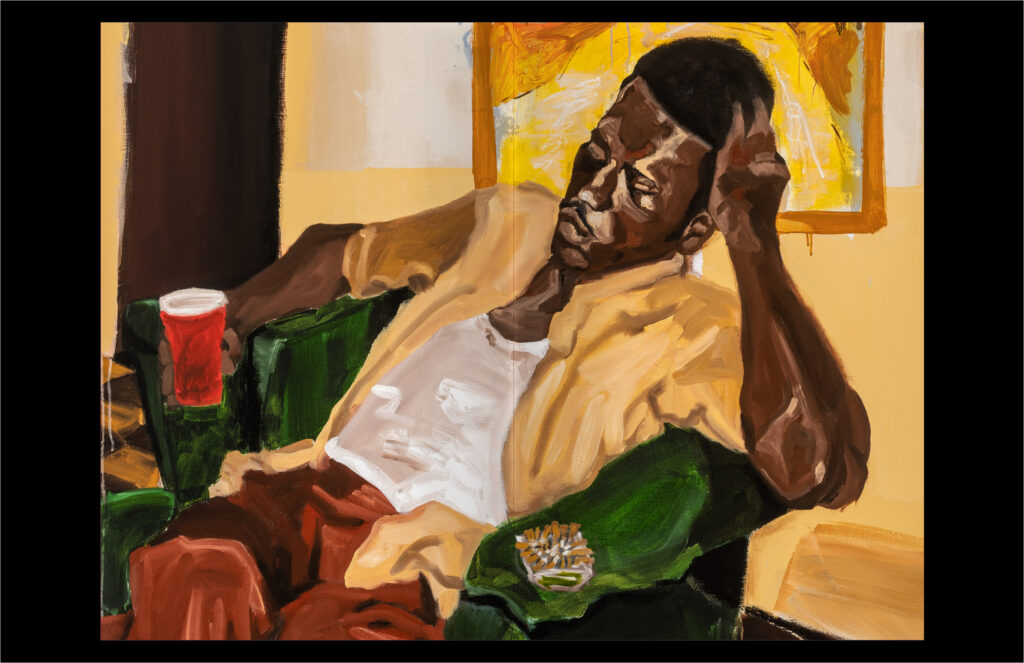
Zigbi-Johnson: Right. Thank you. This orientation toward history and world making requires an entirely new syntax and cosmological structure that guides our work. My life doesn’t exist in any sort of binary. In this sense, there’s nothing objective about what we’re doing, including your decision to make space to explore Mapping Malcolm on The Immanent Frame.
We’re living in a moment where institutions are not only being dismantled but, in many ways, reconstituted to uphold increasingly authoritarian and extractive logics. Your decision to develop this editorial project outside of more traditional academic platforms feels deeply intentional. How do you see this act, both as an editorial and infrastructural pivot, as part of a larger practice of autonomous institution building and intellectual world making? And what does it mean to create space and spaces for scholarship that resist cooptation and instead inform collective imagination and care?
Oraby: Thank you for those questions. Early in my formation as an academic, I was encouraged by advisors and mentors at Northwestern University and the University of Chicago to attend as many talks and events as possible—however far afield they seemed from my research at the time. This was very good advice. These scholars were the first to model for me a kind of thinking that was expansive. They were asking big questions and convening scholars of various backgrounds and from around the world to think with them about those questions.
So I was formed intellectually not just by what I was reading but also by symposiums, conferences, workshops, job talks, and rehearsals across the university. These were held in different spaces on campus: the museum, the center for historical study, the institute for global affairs, the theater, the law school, the library, the seminar room. I was privileged to have been invited to listen and to observe and to participate in all these spaces. To have had access to them. To have had the opportunity to do some curatorial work myself. I soon came to see the whole city—Chicago—as a place of learning, a place where cinematographers and scientists, poets and lawyers, novelists and academics, and musicians and journalists came together regularly to think in libraries and theaters and museums. From there, I developed a view of institutions as hosts for conversation and debate. I can say now that the real intellectual work is in defining a shared problem for thought and shepherding critical inquiry about that object in novel ways and committing to thinking with someone whose way of thinking differs from yours. Universities are a kind of institution that holds this work, can support it, but this work can happen through other mediums and in other spaces.
I have always been interested in how people who are differently situated formulate and answer questions. My editorial work reflects this interest. I imagine multiple seats around a table and a shared object at its center and I wonder: How might someone sitting across from me approach what is at the center of this table? More often as editor, I am not sitting at the table but opening up the room where the table is and inviting people to have a seat. The question becomes: What do you think of the object that together we are observing? Through repeated acts of curation, my hope is that objects of shared inquiry become differently understood—by everyone who is invited to express their views and by those who read about the convening. This is how I’ve experienced autonomy in intellectual world building. So long as we remain open to the challenge of participating in and being changed by the act of convening, how we think and the results of our thinking, if there are results to be shared, in forms material or public, will always exceed institutions.
Zigbi-Johnson: As someone who is not in the academy, it feels really exciting that you find resonance in this project, and that you see this project as worthy of discussion and further inquiry. It’s exciting to see the thought that will emerge from having religious studies scholars engage in a transdisciplinary text that maybe isn’t always academic and that has a lot of art and a lot of mistakes and is deeply personal.
As much as I struggle with the academy as an institutional and hegemonic project in this country in particular, it’s where I found myself. I love the classroom. I love to teach, I love to learn, I love to think. And in many ways, I see myself as sort of an organic intellectual: someone who is thinking, responding to, and living alongside the people in my community and the conditions that we have been forced to exist within, and as someone who has had proximity and access to academic institutions that afford us a lot and that are also deeply destructive. I sit in that tension and I wrestle with that tension. Mapping Malcolm is still a book for academics. It’s a pedagogical project that is supposed to push the discipline of preservation, planning and architecture forward in a way that situates Black liberation, particularly Black sovereignty, at the center of all of our work.
I think about the fact that netanyahu graduated from MIT with degrees in architecture and management, and so I think about the architecture of encampments—at academic institutions but also encampment and genocide and restriction in Gaza—and the ways in which preservation, planning, and architecture shape genocide. And on the other side of that coin, I think about a figure like Malcolm X, who was grappling with the built environment and was remapping not just Harlem but the world through a transnational and liberatory politic. There is something I’m trying to say as an academy-adjacent person: I want to posit Black radical thinkers and organizers like Malcolm as intellectuals who continue to reshape the disciplines we’re a part of.I think about a book like Mapping Malcolm—with burgundy words that move on the page in a particular way—as sort of disrupting the normative structure of academic texts. I also think about the imperative of freedom dreaming, in the words of Robin D.G. Kelley, and what is needed of us as people who exist in the academy, and beyond the academy, but particularly people situated within the academy in this moment—when our capacity to think freely and to engage and talk about history is being monitored in such a scary way. We have to do this work. The world we are striving to build and everyone whoever comes after us is dependent on it.
The post <em>Mapping Malcolm</em>—An introduction appeared first on The Immanent Frame.
]]>The post The karma of this place appeared first on The Immanent Frame.
]]>If we turn to an unexpected place, we do find resources that fruitfully reorient our understanding of karma. This unexpected place is the idea of space or land. I want to first think about space or land with a non-Buddhist thinker whose ideas can illuminate a certain Buddhist conception of space. I have long taught a unit on space and time as analytic categories in the study of religion in my introductory religious studies course. Among other readings, I assign two chapters from Vine Deloria Jr.’s God is Red on Native American religions as organized around space. Recently, upon my yearly re-read of these chapters, I was startled to see there something I had previously overlooked. In the following passage, Deloria offers his account of what is happening when non-Native Americans go seeking in pursuit of Native spiritualities. About these non-Natives, he writes:
… in a variety of ways the American public, searching for a sense of authenticity that it cannot find in its own tradition, is turning to American Indians as it wishes to visualize them. It is not simply the nobility of the novelists or the tragic vision of the historians that America is seeking. In a very real sense, the quest is for the religious insight of American Indians and the feeling of authenticity that Indians project. In seeking the religious reality behind the American Indian tribal existence, Americans are in fact attempting to come to grips with the land that produced the Indian tribal cultures and their vision of community. Even if they avoid American Indians completely, those Americans seeking a more comprehensive and meaningful life are retracing the steps taken centuries before by Indian tribes as they attempted to come to grips with this land.
I was surprised not just that Deloria interprets these non-Native searchers generously in this way, as genuine seekers of something real rather than mere exploiters of the culture and history of the Natives they simultaneously oppress. What I had not seen before is the way Deloria attributes to the land itself a “religious reality” that Native peoples had already “come to grips with” and that we latecomer American settlers are now trying to do the same. We might think Deloria’s point is that this religious reality exists in the relationship between Native peoples and their lands. And while Deloria elsewhere strongly affirms that relationship and its centrality to Native life, this passage presents an arguably more basic claim: that the land itself has its own religious reality, one that is not determined entirely by the people who now live on and in relationship to it. Native peoples, having preceded settlers to this land by millennia, are the ones who know what these realities are and how best to live intimately with them. The settlers now poking around the edges of Native communal life and practices are in fact, as Deloria describes it here, seeking to learn something about the reality of the lands they too now live with.
So how does Deloria’s concept of the religious reality of the land help us think about the karma of place? To approach these questions, I engage the help of the Yogācāra school of Buddhist philosophy. It is considered one of the major textual traditions of Mahāyāna Buddhist philosophy in South Asia, and was arguably the very sea in which many of the fish (schools, thinkers, texts, practices) of East Asian Buddhism hatched and first swam. Much contemporary writing sees in the major concepts of the Yogācāra text tradition something like an idealism drawn from the early modern period of European philosophy. For example, one philosopher who offers an idealist interpretation of central claims of the tradition, has written that Yogācāra offers a “contrastive ontology” which assigns “to the mind and to mental phenomena … a fundamental reality independent of that of external objects, while denying it to apparently external phenomena and assigning them a merely dependent status, a second-class existence as objects of and wholly dependent upon mind.” But this kind of take on the school ignores some of its crucial insights. One of them is the way the school rethinks the concept of karma and situates land within that rethinking.
In particular, some Yogācāra texts repurpose a term that was used in pre-Yogācāra Buddhist thought to distinguish karma that manifests, or is revealed and made known to some mind, from karma that remains hidden. The idea of hidden karma was posited to make sense of the fact that there is usually a time-lag between when an action is performed and when its consequence, its fruit, is borne. Non-manifest karma, which is always expressed in material form, carries through time the potentiality jumpstarted by the action, until the moment when conditions are ripe for its manifestation. The term for manifest that the Yogācāra tradition repurposed is the Sanskrit word vijñapti, best translated as a revealing or manifesting of karma, or a making known of the intentions of past beings. Taking up this concept, the comprehensive, systematic and influential early Yogācāra text A Compendium of the Mahāyāna offers a list of eleven kinds of karmic manifestings. While a good portion of these eleven are keyed to beings as individuals (e.g., the karma that manifests in moments of perception and cognition, where the perceptual and cognitive faculties are unique to each individual being), one of the karmic manifestings is specifically named as the manifesting of shared karma: the karmic manifesting of space or place. The text itself defines space in terms of an old Buddhist distinction between the world of sentient beings and the receptacle world. The world of sentient beings refers to all beings who can feel, while the receptacle world is the space where those sentient lives unfold and that which they unfold in relation to. In Buddhist thought, these two worlds together comprise the whole world, and it has always been understood that the karma of the beings in a given receptacle world is reflected in the features of that receptacle world. Therefore, instead of just calling this site of karmic manifesting space or place, I translate it as “lifeworld,” since here space is not a neutral container, but is rather the place of life itself, or the body of life, if you will. A Compendium of the Mahāyāna gives two examples of what it means by the shared lifeworld: “like a village,” it says, “or a garden.” Villages and gardens are of course social spaces, the space where sentient lives proceed in relation to each other. The text’s claim, then, is that the shared lifeworld is fully the result of the past intentions of past beings. Rather than seeing karma as manifesting only in the happinesses and unhappinesses of individual beings, the Yogācāra textual tradition sees it manifesting also in our shared lifeworlds: villages, gardens, cities, forests, prisons, street corners, schools, et cetera.
The idea of karmic manifestings as presented in Yogācāra thought is of a piece with the concept of subject-object nonduality, which refers to the fact the subject of a given experience arises from the same set of causal factors as does the perceptual or cognitive object of that experience, even while they are commonly experienced as distinct. Indeed, experiencing them as distinct is the basic form of delusion according to Yogācāra thought. For this reason, the subjectivity that encounters a shared lifeworld is therefore not distinguished based on what being is partaking in that subjectivity. It is, rather, distinguished by its object, which is the shared lifeworld itself. This means that when you and I encounter a field, a river, a mountain, a city, a prison, a school, a village, or a garden, we share a subjectivity just insofar as we share the lifeworld experienced in that encounter. Because we share the place itself, we share its karma. The land has, as Deloria puts it, a religious reality of its own.
On this Yogācāra account of karma, every being inherits and is responsible for the karma that is expressed in and through whatever shared lifeworld that being lives in relation to. Whether we: survey a field, river, or mountain in search of riches or for the sake of parceling into private property; walk a field or wade in a river with the eagle eyes of a hunter; or climb a mountain path retracing the steps of our ancestors, in all cases the place remains itself, a full manifestation in the present moment of the intentions of the many beings who have lived in, on, and with it. We inherit the fullness of the place, the reality of the effects of the intentions of its many past inhabitants, human and nonhuman, even if our vision of it and way of being with it remains severely limited. We can think about Deloria’s reference to the religious reality of the land in relation to this idea of shared karma as manifested in our lifeworlds. On this Buddhist account of place, the religious reality of the land itself is that it holds, and manifests, all the intentions of all the past beings who have lived in that place. It is our key to our many ancestors, human and nonhuman.
But within the logic of all Buddhist karma teachings, karma is not something simply to be known and acquiesced to. It is, rather, to be known for the sake of avowing and overturning it. It is a description of what gets us into problems, rather than a description of a neutral state of affairs. Therefore, our moral task with regard to places is to discern the karma of the place by seeing where there is suffering in it, and to take up our position of responsibility with regard to that suffering. This means we are morally obligated to dissolve the common boundaries that apportion various sufferings and happinesses to distinct groups of beings within shared places. If my neighbors suffer, that is the karma of this place, and it is my karmic inheritance too. If my racial, ethnic, class, or religious “other” suffers where I am happy, that is the karma of this place and my karmic inheritance too, doubly so if their suffering and my happiness share a causal matrix. The karma of place pushes us well past the victim-blaming that lies downstream of strictly individualized accounts of karma, into an embrace of a universal responsibility for all that is made manifest in our particular, shared places.
The post The karma of this place appeared first on The Immanent Frame.
]]>The post Karma as active resistance appeared first on The Immanent Frame.
]]>Worse still, the concept of karma has often been used to justify unfavorable conditions by attributing them to the accumulation of negative karma from a person’s previous lives. In this view, discrimination against women is explained as the result of bad karma incurred in women’s past lives. Extending this logic, social injustice is also justified, as those who suffer are presumed to deserve their fate due to karmic debts. If this interpretation is accepted, Buddhism risks becoming complicit in societal discrimination, whether based on sex, race, class, or systemic structures, by providing a rationale for injustice and leaving it unchallenged. This interpretation does not align with Buddhist teaching that emphasizes the equality of all beings based on relational identity.
Years ago, in my Introduction to Asian Philosophy course, a student remarked that the movie Pay It Forward (2000) is a Buddhist film that illustrates how karma works. In the movie, a seventh grader named Trevor proposes that if each person helps three others, a ripple effect will be created as each of those three continues the chain of good deeds. On the surface, the film seems to reflect the idea that performing good deeds leads to the accumulation of good karma and future rewards. However, at the end of the movie—spoiler alert—Trevor dies while trying to help a friend who is being bullied. What the film ultimately portrays, then, is not a simplistic system of reward and punishment but the profound significance of one’s intention to act and the exercise of agency in bringing about change.
Two key aspects of karma warrant closer attention in this context: agency and (non-)temporality. Karma literally means “action,” and the Buddhist theory of karma holds that every deed has consequences that shape future experiences and actions. However, karmic causality does not follow a straightforward arithmetic logic, as is often assumed. Instead, it is far more intricate and largely beyond the grasp of ordinary understanding, a complexity that becomes apparent when we consider the Buddhist worldview of radical interconnectedness. The same action can yield vastly different outcomes depending on the conditions in which it is performed. As Jay Garfield explains, while Buddhist texts may appear on the surface to generalize causes and effects, karma is not a simple calculus of utility or merit points.
The understanding of karma as merely a system of reward and punishment often stems from viewing it within a linear temporal framework, dividing time into past, present, and future. This perspective risks confining the actor within a deterministic model of moral causality. An alternative is to shift the focus from linear temporality to non-temporality and agency, emphasizing the capacity to act meaningfully in the present with full awareness of the interconnectedness of each action across time. People often envision awakening as a temporal goal that comes at the end of long practice. Buddhist schools, however, show that awakening should in fact take place in each and every moment, meaning that each decision should be made with utmost attention to the causes, conditions, and consequences of the action.
Some Korean Buddhist nuns’ teachings can be understood as exemplifying the concept of karma as a call to exercise agency for authentic living. Kim Iryŏp (1897–1961), for example, emphasizes agency and the overcoming of self-imposed and socially constructed limitations as central to Buddhist practice. A former feminist activist before entering monastic life, Iryŏp advocates for breaking free from what she calls the “small self,” meaning the self that is constrained by socially imposed norms and limited in its capacity for freedom.
Iryŏp defines the true nature of the self as freedom, that is, the capacity to exercise agency and transcend the constraints imposed by external conditions, thereby becoming the creator of one’s own existence. She refers to this liberated self as “the great self” and characterizes its actions as expressions of “creativity.” In this view, action is the foundation of existence, and liberated action, or creativity, is valuable not because of its cumulative moral points over time, but because each action represents the full expression of one’s freedom. Unbound by linear temporality, such actions contribute to the alleviation of suffering both for oneself and for others by breaking the hold of various forms of attachment.
Another Korean Buddhist nun, Daehaeng (1927–2012), expresses the activation of agency through her signature teaching of chuin’gong (主人空), meaning “the master of one’s life that is empty.” This phrase conveys a dual insight: that one should take responsibility for one’s life, but that this must not lead to egocentrism, as the self is fundamentally empty. While affirming the traditional Buddhist notion of emptiness that nothing possesses an independent, enduring essence, Daehaeng nonetheless emphasizes the self’s agency. Precisely because the self is empty, it is not fixed or bound by attributes imposed by external conditions such as gender or social class. Emptiness, in this view, does not negate agency; it enables it, echoing Iryŏp’s concept of the great self. Freed from rigid identity and conditioned constraints, the self is empowered to act with wisdom and compassion amid the ever-changing conditions of life.
In both cases described above, karma, or action, is not about accumulating karmic residue, but about activating and expressing one’s capacity to act. Rather than framing karma within a moral dualism of good and bad, which risks fostering conformity to questionable moral codes or unjust social structures, karma, in this view, becomes a dynamic force for critical engagement and personal transformation.
Contemporary Black American Buddhism in the United States powerfully illustrates the dynamic interplay between karma and agency. Black American Buddhists such as Pamela Ayo Yetunde and Lama Rod Owens embrace Buddhist practice as a means of resisting intergenerational racism and systemic oppression. The centuries-long trauma of racism endured by Black Americans has given rise to a collective anger—an anger that, if not skillfully transformed, can fuel cycles of harm and violence. Rather than perpetuating such cycles, Black Buddhist practitioners turn to Buddhism to channel this anger into mindful resistance and transformative action. Yetunde even declares, “We sit together so we can stand together.” Their actions are not merely attempts to accumulate good karma; rather, they represent a conscious activation of agency in the face of a racist society, right here, right now. Like Iryŏp’s creative pursuits and Daehaeng’s teachings of chuin’gong, these actions reflect an active engagement with the world and with life itself.
The German American political thinker Hannah Arendt distinguishes between labor, work, and action: labor sustains life by producing necessities; work creates durable artifacts; but action, she argues, “means to take an initiative, to begin,…to set something into motion.” For Arendt, the capacity to begin is synonymous with the capacity for change and freedom. While one might be able to avoid labor or even work in life, she insists that without action, one is not truly alive. In light of Arendt’s emphasis on the importance of action in making changes and our argument for the centrality of agency in the theory of karma, we must also acknowledge that, in reality, not all actions represent the exercise of agency in a creative or constructive way. Buddhism offers a poignant caution against such actions through the concept of “ignorance,” a technical term referring to a fundamental misunderstanding of the nature of existence. Buddhism teaches that acting in ignorance of one’s existential condition generates suffering for oneself and others. Once we understand karma, or action, as the exercise of one’s agency aimed at eliminating suffering, karma or “intentional action,” as Buddhism puts it, becomes a form of resistance against anything that constrains individuals and keeps them in a state of ignorance.
Political philosopher José Medina emphasizes the epistemic dimension of resistance. What Buddhism refers to as ignorance, Medina describes as “insensitivity,” “numbness,” or “blindness” on the part of individuals or society toward the suffering and injustice experienced by oppressed groups. The effort to overcome such insensitivity is what Medina terms “epistemic resistance.” While Medina’s discussion primarily addresses the social and political dimensions of resistance, Buddhist practice, particularly in the context of Chan/Sŏn/Zen traditions, is not unfamiliar with epistemic resistance. These traditions are often interpreted as teachings aimed at awakening individuals from habituated and unreflective patterns of thought.
Karma, when understood as active resistance, is closely tied to the practice of attentiveness not only to one’s actions but also to the conditions in which those actions unfold. Resistance is often associated with protest against visible social or political injustices, as Medina discusses; but it should also involve confronting the subtler habits of mind such as fear, anger, attachment, or greed that impede one’s liberation. Socially engaged Buddhism addresses this issue, highlighting the social dimension of action, emphasizing structural violence and its role in producing suffering. To conceive of karma as active resistance, then, is to cultivate awareness and agency in ways that challenge both structural and internalized forms of domination.
Despite its long history, Buddhism is often perceived as lacking a robust social and political philosophy. My students frequently comment that Buddhism seems like an individualistic religion, an evaluation largely based on the assumption that practices such as meditation and self-cultivation, which Buddhism consistently emphasizes, belong solely to the private realm. As Leah Kalmanson argues, even solitary meditation can constitute a political act in the Buddhist worldview of interconnectedness. Similarly, Medina contends that epistemic resistance at the personal level is central to protest in its social and political dimensions. He defines protest not merely as a tool for delivering a message, but as a “transformative learning process.” In this view, individual mental transformation is deeply intertwined with broader social change.
This understanding of karma is more urgently needed today than ever, as powerful institutions increasingly fail to fulfill their responsibilities to protect and support people. If karmic action involves an individual’s exercise of agency and resistance to the ignorance that constrains them, then social movements can emerge from the actions of individuals and grassroots communities who challenge the status quo. Reframing karma as meaningful action grounded in awareness and agency offers new insight into the possibilities of both personal and collective transformation. For Arendt, the potential that arises through such action marks the beginning of hope.
The post Karma as active resistance appeared first on The Immanent Frame.
]]>The post Revisited: Political religion and crises of legitimacy appeared first on The Immanent Frame.
]]>American civil religion is among the oldest, most stable, and respected. Russian civil religion is less stable and tends to mutate swiftly into a violent political religion. For example, a civil religion preached by Dostoyevsky, with his belief in the “Russian God” and Russia’s salvific mission for humankind, was used to justify pogroms and eventually the dictatorship of proletarians. After the collapse of this dictatorship, a new civil religion emerged from the ashes of the old political religion. It began taking shape in the late years of Boris Yeltsin’s presidency (1991–1999) and the first two terms of Vladimir Putin (2000–2008). After Putin reoccupied the Kremlin in 2012, a rapid transformation of the post-Soviet Russian civil religion into a political religion occurred. The Russian invasion of Ukraine in 2014 marked the change.
With Russia’s full-scale war against Ukraine in 2022, Russian political religion reached a new zenith—one comparable to what the Nazi political religion had become. The Russian Orthodox Church has justified the current war by describing it as “sacred” and by promising paradise to the soldiers if they get killed. Those in Russia who disagree with the official interpretation of the war promulgated by the church and Putin are forced to leave the country or face fines and even imprisonment. These measures are typical of any political religion whether fascist, Nazi, or communist.
I suggested in my 2017 essay that with the election of Donald Trump as forty-fifth president, an American political religion was no longer impossible. The fideistic and irrational attitude of his followers to whatever he said, be it true or false, was observable long before they attacked the Capitol on January 6, 2021.
The White House’s current attitude toward the Russian war against Ukraine evidences an emergent American political religion. As it was mentioned, a political religion denies or reduces human agency. Ukrainian agency is systematically ignored or mocked by the proponents of political religion in Washington who think Ukraine is merely a mule with no will that should be directed by strikes. This precise imagery was invoked by Trump’s special envoy Keith Kellogg to justify a pause in intelligence sharing. In contrast to Ukrainian President Volodymyr Zelensky, Putin’s agency is fully acknowledged by the Trump administration.
The emerging American political religion is endorsed by various religious groups across the United States who believe that Trump can deliver a long-awaited desecularization of America. I understand a “presecular age” as when the church was seen to encompass and exceed the entire world. We could say that in a “secular age” the world contains the church, which shrinks to be smaller than the former. Many American Christians of different denominations hope to “make religion big again” by embracing MAGA ideology. This hope is a contradiction in terms: If a “great America” is a vessel for a “bigger church,” this church is still smaller than America and certainly smaller than the world. A political religion can promise desecularization, but because it is intrinsically secular, it can only further secularize the churches that subscribe to it.
The essay below was originally published on The Immanent Frame on July 19, 2017.
* * *
This contribution is based on the author’s presentation at the Colloquium on Postsecular Conflicts, organized by Kristina Stoeckl at the University of Innsbruck on January 24, 2017. R.R. Reno and Sergei Chapnin participated in the panel discussion at the colloquium together with the author.
Isaiah Berlin famously described the twentieth century as an antagonism of Communism and Nazism, “totalitarian tyrannies of both right and left.” They were intrinsically connected with each other not only through the prevalence of propaganda over truth, collectivism over individuality, and idea over human life but because both were “religions” in a certain sense. This sort of religion was called “political.” There were hopes after the collapse of the Soviet Union that this sort of religion would never re-emerge, at least in the civilized world. It seems, however, these hopes were premature. Political religion is making its come back in Russia, and it is even lurking in the United States.
Political religion is a phenomenon of modernity and a product of its ideologies. Secular ideologies sold themselves to not-yet-secularized people as political religion. It began in Russia, where the atheist ideology engaged with its base of peasants and proletarians, who remained largely untouched by the process of secularization. Thus, atheism turned to a political religion, with its “saints,” “magisterium,” “priests,” “sacred calendars,” etc. Soviet people were supposed to receive the atheistic Communist regime with religious awe. Those who disagreed were sent to Gulags or executed.
Later on, Nazis developed their own political religion. Nazism evolved as a rejection of Communism with its state-enforced atheism. Yet, it was not interested in Christianity. As a matter of fact, it had existential difficulties with the figure of Jesus Christ and his Jewishness. As a result, it developed a sort of religiosity, which was alternative to Judeo-Christianity–its own edition of political religion, with Nazi’s own “saints,” “magisterium,” “priests,” “sacred calendars,” etc. The coercive route of this religion began with ignoring or violating laws. This was justified, by the way, by Carl Schmitt. In his Politische Theologie he laid down the foundations of the religion, which later on was identified as “political” by Eric Voegelin in his book Die politischen Religionen, and by a number of other scholars. They applied this term not only to Nazism, but to any authoritarian regime that features elements of religion.
Voegelin was forced to immigrate to the United States, where he flourished as a political philosopher who explained many sides of the American political system. Another immigrant from Germany, Paul Tillich, inspired American sociologist Robert Bellah to develop a concept of American civil religion, which became central in defining the American political culture. Bellah borrowed the phrase “civil religion” from Jean-Jacques Rousseau, for whom it constituted one of the foundational elements of social contract. The American social contract, in contrast to the French, featured many Christian elements.
Civil and political religions are similar in many respects. In their core, they are political phenomena and only appear to be religious. Their difference from religion proper is that they are products of the secular age. They cannot go beyond Charles Taylor’s immanent frame, where they have been born. Although their political promises to voters sound almost metaphysical, they cannot elevate anyone to the sphere of the divine.
Politicians like these religions. They are particularly attracted by the capacity of these religions to enhance the legitimacy of their authority, especially when this authority suffers from the deficit of conventional legitimacy. Thus, the Rousseauian civil religion secured legitimacy for the republican government in France, which replaced a monarchy that drew its legitimacy from God. The same happened to the independent American states, which could not rely on the sources of the traditional legitimacy that served the British Crown: the divine hierarchy with God on top reflected in the figure of a king. Instead, the United States of America based themselves on the idea of covenant: an agreement between citizens and God, without the mediation of kings.
With all their similarities, political and civil religions have irreconcilable differences. The most fundamental difference between them is that the former is coercive, while the latter is consensual. Most political religions have been created in the image and likeness of the authoritarian regimes which they served. They force their adepts to participate in their rituals. Civil religion is not coercive. It is like an advertisement on television: it can manipulate and mislead, but cannot force acceptance.
Nevertheless, civil religion can mutate to political. The case of Russia illustrates how rapidly this can happen. The Communist political religion, which had completely substituted religion proper, disappeared with the collapse of the Soviet Union as well. For approximately a decade there was no any significant civil or political religion in Russia. Russians rediscovered Christian faith and filled the restored churches, without experiencing any form of politicized religion. Soon, however, politicized religion reemerged on the margins of the church life, and gradually turned to a religious mainstream during the recent decade.
One of the earliest tokens of its reemergence was the sanctification of the Russian tsar Nicholas II Romanov in 2000. This reopened the church to political agendas featuring nationalism and imperialism. Approximately at the same time the Russian church embarked on the doctrine of the “Russian world,” which became a core tenet of the new Russian civil religion. This religion was actively constructed by the church, without being yet received by the Kremlin. The Russian political establishment accepted it only when it felt the need to enhance its own legitimacy. Legitimacy of the Russian political system was shaken after the elections to the State Duma, the Parliament, in December 2011. There was evidence that they were falsified, which caused mass protests in Moscow. The protests became even stronger after Vladimir Putin succeeded Dmitry Medvedev as the president of Russia in March 2012, for the third time. The protests thus undermined his legitimacy. The crisis of legitimacy, in result, urged the Kremlin to embrace the civil religion, which had been prepared by the Russian Orthodox Church.
The reception of civil religion by the Kremlin, however, changed the character of the former—it soon mutated to a coercive political religion. The turning point was the trial of the band Pussy Riot. This trial marked a transformation from the civil religion to a coercive political religion. This transformation coincided with the dramatic increase of totalitarian tendencies in Russia. The coercive nature of the Russian political religion culminated in the annexation of Crimea and the war against Ukraine. The doctrine of the “Russian world” became the engine of the anti-Ukrainian mobilization. Thousands of Russian military came to Ukraine in the name of the “Russian world.” They came to kill Ukrainians, because the Russian propaganda had told them that Ukrainians allied with the “godless” West, were controlled by “evil” America, and therefore constituted a threat to the “Russian world.”
Initially the civil religion, and later its coercive edition, effectively constituted new social contracts, which the Kremlin offered to the people of Russia. They differ from the social contract, which is supposed to be upheld by the Russian Constitution, and therefore are not quite constitutional. Nevertheless, they secure the legitimacy of the current political regime in a more effective way than the constitution does, and for this reason are preferred by the regime.
A similar transformation of civil religion to a political one can happen in any country. Even the United States is not exempt from such a risk. Indeed, as it was mentioned, the American civil religion was designed to enhance the legitimacy of the American states in the wake of their fight for independence from the British Crown. Nowadays, Mr. Donald Trump is facing an increasing crisis of his personal legitimacy as a president. As a result, he might be tempted to tackle this issue by gearing up civil, or even political, religion. Unlike the original civil religion, however, which served the institutions of the American state, its latest version could be focused on serving the personality of the American president.
The post Revisited: Political religion and crises of legitimacy appeared first on The Immanent Frame.
]]>The post Algorithmic karma in digital samsara appeared first on The Immanent Frame.
]]>To the outside observer, I may seem like a singular organism acting of my own free will, making decisions moment by moment: scroll, stop, read, look, swipe, listen, scroll, read. But something much larger is going on than just the sovereign acts of an individual mind. Each spasmodic twitch of my thumb triggers signals that scurry to local cell towers, then to vast data centers in far-flung locations, which then send more data back to my phone. The massive network responds to my every move. I desire, I receive what I desire, I am offered more of what I desire, I am told what I desire; my desires contract, constrict, congeal into predictable patterns.
Who has the agency here? Who is the actor? Can I maintain my felt conviction that I am a single individual with free will, acting upon the world, or am I a node in a great mechanical system with far greater agency and intelligence, all bearing down upon me?
Perhaps it is no accident that the Sanskrit term for intentional action, karma, has become a familiar part of the English lexicon in this era when action and its consequences may require a thorough rethinking. Classical accounts of karma in Indian philosophy suggested a system of justice built in to the workings of the cosmos. Any morally significant act would produce similar consequences for good or ill.
One of the most sophisticated theories of karma, offered by the Yogācāra school of Buddhism, goes beyond just theorizing the consequences of good or bad acts. It posits that each action of mind, body, and speech a person takes creates a kind of seed or impression that is deposited into the “storehouse consciousness”—metaphorically speaking, a vast container or garden full of such seeds. This consciousness then creates dispositions that eventually ripen and bloom to shape future experiences and perceptions. Some scholars have interpreted it as an ancient theory of the unconscious mind. When actions are motivated by states of mind like hatred, greed, compassion, or joy, they serve to produce future experiences of similar character, shaping the person’s sense of self and world. The Yogācāra school also suggests the possibility of a “transformation of the basis,” i.e., a gradual revolution in the storehouse consciousness through meditation and ethical action, which plant virtuous seeds that eventually take over the karmic garden and transform one’s entire sense of oneself and the world.
This picture bears more than a passing resemblance to action in the online world. In the algorithmic matrix in which most of us live, our online activities are deposited into the immense network of disembodied information, which then feeds back more information that is shaped by our past digital acts. Our digital karma produces results in kind, which induces us to produce more digital karma, on and on and on. But the game is rigged. The algorithms dangle content to grab our attention and induce impulsive reactions in order to keep our eyes on the screen. These reactions, in turn, tell them what we like, what we hate, what we fear—which they instantly provide and promise more of, tightening the knot further. The unique psychic state of our era, the scrolling mind, is fashioned to keep the light of critical thought low and the wire of impulse hot. Countless shiny objects—cat videos, interesting articles, erotic images, political invective, socks—keep us voracious and dazed, hungry ghosts feeding on a constant stream of data, always beckoned to the next image. This tends to smother the faculties of reflection that might otherwise lead one to ask: Do I need this product? Is this a credible source? Is this how I want to spend my time? In its algorithmic preferences for alluring images, terrifying spectacles, and fake news, the internet feeds on what Buddhists call the three poisons: greed, hatred, and ignorance. There is a good case to be made that the digital world, while it has undoubtedly enriched many of our lives immensely, has exacerbated divisions, stoked fear and hatred around the world, and poisoned the political sphere.
The classical Buddhist wheel of samsara—the cycle of birth, death, and rebirth—contains realms of languishing deities, animals, humans, hungry ghosts with large bellies and pencil-thin necks, contentious and power-hungry demi-gods, and residents of multiple levels of miserable hells. We cycle through these realms, spurred on by the driving power of the three poisons. Diverse Buddhist traditions have varying suggestions on what to do about this situation. Some say it’s best to exit samsara completely, leaving birth and death behind forever in favor of the ineffable bliss of nirvana beyond. Others say: stay in samsara indefinitely, work benevolently within the system, relentlessly bringing benefit to others through scattering seeds of infinite compassion and wisdom. Still others suggest that samsara is itself nirvana in disguise; that in the right light, the miseries of embodied life are really a paradisiacal pure land.
We are faced with similar dilemmas in digital samsara. There is always the Luddite option: refuse all silicon chips, make a clean exit, decline to leave our karmic footprints, and spurn the algorithmic cycle. But just as most Buddhists now favor gaining karmic merit for a good rebirth or living a rich, ethical, and mindful life in this world over transcending samsara altogether, the majority of us don’t have the desire or wherewithal to pull off even a benign version of Ted Kaczynski’s rustic retreat in the woods. We are inevitably embedded in the network, which, for all its faults, supports the personal, social, professional, political, and creative projects that make life meaningful. There are, indeed, joys and wonders in digital samsara.
So, if we choose to abide this digital churn of beauty, chaos, hatred, hunger, and love, what kind of actions—karma—do we take and refuse in order to survive and thrive? The banal binary of social/political action versus personal cultivation is too often presented as mutually exclusive. Either fight to change the system or focus on your own peace of mind. In fact, today, these options are inextricably intertwined. At the moment, the possibilities for reforming and regulating the digital system may seem dim. The spectacle of the American tech oligarchy on stage at the inauguration of a flagrantly authoritarian president augurs ill for sensible regulation and much-needed reform of the digital sphere. Yet, as the alien intelligence of AI pervades more and more of life and the systems that maintain it—from commerce to art to medicine to the military—humans must keep a hand on the wheel of digital samsara. Indeed, it might take monumental efforts to secure even modest regulations and reforms of this new power let loose in the world in order to nudge it toward becoming a humane force rather than a means of fracking our attention for the financial benefit of a handful of digital robber barons. A substantial “transformation of the basis” seems unlikely in our lifetime. But try we must, and that will require an active, indeed activist, agenda.
Living in digital samsara will require more than reforming it, though. Some measure of self-cultivation is necessary to intelligently confront the digital world with its content aimed directly at our primal centers of desire and aversion. Because these algorithms work on the basic mechanisms of attention, exploiting our natural weaknesses for getting sucked into the lovely and horrific, the sensual and fearful, the banal and repetitive, it is imperative to develop the capacity to wrest attention back. The same people who came up with ancient karmic theories also developed sophisticated methods of harnessing attention and using it intentionally to curb the three poisons.
A world in which a vast, multi-trillion-dollar industry is dedicated to capturing attention for profit necessitates becoming more familiar with ways to assert some control over our own minds in the midst of the digital storm. Yes, this might involve non-judgmental mindfulness and acceptance of the present moment in order to get a clearer view of what is going on in our consciousness. But it also demands the cultivation of mindful discernment—an explicitly judgmental awareness that is tuned to the ethical and political realities of the times and knows what to accept and what to resist in the present moment. Meditation may provide moments of calm from our otherwise frenetic activity. As Buddhists have always insisted, however, it is also meant for directing the mind toward the best course of action—that is, the most ethical and intelligent karmic activity to guide one through samsara, digital or otherwise.
Buddhist texts refer to the distracted, impulsive, frenetic state that we’re often in as “monkey mind.” Today, the algorithmic hijacking of our minds has supercharged this simian condition. In this odd time, it takes great effort to allow ourselves to be bored—to stand in the grocery store line and raise one’s gaze to the fluorescent lights, the garish magazine covers, the miraculous abundance of food. In crafting a way of resistance, it is tempting to fashion a narrative of the heroically mindful individual wresting herself from control by the oppressive digital forces that threaten to subsume her into the matrix. Buddhist thought is likely right, however, that there is in fact no fixed, independent self—that we are all streams of events hurtling forward and conditioned by innumerable causes and conditions, some of which are our own actions (karma). It also insists that through skillful intention and attention, we can gradually assert some agency over the quality and character of the stream of experience, while at the same time benefitting others. This is a matter of personal control—cultivating the power to do what we actually want, and feel we ought, to do—but also a matter of politics and culture.
To assert agency over my half-conscious, thumb-driven activity in the grocery store line takes an approach to action—karma—that encompasses both the personal and the systemic in ways that Buddhist thought has perhaps not previously grappled with. It requires confronting barely submerged impulses in my mind as well as the implicit Silicon-Valley ideologies that seep into our limbic systems, our visual cortices, our thumbs, our legislatures, and our legal codes. Karma, as Buddhists and scholars have pointed out, is both individual and collective.
The post Algorithmic karma in digital samsara appeared first on The Immanent Frame.
]]>The post Karmic historiography appeared first on The Immanent Frame.
]]>Let’s call that karma. Abandoning your principles out of greed makes you more vulnerable, even if you do manage to acquire more stuff. At least, sometimes it does, from a certain perspective, right? But when, and why? And what is that perspective, exactly?
Take another example. After the 2024 US presidential election, it seemed clear to me that most voters for Trump adhered to two pieces of professionally manufactured misinformation: (1) The 2020 election was stolen (the “Big Lie”) and (2) the Democratic Party leadership was corrupt and untrustworthy. So-called “swing voters” mostly believed that, even if Trump was not perfect, the Democrats offered no credible alternative. More recent revelations about Biden’s mental decline make it clear that (2) was true all along! Granted, Fox News was attributing different lies to the Democrats than they were really telling. But Democrats’ failure to gain the people’s trust—even trust in evident facts—is somehow less surprising if they are lying. It helps to explain the manipulators’ success.
Jake Tapper and Alex Thompson named their book about the cover-up of Biden’s mental decline Original Sin, but here, too, the metaphor of karma is at least as illuminating as the reference to the Garden of Eden. Lies make you less credible, even when you try to speak the truth. At least, sometimes that’s the case. But when, and why?
These are real questions that warrant investigation and analysis. The Buddhist concept of karma is about actions and their results; principally, it is about how people’s morally significant intentions can bring long-term, generally unintended, effects. To notice institutional consequences from lawyers abandoning their principles for money, or to notice historical consequences from Democrats’ lying to cover up Biden’s mental decline, is to acknowledge the possible utility of this framework for understanding the present world.
Call it karmic historiography, then, when we interrogate history for where it is, potentially, the outcome of accumulated moral acts—whether positive or negative. This TIF forum uses the notion of karma and related Buddhist ideas to bring new and surprising light to contemporary society and politics. The Buddhist conceptual toolset provides new analytical methods and prompts reconsiderations of prior historical and sociological approaches.
How can Buddhist ethical analysis—deploying not just karma, but also concepts such as dependent origination, defilements, suffering, and no-self—serve to illuminate moral and psychological dimensions in historical and social phenomena? Karma emphasizes the cyclic and cumulative effects of repeated actions; dependent origination emphasizes the way seemingly independent events and individuals emerge out of complex webs of causes and conditions; attention to defilements illuminates the deeply conditioned, psychological motives for negative intentions; consideration of suffering recasts historically dominant desires for wealth and power as having unreliable motivations and lasting negative psychological and social effects; no-self draws attention to how social settings and roles are always in flux, and social ills result from attachments to narrow identities. The present series is a test of these and related principles. It is not a claim that Buddhists have historically thought this way, but an offering for readers of TIF to sample and see if it is useful to think this way today. You do not need to be a Buddhist to see the benefit of putting these concepts to work.
Through this series, we find karma offering fresh perspectives on the opening of traumatic wounds in psychoanalysis and in sex; on the recursive, delusive self-making involved in mindless scrolling; on how large language models evince the intertwining of the material and the mental; on how spaces and places carry the “karmic” imprint of past injustices; on how agency is both dispersed and channeled by sociopolitical roles; on how the socioculturally transformative potentials of such interdependent agency are communicated through the Buddhist cosmological “multiverse”; and on a Buddhist model for deliberative democracy that remains instructive today. Essays also explore challenges to, and potential shortcomings of, this Buddhist-inspired approach, especially when it is pursued in a shallow manner. Karma, we will see, is too often interpreted as punishment or destiny, rather than a method of moral scrutiny that motivates active engagement. It can be dangerous, as well, if it is taken as justification for discounting the claims of one’s (ostensibly deluded) opponents.
These essays open a more extended conversation and point toward new practical disciplines that would seek to apply the fruits of the humanities and social sciences to issues of broadly accepted significance and obvious moral weight. Is Donald Trump a producer or a product of our media environment? How is bias-based violence related to the public rhetoric of politicians? Why do attempts to intervene in poverty, violence and so much else (everything else?) repeatedly, if often unintentionally, renew and reinforce power differentials? What dynamics explain the social phenomena of backlash, or the entrenchment of views in polarization and ethnonationalism, or active ignorance (as José Medina puts it), or repeating cycles of trauma? Many fields and approaches shed light on these topics; this forum makes clear that what we call karmic historiography ought to be one of them.
Buddhist approaches to causality, intention, and ethics can deepen our understanding of historical and social processes, while providing practical insights into contemporary critical concerns—but they are nothing more or less than practical tools. They are, as Buddhists say, “conditioned” or even “empty.” They may be useful, but only sometimes, not always and only so. Yet that’s the best we can hope for, as long as we’re stuck cycling in samsara—that is, before we reach enlightenment. Consequently, while it may seem naïve to tell politicians not to lie, or to tell lawyers that they should not sacrifice their integrity for money, it just might turn out to prove compelling, once such moral advice is grounded in evidence-based, karmic reasoning. In the meantime, then, we may as well take these ideas out for a spin.
The post Karmic historiography appeared first on The Immanent Frame.
]]>The post Most-Read Essays of 2024 appeared first on The Immanent Frame.
]]>
Check out The Immanent Frame‘s ten most-read essays of 2024! This year’s essays were featured in the forums “Ruinations: Violence in these times” and “Experimental books.” Others were standalone essays, previously published on TIF but appearing this year with new introductions, or published in 2024 for the first time. Scholars address wide-ranging topics—from thinking critically about the different experiences of violence in Palestine and in Israel to the challenge of comparative philosophy.
Explore all essays and exchanges from the past year and beyond. Thank you to all of the contributors who wrote for The Immanent Frame in 2024. We look forward to another year of scholarly exchanges!
* * *

1. “Objects, trauma, violence, and loss: Telling stories, doing justice”
by Laura Levitt (8/14/24)

2. “Revisited: On ‘beyond Trump’: Evangelical politics, born again”
by Joanna Tice Jen (5/1/24)

3. “Carceral afterlives: Recording my father’s prison memoirs”
by Walaa Quisay (9/4/24)

4. “The surprising history of global blasphemy law”
by J. Barton Scott (4/15/24)

5. “Experimental books—An introduction”
by Mona Oraby (6/19/24)

6. “A (digital) reformulation of Islamic pasts”
by Shahzad Bashir (7/10/24)

7. “Revisited: The “good” and the “bad” Muslims of China”
by Yuting Wang (4/8/24)

8. “Revisited: Underestimating the force of the New Evangelicals in the public sphere”
by Rebecca C. Bartel (5/6/24)

9. “Virūpa, meet Fichte: Uncanny resonances in comparative philosophy”
by Alexander Englert and Jonathan Gold (7/31/24)

10. “They tell the Bible so: On hermeneutical determinism”
by William Stell (11/13/24)
The post Most-Read Essays of 2024 appeared first on The Immanent Frame.
]]>The post Fall 2024 Call for Individual Essays – US Politics and Religion appeared first on The Immanent Frame.
]]>This call invites essays that address US politics and religion, broadly construed, in contemporary or historical perspective. Essays need not address phenomena that occur specifically in the territorial United States. Global and comparative perspectives are especially encouraged. Topics may include, but are not limited to, the role of religious ideas, practices, and organizations in the 2024 presidential race and its outcome; changing views on migrants, borders, and territory or land; moral refusal, political abstention, and the ethics of abandonment; deferral of responsibilities in governance and environmental crisis; war, militarization, and/or humanitarianism; and protest or activist ambivalence.
Scholars of any academic discipline and methodological orientation are invited to submit 1500-2000-word essays for consideration. Applicants are requested to articulate alongside their submission 1) the main question the essay addresses and 2) the significance of the question to the academic study and public understanding of secularism and/or religion.
Essays that foreground questions that have not received significant coverage on TIF or that suggest innovative approaches to enduring questions in the social sciences and/or the humanities will be considered favorably. TIF seeks submissions from a diverse pool of potential contributors, including with regard to institutional affiliation, rank, and research expertise.
The deadline for submissions is January 6, 2025. Submissions will be reviewed on a rolling basis. The TIF Editor will liaise with applicants whose essays are selected. Only essays submitted through the online application form will be considered. Please direct any questions to ifblog@ssrc.org.
Click here for the submission form.
The post Fall 2024 Call for Individual Essays – US Politics and Religion appeared first on The Immanent Frame.
]]>The post They tell the Bible so: On hermeneutical determinism appeared first on The Immanent Frame.
]]>When asked about their departure, members of the new anti-LGBTQ denomination tend to sound the same note: they have done what the Bible tells them to do. According to one GMC elder, the UMC’s recognition of same-sex marriages, following the recent repeal of its 52-year-old antigay statement in its Book of Discipline, “separate[d] the denomination from the ancient, orthodox, ecumenical, biblical Christian faith.” Consequently, those joining the GMC, in the words of one member, have merely “chosen to follow the Biblical tradition of Methodism.” Officially, the GMC’s Transitional Book of Doctrines and Discipline maintains that the new denomination adheres to “a scriptural view of sexuality and gender.” Such rhetoric is ubiquitous among Christians who, like the GMC contingent, are called “evangelicals.” In the GMC and elsewhere, evangelicals simply point to the Bible to explain their views on sexuality and gender.
What’s more, such rhetoric—such simple pointing—is replicated in scholarly accounts of those views. From scholars who identify as “evangelical” themselves to scholars who fancy themselves “secular,” the same note keeps sounding: evangelicals are antigay because they believe the Bible teaches that homosexuality is a sin.
As for why evangelicals have come to believe this, many scholars, journalists, and other commentators treat the biblical interpretations of evangelicals as a natural product of their ostensibly stable approach to the Bible. That approach is usually described with language like “literalism,” “inerrancy,” and “a high view of biblical authority.” Often echoed without any interrogation, these terms are made to function as straightforward explanations for why evangelicals do what they do. So, scholars tell us—like evangelicals themselves tell us—that evangelicals are antigay or antifeminist because they have a high view of biblical authority and thus base their positions on biblical texts. Similarly, scholars tell us—like evangelicals themselves tell us—that evangelicals are antigay or antifeminist because they are biblical literalists, and some biblical texts, read literally, teach that homosexuality is sinful and that women are to be subordinate to men.
I call this “hermeneutical determinism”: attributing the actions of religious subjects to the interpretive principles and approaches that those subjects purport to apply when reading their scriptures.
In the case study of evangelical stances on sexuality and gender, hermeneutical determinism obscures hermeneutical diversity and hermeneutical change within evangelical communities. As my forthcoming book on the history of evangelical gay activism shows, drawing from a host of evangelical publications and archives of evangelical institutions, a minority of evangelicals in the United States have advocated for churches to recognize same-sex unions and ordain gay and lesbian people since the 1970s. They have frequently done so by using the same evangelical discourses about the Bible—language of literalism, inerrancy, and a high view of biblical authority—that their antigay counterparts have used. The same is true for the evangelical feminist movement that coalesced in the 1970s, which many of the movement’s leaders preferred to call “biblical feminism.”
Moreover, even within antigay and antifeminist evangelical circles, discourses of literalism, inerrancy, and biblical authority have resulted in shifting and conflicting exegetical conclusions. Take, for example, the history of evangelical interpretations of Sodom and Gomorrah’s destruction in Genesis 19. In the late 1960s, when evangelicalism’s flagship magazine Christianity Today began deliberately addressing “what the Bible says about homosexuality” for the first time, Genesis 19 was authoritatively cited as clear proof that homosexuality was sinful. Over the course of the next decade, however, authors in the magazine wrestled with alternative interpretations of Sodom’s sins (Was this not a story about a gang rape? Were the perpetrators really homosexuals? Was there such a thing as a real homosexual?).
By the late 1970s, variable readings of Genesis 19 were raising more questions than a perspicuous scripture was supposed to raise, and authors in the magazine began conceding the inapplicability of this text to an evangelical antigay stance. Meanwhile, other evangelical publications employed literalist devices in their insistence that the sinners of Sodom really were homosexuals. When we attend to exegetical shifts and conflicts such as these, as well as attend to the broader diversity of evangelical hermeneutics, we realize that the antigay and antifeminist positions of evangelicals are not an automatic consequence of their theology or hermeneutic of the Bible.
Hermeneutical determinism is problematic even apart from its tendency to under-historicize and to flatten intra-religious diversity. Scholars who rely on hermeneutical determinism in their analyses of evangelical stances tend to parrot evangelicals’ discourse under the guise of analysis while fundamentally misunderstanding the discourse they are parroting. Terms like “scriptural authority,” “inerrancy,” and “literalism” simply do not refer to stable beliefs about scriptural texts or to coherent methods of reading them. They refer to versatile rhetorical tools that evangelicals have wielded in a plethora of ways.
For the sake of ascertaining the extent of that versatility, scholars would do well to discard the widespread view that a scripture is a source of authority, for texts in themselves have no authority to exercise. Instead, we should treat a scripture as “a complicated site of contestation with respect to religious authority.” When they converge on the site of a scripture, religious actors construct various interpretations of scriptural texts, generating “a high-stakes competition of unstable claims” in which religious actors struggle to exercise their own authority through those texts. Conceiving of a scripture as a source of authority is also problematic insofar as we are imagining a singular entity that is isolable from other things regarded as sources of authority, like “science” or “experience.” One cannot engage a scriptural text or lay claim to “scriptural authority” without bringing one’s brain and background to bear on that text (though one can certainly pretend). Evangelicals do a lot of pretending here—that is, accusing their opponents of relying on extra-biblical sources of authority while declaring that they themselves have relied instead on “biblical authority.” Scholars ought not to pretend with them.
In their efforts to maintain their interpretive authority, religious actors often project coherence and confidence where there is conflict and contingency. For example, in the 1986 Chicago Statement on Biblical Application, the International Council on Biblical Inerrancy (ICBI) projected a unified evangelical front on the subject of divorce: “God hates divorce, however motivated,” although “in a sinful world separation is sometimes advisable and divorce is sometimes inevitable.” All it takes is a few minutes of browsing the ICBI’s archive to reveal not a unified front but a behind-the-scenes battle. Some evangelical leaders, terrified of the rapidly rising divorce rate since the 1960s, maintained that divorce was never justified and cited Jesus’s words to that effect in Mark 10. Other evangelical leaders, mindful that the divorce rate was rising among evangelicals as well, maintained that divorce was sometimes justified and cited Jesus’s words to that effect in Matthew 19. The latter group won the battle, even as both groups agreed to insist that, notwithstanding their competing biblical citations, “we deny that any contradiction exists within Scripture on the subject of divorce and remarriage.”
For American evangelicals, the labor behind projections of hermeneutical coherence and confidence has become only more complicated since the mid twentieth century, as translations of the scriptures they deem authoritative, inerrant, and perspicuous have proliferated. At times, the proliferation can work to their advantage. In his 1965 book World Aflame, for instance, evangelist Billy Graham included a lengthy discussion of “sexual sins,” in which he consistently cited the King James Version (KJV) of the Bible—until, that is, he discussed Romans 1:27. According to this verse in the KJV, men who had left “the natural use of the woman” and “burned in their lust one toward another” had received “recompence of their error.” Graham was not content with the connotations of “error,” however, and so instead of citing the KJV, he switched to the New English Bible (NEB). Where the KJV used “error,” the NEB used “perversion”—a coded reference to homosexuality at the time of Graham’s writing. Regardless of whether or not any of Graham’s readers pondered or even noticed the switch, Graham himself knew what he was doing and knew what it indicated: the more biblical translations in circulation, the less clear the Bible would seem, and thus the less compelling appeals to a “literal” reading would be.
But the notion of a literalist hermeneutic needs to be interrogated further. In my analysis of antigay evangelical exegesis from the 1950s through the 1980s, I found that the rhetoric of biblical literalism in evangelical discourse on homosexuality increased just as gay-affirming exegesis was on the rise, pressuring antigay evangelicals to assemble more and more elaborate defenses of their own exegesis. Antigay evangelical leaders ramped up their talk of the Bible’s “plain meaning” regarding homosexuality precisely as their own discourse revealed that the issue was becoming less plain. Evangelical communities did not become rabidly antigay because their members read certain biblical texts literally; members of those communities were taught to talk about reading those biblical texts literally as a means of advancing the antigay positions of their community.
When GMC members and other evangelicals, then, say that they are defending biblical authority, or say that they believe in biblical inerrancy, or say that they are reading the Bible literally, these phrases do not necessarily indicate underlying motives. Rather, they indicate rhetorical strategies. Whatever evangelicals think they are doing when they say that they are defending biblical authority, they are rhetorically defending their own and their communities’ authority to dictate interpretations of certain biblical texts. Whatever evangelicals think they are doing when they say that they believe in biblical inerrancy, they are making use of a term that empowers them to proclaim that their interpretations are inerrant. Whatever evangelicals think they are doing when they say that they are reading a biblical text literally or relaying the plain meaning of a text, they are deploying yet another rhetorical tactic in support of their own interpretations.
None of this means that scholars should not take what evangelicals or other religious subjects say seriously. It means that we should not go along with our subjects when they appear to not understand what it means to read a text. Nor does this mean that we should treat all scriptural interpretations as epiphenomenal. It means that an approach amounting to “because the Bible tells them so” will not provide a sufficient historical explanation.
My own research has benefited immensely from critical engagement with what my subjects say about how they read their sacred texts and what their readings of those texts compelled them to do. To my eyes, such engagement is especially needed when examining religious views on sexuality and gender. Some scholars seem inclined to stop their inquiry once apparently sincere individuals start pointing to their scriptures. Our job is not to point alongside them, but to look—not so much at the texts, and certainly not for the sake of ascertaining what the texts “really say” about any given matter, but at wider histories of reading and the myriad phenomena that have shaped them.
The post They tell the Bible so: On hermeneutical determinism appeared first on The Immanent Frame.
]]>The post Revisited: Jesus, religion, and revolution in the South African elections appeared first on The Immanent Frame.
]]>Though the African National Congress (ANC) once symbolized hope for the future, the outcome of the 2024 national elections raises new questions about the viability of its democratic vision. The ruling party failed to win a majority of the vote, forcing the ANC into a coalition government for the first time since apartheid ended in 1994. As dissatisfaction with the ANC grows, religion remains a powerful force in the political sphere. For example, former president Jacob Zuma, who broke from the ANC to form the uMkhonto weSizwe (MK) Party, leans heavily on religious allies to rally support. His spiritual backers, including African Traditional Healers and Pentecostal pastors, cast him as a decolonial “Moses” destined to liberate Black South Africans from white dominance, despite Zuma’s own record of corruption. Meanwhile, the ANC rallies its own cadre of religious leaders to bolster electoral support.
Yet, religious involvement in politics is not limited to these alliances. Faith leaders continue to play a critical role in sustaining the hope for a just and peaceful society, which is itself political work. Religious leaders mediate conflicts, monitor elections, and speak out against state-sanctioned violence and corruption. Faith-based organizations like Gift of the Givers, founded by Dr. Imtiaz Sooliman, provide essential services to impoverished communities in South Africa and beyond. This Muslim-led NGO has become Africa’s largest faith-based humanitarian organization, drawing significant support from South Africa’s Muslim community.
South Africa’s religious leaders are also involved in global struggles for justice. Christian groups, alongside Jewish activists, have long advocated for Palestinians, drawing parallels between South African apartheid and Palestinian self-determination. In late 2023, a diverse Christian delegation spent Christmas in Bethlehem in solidarity with Palestinians under siege, while Jews for a Free Palestine hosted a multifaith Shabbat Against Genocide at the Nelson Mandela Foundation in Johannesburg in early 2024. While these groups draw parallels between the anti-apartheid struggle and Palestinian struggles for self-determination, the Shembe Nazarene Baptist Church, a major Afro-Christian denomination, has pledged solidarity with the Jewish state, mirroring the trend towards African Christian Zionism on the continent and revealing the complexity of religious-political alliances in South Africa.
Sadly, in 2021, former Anglican Archbishop Desmond Tutu—a global human rights icon—died. But, as the examples above show, Tutu’s vision of justice, dignity, and human flourishing is still very much alive. While religion in South Africa, historically and today, is often entangled with social inequalities, it also serves as a powerful motivator for everyday acts of kindness, solidarity, and justice amidst a broader climate of political disillusionment. The quest for a New South Africa is not just a dream—it is a living, active struggle carried forward by ordinary people, both within and outside of faith communities.
The essay below was originally published on The Immanent Frame on June 2, 2014.
* * *
In 2004 and 2008, South African president Jacob Zuma notoriously declared that his party, the African National Congress, will “rule until Jesus comes back.” The recent national election results favor his prediction, with the ANC winning its fifth national election since 1994.
To outsiders, the audacity of President Zuma’s statement can seem puzzling. The truth is that the ANC has managed to win election after election since 1994 because it continues to be seen by the majority of citizens as the political organization that ended apartheid, the party of heroic leaders like Nelson Mandela, and the party of black liberation and freedom. However, this narrative is becoming more complex, in part because new stories of discontent and resistance are emerging. In fact, the real surprise this election season was not the ANC’s victory, but rather the increasing number of black opposition voices who leveled stinging moral critiques at the ANC. Moreover, religion dramatically re-entered the political sphere. Critics deployed religious rhetoric in the service of radical leftist politics, and religious leaders embarked on protest campaigns aimed at holding the ANC (rather than the apartheid government) accountable, prompting President Zuma to assert: “bishops and pastors are there to pray for those who go wrong, not to enter into political lives.”
Certainly, religion has not been absent from politics over the last twenty years. Because the majority of black South Africans identify as Christian, churches frequently attract the attention of ANC leaders, especially during election season. But compared with heightened mobilization under apartheid, the noticeable political withdrawal of Christian churches and other religious bodies since 1994 has been a constant source of anxiety for progressive clergy and theologians. During the course of my fieldwork, I have heard many religious activists express frustration about the complacency of religious institutions in comparison with the “prophetic” role that religiously-affiliated organizations like the South African Council of Churches played during apartheid.
This election season, however, saw religious leaders from all sectors, including those from evangelical, charismatic, and Zionist churches, increasingly comfortable speaking out against the ANC government. The issues of concern? Poverty, unemployment, violence, police brutality, corruption, labor rights, land distribution, education, racial inequalities, and the ever-rising gap between the rich and the poor. While linked to South Africa’s tortured past, the persistence of these problems also implicates the current ANC leadership. For example, in an incident reminiscent of apartheid era violence, 34 striking miners were shot dead by police in 2012. The “Marikana Massacre” shocked the nation and the world, but to date no one has been held accountable for the decision to use lethal force.
Shocking events like Marikana help explain why founding Barney Pityana, black liberation theologian and member of the Black Consciousness Movement, lent his public support to the “Vote No” campaign, which encouraged the public to vote against the African National Congress in protest. In a scathing opinion piece, Pityana wrote, citing Hannah Arendt, that “South Africa under the Zuma ANC has all the makings of a descent into an authoritarian one-party state.” With crime and corruption rising, Pityana reminded his readers that “the overwhelming victims of this state of insecurity are the poor, women and black people.” For Pityana, the ANC has failed to create a compelling vision of transformation and instead pushed the poor into greater dependency and dehumanization. He goes on to suggest that the ANC has systematically undermined “the vision of a new South Africa” founded on values of human dignity, equality, and social justice.
I was particularly struck by the high level of political activity that took place in churches, or that involved clergy, over Easter weekend. This weekend proved an opportune time for activism because it fell just prior to Freedom Weekend, when the country celebrated twenty years of democracy, just two weeks before the national election on May 7, 2014.
In Durban, the ecumenical Diakonia Council of Churches used its annual Good Friday service to demand that “things must change.” Citing inequality, greed, violence, poverty, and corruption, over 3,000 people marched to City Hall. The tone of the day’s address mirrored that of the 1980s. Participants were called to confront “the powers” of this world and encouraged not to “lose sight of the real choices to be made.”
On Easter Saturday, April 19, Anglican Archbishop of Cape Town emeritus Desmond Tutu and current Archbishop Thabo Makgoba, along with Jewish and Muslim leaders, marched to Parliament in a “Procession of Witness.” The procession saw a wide range of ecumenical and inter-religious support, once again recalling anti-apartheid activism of the 1980s. The aim of the march was to send a direct message to President Zuma and the ANC. In his statement, Archbishop Makgoba called on political leaders to “live up to the national values established by the Constitution.” He further asked those with influence and power to “return to Nelson Mandela’s way of governance and leadership”—a style not threatened by social debate and mindful of the marginalized. Makgoba’s words gesture towards two widespread critiques of the “ruling” party: its autocratic leadership and neoliberal economic policies, both perceived to be at odds with Nelson Mandela’s vision of a democratic and transformed South Africa. Perhaps most significant was a public confession that faith communities had lost sight of their moral responsibilities to the poor and remained silent for far too long.

Occurring on the same day, Pastor Xola Skosana of Way of Life Church organized his own march called “Welcome to Hell – SA Townships.”
The march, based on an “out of body” vision Skosana says he received, is now in its fourth year. Skosana has made it his life’s mission to draw attention to what he calls the “gruesome violence of township life.” Townships are residential areas originally designed to provide racially segregated labor to urban centers. Many townships have large sections of middle class homes, but overcrowded living conditions and lack of sanitation remain the norm. Skosana does not mince words about the current state of affairs:
“Townships are nothing but glorified refugee camps, rat infested hellholes that must be exposed for what they really are. In many parts of South Africa, townships exist as readily available hubs of cheap labour to keep labour intensive industries going for the benefit of the few. Let it be known across the breath and length of this country that the continuation of separate development, and integration based on affordability, is the perpetuation of the notorious Group Areas Act of yesteryear.”
This is not the first time Skosona has used controversial tactics to draw attention to the plight of the poor. In 2011, he went on a month-long hunger strike. The march began in the township of Gugulethu and ended in Khayelitsha, both near Cape Town. Throughout the 11.5 K march, Pastor Skosana carried a large wooden cross.

While much smaller than the “Procession of Witness,” the “Welcome to Hell” march is especially noteworthy because it attracted the support of a newly formed political party—the Economic Freedom Fighters. Formed by expelled ANC youth leader Julius Malema, the EFF views itself as a “revolutionary” movement in the tradition of Frantz Fanon and Steve Biko. Known for their red berets and militant discourse, its supporters have been instrumental in provoking national debate about economic policies that continue to favor white elites. Their agenda includes land redistribution without compensation and the nationalization of all mines. Although their message is directed towards the poor, many middle-class black South Africans and intellectuals are also attracted to their urgent call for social change. The EFF received over a million votes this year, an impressive showing for the renegade party, making it now the second largest opposition party in South Africa.
Perhaps the most shocking challenge to the ANC came on Easter Sunday, when Bishop Barnabas Lekganyane, the main leader of the Zionist Christian Church, appeared to use his sermon to encourage millions of members to vote against the ANC. Though the ZCC is often considered apolitical because of its emphasis on African self-reliance, its massive Easter service occupies a special place in South Africa’s political landscape. Nelson Mandela delivered a rousing Easter address in 1992, and President Zuma was an invited guest of honor in 2012. In this year’s sermon, the Bishop urged members to elect “smart and intelligent” leaders who do not “confuse public funds” with their own. This can be interpreted as a double swipe at President Zuma, who is often derided for his lack of formal education and has been accused of corruption. A recent report by Public Protector Thuli Madonsela found that President Zuma improperly used public funds for a $25 million dollar upgrade to his private Nkandla estate—all while unemployment hovers at 25 percent.
As a result of this report, Madonsela gained recognition from Time magazine as one of the world’s 100 most influential people. The profile praised her “ability to speak truth to power and to address corruption in high places.” But her office has become the site of intense spiritual struggle. An unknown group called the Concerned Pastor Organization sought to cast out the “demons” in her office, prompting statements of condemnation from the Evangelical Alliance of South Africa and Archbishop Thabo Makgoba. Religious leaders in Cape Town, including Desmond Tutu, also held a silent protest in support of the Public Protector’s Office and her Nkandla report.
The resurgence of dramatic and symbolic forms of protest in South Africa, and the active presence of religious leaders in the public sphere, underscores the complexities of postcolonial “liberation” in one of the most unequal societies in the world. While ghosts of apartheid and colonialism continue to haunt, new specters of repression loom on the horizon.
In response, a renewed emphasis on moral and political struggle by religious leaders and activists suggests that the principles of anti-apartheid activism are increasingly being recalibrated for a post-Mandela era. In a public message on Facebook, posted on Good Friday, resident ideologue and EFF leader Andile Mngxitama shared a message from a follower: “We remember Jesus the communist who walked into the temple and unleashed an armed struggle on the exploiters!” This sounds not too different from the statement made by Black Consciousness activists on trial in 1973, when Jesus was named “the first freedom fighter to die for the oppressed.” Whether Jesus, the armed communist, will be a rallying cry in the future remains to be seen. What is clear, however, is that Jesus no longer simply serves as the ANC’s election barometer. The fact that those once heralded as liberators are now considered exploiters will certainly have political reverberations for years to come.
The post Revisited: Jesus, religion, and revolution in the South African elections appeared first on The Immanent Frame.
]]>The post Revisited: Making budgets moral again appeared first on The Immanent Frame.
]]>As I wrote in 2019, the argument that “budgets are moral documents” has become common among religious progressives—a way of declaring that the technical debates about spending that roil Congress every year are also debates about our deepest values. As Rev. Jim Wallis, a prominent voice on the evangelical left, puts it, “mathematical facts are moral choices.”
In her recent statements on the budget, however, Novak has added a subtle twist. It is not just “how we spend” but also “how we tax” that warrants moral scrutiny. Of course, any discussion about public budgets must, at least implicitly, involve a discussion about taxes. While budgets delineate the uses of public funds, taxation determines the amount and sources of those funds. They are two sides of the same proverbial coin.
Still, the current emphasis by the religious left on taxes is a significant development. For decades liberals and progressives have rarely made an affirmative moral case for taxation, if they spoke of it at all. Since the 1970s, the antitax movement has been extremely successful in framing taxes as a profane threat to what Americans hold most dear—individual freedom, personal property, and even life itself.
This “tax cut revolution” placed champions of taxation on defense. Afraid to provoke criticism by antitax zealots, liberals emphasized the necessity of government programs and services with little reference to how they would be paid for. When talk about taxes was unavoidable, liberals often dwelled in the technical, boring, dry mechanics of the tax system. Put simply, in an effort to insulate taxation from the electric current of moral debate, liberals tried to make it mundane. But in so doing, they abandoned the positive moral case for taxation.
This positive view of taxation was once dominant. During the first half of the twentieth century—and especially during WWII and the decades that followed—progressive intellectuals, government agencies, civic educators and even artists worked to frame taxpaying and the various uses of tax dollars as sacred expressions of American citizenship, patriotism, and civilization.
Today, it is an unlikely group—the religious left—that is once again taking up this cause. In concert with an ascendant global tax justice movement, NETWORK has emerged as a rare voice that expresses the tax justice argument in explicitly moral and religious terms. As its former executive director, Sr. Simone Campbell told me, tax justice is “a moral issue of our time.”
As the 2024 presidential election looms, the Heritage Foundation’s Project 2025 lays out a blueprint for a future Trump administration that would transfer federal tax burdens from the wealthy to the middle class, and defund and politicize the IRS. This initiative would also cut federal spending for Medicare, Medicaid, Head Start, and veteran’s benefits, and completely eliminates federal agencies including the Department of Education.
With the possibility of such major changes on the horizon, it is essential that Americans be prepared to subject federal budget and tax policies to a “moral values audit.” Though unusual suspects, the religious left is well positioned to bring moral clarity and vision to that process.
The essay below was originally published on The Immanent Frame on November 1, 2019.
* * *
“You put your hands on the Bible to swear yourselves into office,” Rev. Dr. William J. Barber II reminded members of the House Budget Committee at a hearing in June 2019 on “Poverty in America: Economic Realities of Struggling Families.” “You should hear what Jesus said.” He held notes in his hand, which he glanced down at occasionally while he spoke, but when quoting from scripture he looked straight into the faces of the committee members. “When I was hungry, did you feed me?” he riffed on Matthew 25. “When I was a stranger, an immigrant, did you receive me? When I was sick, did you care for me? Because every nation will be judged by God for how it treats the least of these.”
Since attracting national attention in 2013 as the leader of “Moral Monday” protests at the North Carolina General Assembly, Barber has become one of the most recognizable faces of the “religious left” in America today, although he avoids using this label. “Our campaign agenda is neither left nor right,” he told the Budget Committee in June. “It aims to challenge both sides of the aisle. It aims to reach toward the moral high ground.” Barber, in a clerical collar and a white stole bearing the words “JESUS WAS A POOR MAN,” was seated at the center of a long table facing House Speaker Nancy Pelosi and the members of the Budget Committee. His testimony was given top billing that morning. He was no economist or policy expert, but he was intimately acquainted with the “economic realities of struggling families,” having spent the past two years traveling the country as co-chair of the Poor People’s Campaign: A National Call for Moral Revival, which he and Rev. Dr. Liz Theoharis had relaunched fifty years after it was begun by Rev. Dr. Martin Luther King, Jr. Their journey organizing the poor had led them to Washington, DC, and they had brought a plan: the Poor People’s Moral Budget.
With their Moral Budget, the Poor People’s Campaign highlights the intrinsically moral nature of the process through which a nation decides how to spend its money; and demonstrates what it would look like for the federal budget to express the movement’s moral values. It is often said that politicians campaign in poetry but govern in prose, just as many religious activists speak prophetically but act pragmatically. The Moral Budget represents a bold act of translation between the two registers: a distillation of the prophetic and poetic into the pragmatic and prosaic; an insistence that politics is not a choice between math and morality, but rather that “mathematical facts are moral choices.”
The release of the Poor People’s Moral Budget calls forth decades of efforts to reframe the budget as a moral concern. This history sheds light on an active, if fragmented, network of faith leaders who reject the religious right’s decades-long monopoly on public morality. Their rising visibility during the Trump era has been interpreted by some as evidence of the emergence of a new religious left that could serve as a counterweight to the religious right. Others have dismissed this as wishful thinking, citing religious liberals’ small numbers among the electorate. But it is a mistake to reduce the religious left to a voting bloc alone. Historically, the influence of the religious left has not derived from its numbers, but from its ability to infuse issues with moral meaning and urgency, from slavery to war to racial and economic inequality. When effective, these moral frames help a broad array of citizens—religious and secular—to understand why progressive policies are necessary to solve social problems and consistent with American values.
“Budgets are moral documents”
By approaching the budget as a moral concern, today’s Poor People’s Campaign follows directly in the footsteps of Martin Luther King and other civil rights leaders. In 1966, the civil rights and labor leader A. Philip Randolph, along with other key participants in the 1963 March on Washington, released “A Freedom Budget for All Americans.” In the text of the Freedom Budget, Randolph is quoted describing the moral nature of the project. “Here in these United States, where there can be no economic or technical excuse for it, poverty is not only a private tragedy but, in a sense, a public crime. It is above all a challenge to our morality.” King concurred in his foreword to the document. Pledging his own and the Southern Christian Leadership Conference’s full support for the plan, he explained that the Freedom Budget “is a moral commitment to the fundamental principles on which this nation was founded.” But the Freedom Budget did not merely reference abstract moral principles. “It is not visionary or utopian,” Randolph explained in his introduction. “It is specific. It is quantitative. It talks dollars and cents. It sets goals and priorities. It tells how these can be achieved.” According to a 2011 Working Paper on “The Freedom Budget at 45,” these ideas “provided the cornerstones for King’s ‘Poor Peoples’ Campaign’ and ‘economic bill of rights.’”
The idea that budgets are moral documents became a cornerstone of economic justice organizing in the early 2000s as well. In 2005, as President George W. Bush entered his second term in office, thanks (allegedly) to strong support from “values voters,” more than sixty faith leaders from around the United States signed onto “The Federal Budget as a Moral Document: A Letter from Religious Leaders.” “Despite its complexity,” they wrote, “the budget is essentially a moral document—the specific expression of the values of the nation.” Jim Wallis, the progressive evangelical leader, prolific author, and founder of the Christian social justice organization Sojourners, was among the signers of this letter. Today, he is the person most commonly associated with the idea that “budgets are moral documents.” For Wallis, this not only means that, practically speaking, “examining budget priorities is a moral and religious concern.” It is also an opportunity to broaden what counts as a “values issue” and who counts as a “values voter.” In a 2005 interview, Wallis took aim at conservatives’ tendency to “define ‘moral values’ narrowly, almost exclusively in terms of wedge issues like abortion and gay marriage.” As Wallis explained, this narrow framing allowed conservatives like Bush to say, “I’m a Christian and it applies to this, this and this, but it doesn’t apply to my budget.” Wallis called upon Christians to speak up and say, “Yeah, faith does scrutinize budgets, so let’s have a moral values audit of the budget.”
In late 2010, Wallis joined a group of sixty-five Christian leaders around the country as part of a new coalition, the Circle of Protection, which dedicated itself to conducting this moral values audit. As the newly Republican-controlled House of Representatives embraced the Tea Party movement’s calls to reduce the federal deficit, this coalition of Christian leaders released a statement of principles that declared, “We look at every budget proposal from the bottom up, how it treats those Jesus called ‘the least of these’ (Matthew 25:45).” In the almost-decade since its founding, the group has held prayer vigils on Capitol Hill, led fasts, and met with President Barack Obama and leaders in Congress. “What would Jesus cut?” they ask lawmakers to consider.
Around this same time, an interfaith coalition of thirty-six organizations—including Protestants, Catholics, Jews, Muslims, and other faith communities—went beyond a “moral values audit” of the official budget and released a “Faithful Budget” of their own, which they have continued to release annually. As an “interfaith document,” the Faithful Budget references Jewish, Christian, and Muslim texts to justify its call for the country to “act with mercy and justice as one nation under God.”
“What would Jesus cut?”
While people of faith disagree on the finer points of lots of political issues, caring for the poor and marginalized tends to be a place where a wide range of faith communities can find common ground. The Circle of Protection, the Faithful Budget Campaign, and the Poor People’s Campaign represent different models of faith-based coalition building to this end: the former is explicitly Christian but relatively diverse politically; the latter two are religiously diverse yet lean politically liberal. Despite their differences, these groups tend to agree on the broad strokes of what would make the federal budget “moral.” All would bolster government support for the poor, and pay for it with some combination of higher (“fairer”) taxes on the wealthy and corporations, and cuts to military spending (which some among them view as a moral good in its own right).
Of course, some religious groups have a starkly different vision of what “moral” budget and tax policies look like. In 2017, Donald Trump’s first budget called for severe cuts to domestic programs and an increase in military spending. These priorities, paired with the promise of lower taxes following the passage of the Tax Cuts and Jobs Act, did not concern Trump’s Christian supporters. To the contrary, white evangelical Christian voters have remained steadfastly by Trump’s side, and prominent conservative Christian spokespeople have publicly defended the budget and tax cuts. Directly following the passage of the tax cut plan, Erick Erickson took to Twitter to insist, as the journalist Jack Jenkins summarized, that “the bill’s critics were trying to ‘pass off’ their ‘individual’ Christian responsibility to the poor to the ‘government.’” An article in the Christian Post describing the ensuing Twitter debate was titled, “Is Jesus Opposed to Tax Cuts?” Jerry Falwell, Jr. reprised the debate in an early-2018 tweet, “It never ceases to amaze me how leftist Christians twist the words of Jesus—who never told Caesar how to run Rome and never said to care for the least of these by voting to tax your neighbor to help the poor .”
.”
Among the “leftist Christians” they were responding to was Wallis, who upon the release of Trump’s budget had called upon Christians to revisit the question, “What Would Jesus Cut?” Wallis’s answer to this question was unambiguous: “The priorities of this budget are not consistent with Christian, Jewish, or Muslim values. They are not only bad economics, they are also bad religion; as we say in the evangelical community they are unbiblical.” Sojourners underscored his point with a list of “Some of the More Than #2000Verses in Scripture on Poverty and Justice,” which formed the basis of a hashtag campaign on social media, and a protest in which “12 Christians were arrested reading #2000verses and praying in the senate office building calling on senators to oppose the GOP tax bill.” The praying protesters served as a vivid juxtaposition to the widely-circulated images of evangelical leaders encircling Donald Trump in the Oval Office earlier that year, their hands laid on his back as they prayed.
With their Poor People’s Moral Budget, Barber and Theoharis continue this prayerful protest. By the end of the three-and-a-half-hour Budget Committee hearing this June, Barber showed signs of frustration. “We came here to have a real conversation,” he said, dismissing Republican committee members’ denial of the government’s responsibility for alleviating poverty as “mythology and foolishness.” “We have a budget. You got your budget. Hold it up, Liz.” He and Theoharis lifted spiral-bound photocopies of the Moral Budget, turning them so the covers faced the cameras. “I’m going to speak to America now.” His voice slowed and he spoke as if he wanted each word to land. “Where your treasure is, that’s where your heart is,” he said, referencing Matthew 6:21. “Justice requires not just praying and going to church… Jesus said that people who engage in religiosity but do not care for justice, he called that hypocrisy. So let’s talk about investment.”
The post Revisited: Making budgets moral again appeared first on The Immanent Frame.
]]>The post Thinking about the discourse of “religion and violence” appeared first on The Immanent Frame.
]]>As Mark Juergensmeyer writes in his introductory essay, there has been a proliferation of studies on “religion and violence” over the past few decades. Work on “religion and violence” or “religious violence” tends to puzzle over the supposed special link between violence and religion, while avoiding the difficulties involved in determining what “religion” is. Juergensmeyer is right that “the English word ‘religion’ can refer to all kinds of things,” but if, as he says, “it can simply mean the social identity of a particular ethnic group,” then the line between what is religion and what is not religion is unclear. Elsewhere, Juergensmeyer writes that “secular nationalism is ‘a religion,’” which rather throws the whole religious/secular distinction into question. Does the violence of secular nationalism then count as evidence of the violence of “religion”? Is it the case, as Christopher Hitchens argues, that atheist totalitarianism is essentially “religious,” such that the religious/secular distinction is really the distinction between things Hitchens doesn’t like and things he does?
According to Juergensmeyer, difficulties with saying what religion is, in addition to unique difficulties with assigning causation to religion, give scholars pause. “No scholar,” he writes in his contribution to this forum, would say that “religion causes violence.” If that phrase means that religion always causes violence, or religion is the sole cause of violence in any given context, then Juergensmeyer is correct. But there is in fact an entire scholarly industry making causal links between religion and violence. Here’s a small sampling. Martin Marty: “Religion can cause all kinds of trouble in the public arena” and “religion can be violent.” Charles Kimball: “More wars have been waged, more people killed, and these days more evil perpetrated in the name of religion than by any other institutional force in human history.” David Rapoport: “Perhaps circumstances and context frame the disposition towards violence. But some relevant element seems to be inherent in the nature of religion itself.” Bhikhu Parekh: “Religion. . . has a propensity towards violence.” Juergensmeyer himself has written that “religion seems to be connected with violence virtually everywhere.”
In the introduction to this forum, Juergensmeyer backs away from causal language, preferring “religion-related violence” and claiming that “religion cannot do anything on its own.” This seems to be another version of a distinction he makes elsewhere between seeing religion as “the problem” and seeing it as “problematic”; religion does not cause violence but exacerbates it by ratcheting mundane disagreements up to a cosmic level. Either way, however, “religion” is charged with making things worse. Given this, I am not sure I understand the idea that “religion cannot do anything on its own.” Is this a version of the old materialist bias that dismissed religion as a mere epiphenomenon of more real material causes? Is religion a phenomenon out there in the world, but a peculiar sort of phenomenon strangely devoid of causal power? Or does it mean that religion is not just a “natural kind,” something one bumps into out there in the world? Is it rather the religious/secular distinction, a Western ideological construct, that does real work in the world, as Talal Asad and others claim? If this last is the case, and I think it is, then continuing to talk about sacrifice as a “defining element of religion” or “religion” as a problematic “factor” that gets “injected into” the production of violence is unhelpful.
Instead of seeing “religion” as a word that “can refer to all kinds of things” and then puzzling over the connection between those things and violence, we need to interrogate the ideological uses of the religious/secular distinction. Does “religion and violence” discourse get at the root of violence, or does it point us toward certain kinds of violence while making it possible to ignore others?
It may be that the “religion and violence” industry is not itself without ideological uses. In scholarship, in domestic politics and foreign policy, in jurisprudence and more, there is a prevalent notion that “religion” has a greater propensity toward violence than what is not religion, that is, the “secular.” “Religion” is heterogenous and hard to define but nevertheless has some peculiar relationship to violence that “secular” things do not share. And so there are endless volumes and collections on “religion and violence” and “religious violence” and very little on “secular violence.” The idea that there might be a secularist bias at work here should not come as a surprise. My point is not that Christian or Shi’ite theology cannot or does not contribute to violence; they certainly can and do. But to take the case of Iran, the idea that “religion” has a peculiar relationship to violence allows us in the West to cast a convenient fog of amnesia over the secularist Shah’s brutal rule—which had full US support—and start the story in 1979 when the ayatollahs took over. The “religion and violence” industry, intentionally or not, reinforces self-congratulatory Western narratives of a peaceful secular order that has learned to tame religion versus those crazies over there who continue to “mix religion and politics.” Such narratives are not always innocent. Christopher Hitchens was not the only one who unapologetically cheered on the Iraq War as a “war for secularism.”
Instead of puzzling over what “religion” is and why it is so problematic, Asad and many others have taught us to examine how the religious/secular distinction gets constructed in any given context and what interests that construction serves. This has important implications for the study of violence. Rather than see Hindu nationalism as one more species of the genus “religious violence,” for example, it is more helpful to query why many Hindu nationalists refuse to call Hinduism a “religion.” They consider the category of “religion” to be a colonial imposition that attempted to privatize what it meant to be Indian. Hinduism, in their view, is not a mere religion, but encompasses the fullness of Indian culture, ritual, politics, social life, and so on, which is precisely why it deserves a privileged place in Indian society and governance.
Where the question is raised about “religion and violence”—especially in colonial and postcolonial contexts—the question for scholars should not be “what work is religion doing here?” Instead, we must begin rather with the questions “what work is the religious/secular distinction doing here? In what ways is the religious/secular distinction a Western import, and is the distinction helpful or not for making sense of the violence that is happening on the ground?” Or further, “what work is the idea that religion promotes violence doing for us?” It may be that the study of religion and violence has grown exponentially in recent decades due not only to “the rise of strident religion-related political movements around the world,” in Juergensmeyer’s words, but also because Westerners need to find an explanation for anti-colonial violence other than as a response to our own colonial violence. The discourse of religious violence can serve to focus attention on, for example, Muslim theologies and deflect attention away from the history of US and British interventions in the Middle East.
Of course, if the subject is not “religion and violence” but rather “violence in these times,” as this forum’s subtitle puts it, then it might just be best to avoid the term “religion” altogether. The featured essays generally take this approach, steering clear of the term “religion” in favor of talking more specifically about groups of Muslims, Hindus, Christians, Buddhists, and so on. Chatterjee and Mahadev reject tropes of primordial rivalry between Hindus and Muslims, or Buddhists and Christians, and show instead how postcolonial nationalist projects mobilize groups against one another. Quisay reverses the usual trope about Muslim activists and violence, exploring instead how a “neutral” or objective voice makes it possible for current and former prisoners to narrate brutal treatment in state prisons in different ways. There is no mention of “religion” in essays by Levitt and Osanloo. Levitt speaks about Jewishness without speaking about religion in general or about Judaism as a religious tradition. Osanloo does not mention “Islam” in the abstract, though the context of Iran implies the influence of Islamic theology. Haywood and McTighe blur the religious/secular distinction by talking about Women With A Vision as a “secular place with a divine mission” in opposition to the disenchanted world of the powers that be. Moin messes with the religious/secular distinction in a different way, holding up the Mughal-Mongol model of sacred kingship as neither religious nor secular. Van Geuns operates in an explicitly Durkheimian frame, in which “religion describes our means for coming to social life,” a frame that applies to all social life and thereby calls the distinction between religious and secular societies into question. The mass shootings Van Geuns examines are not “religious” except in a Durkheimian way that abandons the substantivist religious/secular distinction on which “religion and violence” arguments depend.
I consider the heterogeneity of approaches in this collection of essays to be a significant strength. The authors present empirical accounts of encounters between different types of faith communities and different modes of political, economic, and social power. General statements about the defining elements of “religion” or “Islam” or “Christianity” are eschewed in favor of careful analyses of the ways that contextual uses of group identities, theologies, political power, and economic advantage combine to produce or resist violence. The subject of these essays is violence, not “religious violence,” and taken together they imply that dividing up violence into “religious” and “secular” forms is not very helpful for—and often hinders or mystifies—our understanding of violence.
I offer my thanks to the authors of these essays for their careful research and insightful engagement with violence in a variety of contexts. All are focused by an ethical concern to promote understanding among groups of people. One way of doing so, exemplified in these essays, is to hesitate before dividing violence into “religious” and “secular” categories.
The post Thinking about the discourse of “religion and violence” appeared first on The Immanent Frame.
]]>The post Mughal neopaganism and the romance of history appeared first on The Immanent Frame.
]]>The liberal or modernist position that favors secularism in South Asia has steadily lost ground to religious nationalism. In India, the liberal position was built on a vaguely defined civilizational essentialism that holds that India has, for millennia, produced indigenous means of sustaining religious pluralism that made it conducive to modern forms of secularism. This view offers as evidence two era-defining rulers from pre-modern times—the Mauryan emperor Ashoka (r. 268-232 BCE) and the Mughal emperor Akbar (r. 1556-1605)—who forged political unity out of religious diversity. Nevertheless, this vision of history does not explain what was particularly Indian about the political solutions crafted by men like Ashoka and Akbar. In Pakistan, a hurriedly created country with two wings separated by a thousand miles, a stable historical narrative was even more difficult to sustain.
Postmodern and postcolonial scholarship routinely blames religious conflict on the nation-state system. As the argument goes, under Western colonial rule, secular governance reified religious difference and engendered communal conflict in non-Western societies. In this view, postcolonial states made matters worse by continuing the policies of the colonial era. The solution to religious violence, by this logic, is not more secularism but less. It has even been argued that humanity should embrace a good form of Orientalism and turn to the ethics enshrined in Islam, Hinduism, and Buddhism to escape the amoral hegemony of the nation state.
These modernist and postmodernist visions of politics and religion are built on highly romantic readings of premodern pasts. By contrast, I present a view of the Mughal history unburdened by nationalist concerns or postcolonial guilt and use it to rethink the terms of the contemporary debate.
In the 1580s, the Mughal emperor Akbar instituted the controversial policy of “total peace” (sulh-i kull) with all religions. Under this policy, the empire formally declared the end of discrimination based on religious identity. An officer of any religion or sect, Muslim or otherwise, could join the Mughal empire at the lowest ranks and rise to the highest without changing religious affiliation. Moreover, the empire forbade religious violence and even protected heretics and apostates from Islam, a policy that was inconceivable in any other Muslim- or Christian-governed empire of the sixteenth century. The Ottomans, for instance, required conversion to Sunni Islam as a sign of loyalty for serving in the military or in high office and even held grand circumcision ceremonies. Similarly, the Safavids mandated conversion to Shi‘ism on pain of death for noble and commoner alike, and required the public cursing of Sunni figures. The perpetual wars and tensions between Catholics and Protestant Christian powers are too well-known to be rehearsed here.
Against this global background of politics shaped by religious zeal, let us consider the nature of the Mughal policy of “total peace” with all religions. To start, the Mughal approach was the precise opposite of modern secularism. Instead of disenchanting the public sphere, it took an enchanted view of all public matters. Instead of declaring religion to be a matter of individual conscience, it acknowledged all religions to be ritually efficacious. Instead of expecting all citizens to act like atheists in political matters, it expected all imperial subjects to demonstrate their loyalty by praying for the empire in their own style. In other words, what the Mughals promoted was not the privatization of religion but rather a very public sacralization of the state, by all cosmic means possible.
Indeed, several Mughal emperors openly worshipped the sun and drew upon the magical powers of the planets. Yet this does not mean that the Muslim dynasty of the Mughals had gone “native” in India and embraced Hinduism. Instead, they turned toward their ancestral past in Inner Asia and resurrected the imperial practices of their Mongol ancestor, Chinggis Khan, who had treated all the religions of his vast Asian realm as equally efficacious ways of entreating heaven. Moreover, the Chinggisid dynasty fashioned for itself a “free association” with heaven that was not dependent on any organized religion.
From the perspective of Christians, Muslims, Jews, and even Buddhists, Mongol religious attitudes threw up a series of paradoxes: the Mongols seemed to act like pagans while taking an interest in all religions. They accommodated all religions because they did not follow any religion themselves; they were not atheists but did not accept the exclusive truth claim of any religion. Suffice it to say, the analytical categories of scriptural religions and specifically biblical monotheism broke down before these conundrums. The religious philosophy that could make sense of this new world order was Neoplatonism, which witnessed a major renaissance in the Mongol and post-Mongol Muslim empires, and especially in the realm of the Mughals. In short, the Mongol-Mughal position toward religion came not from a proto-secular worldview but a neopagan one.
To understand this neopagan turn, it is helpful to use a three-part schema for the state management of religion: sacred kingship, the religious state, and the secular state. In sacred kingship, the ruler is considered the most sacred person in the polity, with a direct relation with the cosmos. Ancient Egypt is the oldest and longest-lasting example of this cosmotheistic paradigm, but it can be found in all ancient civilizations that venerated the cosmos—especially the sun, moon, and the planets—as aspects of the divine. A sense of the one true religion was absent from this paradigm. Importantly, law lay squarely in the domain of kings; there was no concept of theocracy or direct rule of the gods.
The idea of the religious state and theocratic rule emerged when sacred kingship came under intense criticism during the Axial Age. Between the middle of the first millennium BCE and Late Antiquity, scriptural religions propagated by prophets and philosophers swept across Eurasia. A major development of this time was the advent of biblical monotheism, which defined itself in opposition to cosmotheism and rejected the divinity of the cosmos as well as that of kings. The original text of biblical monotheism, the Hebrew Bible, casts Pharaonic kingship as the worst form of politics and seeks to replace it with the theocratic rule of the one true God, making it the duty of the king to recite scripture all day long. Similarly, the Quran uses the title of “deputy” or caliph (khalifa) for a righteous ruler, emphasizing his subordinate and profane status. Christian and Islamic states introduced a new type of violence. Now, only one religion and one God’s law could reign supreme; all other religions had to be demoted or banned outright.
The modern secular state came into being as a solution to, among other things, the religious persecutions and holy wars unleashed by the religious state in Western Europe. It demoted, privatized, or in extreme cases banned religions. Not only was the secular state imagined to solve the violence of the religious state, but it also learned the art of disenchantment from the religious state. Biblical monotheism partially disenchanted the state when it put an end to sacred kingship. It had banned the king from performing any priestly function or claiming an exclusive connection to the cosmos—to be a son of heaven or the living law—and instead erected the edifice of revealed law and the church. The secular state took the partial disenchantment caused by the religious state to its logical conclusion and rejected the authority of the church and revelation wholesale.
The three-part scheme of sacred, religious, and secular politics corresponds to three different degrees of enchantment of the state: total, partial, and none. What this scheme also reveals is a commonality between sacred kingship and the secular state. In relation to the religious state, both sacred kingship and the secular state are non-theocratic. This is why sacred kingship—including in Ashoka and Akbar’s empires—can appear akin to “proto-secularism” and secular politics akin to a “return to Pharaoh.”
Let us now briefly consider what transpired under the Mongols. The Chinggisid conquests had disrupted the order of the Islamic state across Muslim Asia by destroying the Abbasid caliphate (750 to 1258), the longest-serving institution of sovereignty in the history of Islam. The Mongols did not displace Islam, but parochialized it by refusing to acknowledge its theocratic mission. They also pressed all religions into the service of the state to sacralize the ruler. Once sacralized, the king could then enact policies to lessen religious friction among his subjects. Sacred kingship, as this case shows, was violent toward the proponents of the religious state, for whom only one scriptural religion could reign supreme.
When the Mughals revived the Mongol imperial model for managing religions, they did so by commissioning a major historical research project into Mongol history. In the resulting historical narratives, they praised the Chinggisid way of allowing for all religions to co-exist as equals. The Mughals also sacralized the ruler above all religions. They chose the year of a major cosmic event, a Jupiter-Saturn conjunction that coincided with the end of the first Islamic millennium, to unveil the new dispensation in which there was to be total peace. Not all Muslims and Christians were happy with this new turn of events. One Jesuit missionary at Akbar’s court lamented that the emperor “cared little that, in allowing everyone to follow his own religion, he was in reality violating all religions.”
Mughal total peace lasted for the better part of a century, but its effects were felt for much longer in the elite literary and bureaucratic culture it created. It was gradually forgotten in the nineteenth century, with the advent of British rule. By the twentieth century, the thoroughly enchanted mode—astrological conjunctions, solar veneration, magical rites, ruler worship, and so on—in which it had been enacted made it something of an embarrassment. Modern intellectuals can bear to describe it only in “respectable” terms, either as inspired by Sufi mysticism or as a practical form of proto-secular politics.
Yet Mughal total peace was a specimen neither of a proto-secular state nor of a religious one. It was an unadulterated form of sacred kingship. It satisfies neither the secular needs of liberal nationalism nor the asecular desires of postmodernism. What the Mughal-Mongol example teaches us, however, is that there are three difficult choices for a state to make when it comes to the management of religion. If the state serves the pious believers, the unbelievers must suffer. If the state allows for all belief, the pious must be made to suffer heretics and apostates. If the state allows for no belief, only the atheists are left to rejoice. No romance with history will make these choices any less fraught.
The post Mughal neopaganism and the romance of history appeared first on The Immanent Frame.
]]>The post Rabid for a peace appeared first on The Immanent Frame.
]]>If the mass killing is a genre of violence, the manifesto is one of its most reliable conventions. Incel perpetrators write of themselves as so frustrated that murder gradually became the most viable path out of the loneliness reticent women impose on longing men. Celibacy, in their writing, is an imposition, a form of social exclusion that makes men boil over into indiscriminate violence.
What can we say about violence and its roots? Scholars of religion should consider the role of social impositions like involuntary celibacy alongside the self-directed moral commitments and meaningful choices that usually capture our attention. The path from frustration to violence is in our domain of expertise, especially in light of the Durkheimian tradition in the field. If, as this tradition posits, religion describes our means for coming to social life, the mass killing comes into our purview as sociality’s total breakdown.
*
Isla Vista killer Elliot Rodger rants about his sexual frustration in a 141-page manifesto he entitled My Twisted World. “Knowing that they gleefully show off their desirable forms, yet they would never give me a chance to be their boyfriend,” he writes, “increased my already boiling hatred.” His manifesto toggles between statements of abject hopelessness and detailed plans for a mass murder spree. Rodger believed that his unwanted celibacy meant that he could never be happy or fulfilled, to the point that he eventually saw no path to “peace and serenity” outside of “violent revenge.”
His writing is the tilted mirror image of a much older text, in which sexual frustration becomes a path to peace. In Aristophanes’s Lysistrata, first performed in Athens around 411 BCE, women refuse men’s attentions. Everyone in the play wants to have sex, but men want it so badly that their sexual desire reroutes their desire to continue the slaughter of the Peloponnesian War. Lysistrata is the woman who proposes this strategy of redirection. When her friend asks her how peace will be induced, she responds that “all we have to do is idly sit indoors, […] our bodies burning naked through the folds of shining silk.” The moment women show off their desirable forms, men will “beg our arms to open,” she predicts, gleefully certain that “that’s our time!” Brought to a fever pitch of longing, men “will soon be rabid for a peace.”
Lysistrata and My Twisted World are peculiar twins, one pointing from burning desire and its frustration to the cessation of violence and the other moving from this frustration to mass killing. Both render sexual frustration as a state that begins between specific people but eventually bears an imprint on social life more broadly. The lack of relations between one man and the women he desires reorients the relations between strangers. Frustration churns into furious excitement, a rabidness that can swing in one of two directions once it veers into society at large.
*
The rendition of desire as double-edged, capable of driving people to greatness and of tipping them toward horrifying violence, is a staple in what we might call “libidinal” accounts of society. For most of the twentieth century, libidinal explanations for social ills made direct reference to religion.
In a 1916 diatribe against the scourge of spinsters and unmarried men, for example, British eugenicist Walter Gallichan described celibacy as a “disintegrating force in society.” Gallichan attributed rising crime and brutality to birth rates. The wrong kinds of people were procreating. For this he blamed religious valuations of chastity, admonitions to which properly civilized, white, able-bodied people were unfortunately more receptive. Yet he also proposed that religion, currently a troublingly “restraining force,” could be part of the solution. Christians—and Gallichan meant all of them—should stop punishing and shaming sex and instead encourage the “hygienic” unfolding of healthy people’s “massive and often overwhelming” desires. A religion that directs sexual desire properly has the “power to ensure that we shall all be well-born.” For Gallichan, deeply worried about increases in violence, the anchoring of “racial responsibility” through religion offered a path to peace.
The stakes were even higher in what is perhaps the archetypal text elaborating the linkage between sexual frustration and mass violence. Wilhelm Reich’s The Mass Psychology of Fascism attributed the post-World War I popularity of fascist authoritarianism to the intensification of sexual repression in Germany. Children were raised to sublimate their innate longing for sexual pleasure into a longing for the right kind of middle-class “family life.” Religion—Reich, too, wrote in a confidently general key—was central to this repression and redirection. “The core of any religious dogma,” he explained, is “the negation of sexual pleasure.” This negation is never fully successful, however, and so Germans, taught to fear “rebellious forces” within themselves, were primed to approve of the social control authoritarian regimes could provide. If religions instill the sense that repression is necessary, the dictator promises to realize a society in which it is possible. Reich predicted in 1933 that this intensified striving to repress would not end well. “Sadism,” he quipped, “derives from unsatisfied orgastic longing.”
Reich and Gallichan, as well as others writing in a much wider tradition of concern over the havoc wrought by sexual repression, relied on the psychoanalytic assumption that sexual feeling is the structure undergirding interpersonal, social, and even political feelings. Social phenomena can and should be stripped back to the orgastic longing at their root. Sexual desire is dangerously anti-social when misdirected into shame and guilt but can be constitutive of sociality when allowed to unfold properly. This line of argument has found particular resonance in French philosophy, usually via Reich. Deleuze and Guattari’s Anti-Oedipus and Lyotard’s Libidinal Economy, for example, are two texts that do not just present sexual repression as productive of bad sociality, but also propose that the unleashing of sexual desire could be productive of good sociality. In this vision, which gained traction in tandem with the changing social norms of the sexual revolution, the satisfaction of desire becomes an explicit antidote to the social ill that is mass violence. To prevent frustration is to protect society; pleasure secures peace.
Contemporary accounts of violence as rooted, somehow, in men being single, do not usually address themselves to religion, while older libidinal explanations routinely task religious traditions with the proper regulation of sexual desire. Yet something of this older assumption of a linkage lingers in manifestos composed by sexually frustrated killers, which almost always open with their religious disillusionment.
*
Incel mass killer George Sodini, who was asked to leave his non-denominational Christian church after he “bothered” a woman, notes that “religion is a waste.” It imposed “that moral standard that always contradicts the natural tendencies and desires of a person”—it taught him repression—and he ended up inhabiting “a closed world with me specifically and totally excluded.” Seeing no pathways into the encounters he wanted, Sodini walked into a women’s aerobics class, pulled out his gun, and opened fire.
Rodger, by contrast, read The Secret and tried his hands at the Law of Attraction. He spent hours in intense meditation, speaking to the universe and telling it he wanted hot blondes. “I wanted to believe,” he writes, “that I had the POWER to do it.” He “almost ripped the book apart” when his wishes did not materialize. This episode marked the beginning of a slow escalation from throwing cups of hot coffee at couples to stabbing his roommates, driving into pedestrians, and shooting women in front of a sorority house.
Ethan Miller, whose online writings alternate between his desire for sex and romance and elaborate fantasies of violence, was certain that he was perhaps the only man who “just can’t have what [he has] always wanted.” Moral considerations about good and evil lose salience against the enormity of his unfulfilled desire. “Fuck your ‘God’ and your ‘Devil,’” he concludes over and over, he is “going to find Peace” by other means. He fired his first shots in the parking lot of a local grocery store.
While the institutions targeted in these manifestos range from non-denominational Christian churches to more metaphysical traditions, religion appears in manifestos wherever these men express the sense that there would have been a way to do things right and reap the rewards. This assumption of a systematic social life, in which good behavior neatly and reliably connects to good outcomes, undergirds incel murderers’ disillusionment with their traditions of choice. Religion ought to have equipped them to navigate social life to their satisfaction, and it did not.
“No fruits for me to enjoy,” laments Miller. Or, in the words of Chris Harper-Mercer, whose manifesto teems with references to demons, there is no “loot” for “good individuals like myself,” while “wicked” men—“vaginal pirates,” even—do get to have sex with the women they desire. Theirs and other manifestos describe an unbearable intersection: the certainty that social life is predictable, systematic, and capable of being organized toward satiation, lives alongside the undeniable lived experience of affection and attention flowing in erratic and even “unfair” ways. It is at this crossroads that the incel killer first grows frustrated, and then rabid for peace.
*
“You will pledge good behavior and uprightness,” said Lysistrata to men ready to kill, and “then each man’s wife is his to hustle home.” She is correct, because she lives in a play, where pleasure gained is peace secured. But for incels, as for all humans living in a society rather than according to a script, neither the paths to pleasurable intimacy nor its social consequences are ever so straight or certain. Still, even as he has grown disillusioned with the religious systematizations to which he was once committed, the incel killer cannot imagine a life where there is no system at fault for his frustration. It must be there, but where?
Randomness and arbitrariness are alarming. One French theorist of desire predicted that only “the single flash of terrorism” would eventually still be capable of “checking the system in broad daylight.” The indiscriminate mass violence that incel killers first fantasize about in their manifestos and then realize becomes a revelatory act. The system that assigns some men to sexual fulfillment and others to frustration is a cruel lottery whose workings remain opaque. Incel killers seek peace in its illumination.
Scholars of religion have long produced their own systematizations of social life, and violence often prompts us to consider how some people are assigned to its peripheries. The mass killing, characterized by the killer’s indiscriminate and random distribution of life or death, is a spectacularized refusal of systematicity. It is a refusal born of the hope that systematicity will reveal itself anew once it has been denied so forcefully. “Maybe all this,” writes Sodini in his manifesto’s final lines, “will shed some light on why some people just cannot make things happen in their lives.” He adds: “some people like to study that stuff.”
Yet we should resist the urge to look over killers’ shoulders as they endeavor to pull back the curtain on their own exclusion. Social failure is not about the “stuff” of frustration—the precise racist or misogynist explanations to which mass killers turn—but about the abyss that exposure is meant to keep at bay. What if there was no part to play to satisfaction, no script to live out correctly? If nothing else, mass violence exposes to scholars of religion how peace and pleasure become impossible to imagine once we grow anxious that there is no system holding us together.
The post Rabid for a peace appeared first on The Immanent Frame.
]]>The post When mercy doesn’t season justice: Rights versus humanitarian relief appeared first on The Immanent Frame.
]]>My interest in justice and mercy stems partially from having worked as a refugee and asylum lawyer in the United States. Later, as a legal anthropologist, I sat in on murder cases in Iran’s capital Tehran over a span of a decade. A curious aspect of the criminal justice system that I sought to examine was the victims’ extreme right of retribution: in homicide and other major crimes, the victims’ immediate family members may seek justice in kind for harms done to their kin. In these cases, the victim’s family may also exercise what activists are increasingly referring to as another right: that of forgoing retributive sentencing altogether.
In this system, the entire negotiation or reconciliation process is extra-judicial and mostly unregulated. That does not mean that judiciary officials are uninvolved. They are involved at every juncture. The codes of criminal procedure impose an imperfect duty on all government officials to bring the parties to reconciliation in a settlement short of exacting retributive punishment. This legal and moral duty to forgive, without any formal guidelines for how to do that, has generated a cottage industry of forgiveness work in Iran. While forbearance constituted the legal term of art used in these judicial proceedings, my activist interlocutors referred broadly to their work as pertaining to forgiveness and as part of a broader ethic of mercy. If they saw forbearance as refraining from exercising a right, they considered forgiveness as an act of material and spiritual release from the burden of the wrongdoing. My interlocutors often used these terms interchangeably, along with mercy, a term that they said encompassed the other two.
The work of the social activists who I observed is also part of a broader attempt, perhaps a movement, aimed at changing the culture on the ground. These activists endeavor to do what they call the “cultural work” of making Iranian society as a whole feel more forgiving, more compassionate. They try to replace the initial emotional, and perhaps historically and culturally inscribed, urge toward revenge (of which retribution is already a diminution), to one of compassion, based on many practices grounded in layered local traditions and ritual practices. At all costs, they attempt to prevent the cases they are working on from becoming too mediated and politicized—key ingredients likely to turn the tide back to revenge seeking.
The larger goal of many activists, however, is to change the law. Short of that, they seek to change the cultural ethos to one in which forbearance is the norm and retribution the exception. Some recent changes to the laws, substantively and procedurally, make forbearance more appealing. Activists also enjoyed the singular feeling of elation when victims’ families agreed to forgo retributive sanctioning. Families who forgave received local and international praise. Individuals ranging from state officials to anti-death penalty activists would find common cause in public celebrations of forgiveness and mercy.
Jacques Derrida highlighted mercy’s manifold qualities through a single word he changed in Victor Hugo Jr.’s French translation of The Merchant of Venice. Derrida found Hugo’s term tempere (to temper) for “seasoning” wanting because it failed to capture the robust meaning that “seasoning justice” conveys in Shakespeare’s original phrasing. He proposed the term relever (to lift up) for its affinity with the term seasoning. Derrida’s consideration of a “relevant translation” of the quality of mercy adumbrates a divine power interiorized in individuals: mercy is “God-like” and translates “the theological into political.” Through their forbearance and forgiveness, my interlocutors likewise exhibited mercy’s divine yet material qualities.
Derrida’s methodical analysis depicts a certain richness in the quality of mercy and adds to the literature on mercy in law as a corrective to injustice or as the curbing of a deserved punishment. The analysis of how a seventeenth-century play lifts up justice through recourse to mercy, however formidable, leaves contemporary readers with a discomfiting, if not mistaken, sense of the power of mercy—particularly when it is projected onto international law and contemporary political arrangements.
In my years of research, one group showed particular disdain for the pervasiveness of mercy in Iranian criminal sanctioning: defense lawyers. They found fault with a system that turned their clients into supplicants while underwriting the political-theological dimensions of sovereign power. A simple retort by one defense lawyer put things into perspective for me: “My client has rights.” She asked, “Why should she be forced to beg for forgiveness?” Another added, “We want justice based on law, not mercy,” separating human-made laws from divine mercy. Even if these boundaries were artificial, the lawyers were signaling something significant. The rule of law that accords rights according to consensus is opposed to the discretionary force of mercy handed down from on high.
Thus, for these interlocutors, mercy is inimical to a justice framework based on human rights, in which certain rights are understood to be inherent, and not subject to discretionary authority. Socio-legal scholars have suggested that status-based societies became “modern” when retribution (and its flipside, mercy) shifted from the province of individuals to that of states. And today, mercy exists in forms well beyond forbearance in criminal justice. Iran’s seemingly exotic juridical process shows the laudable qualities of mercy in injustice, but it also allows us to consider mercy’s limits.
From a human rights standpoint, the logic of mercy, embedded in discretionary power, is troubling precisely because it depends on the discretion of an authority who holds power over the life of another. Appeals to compassion are pleas to powerful authorities to grant mercy; they are based on the potential of benevolence as opposed to the necessity of equality. They rely on and entrench social, classed, racial, and gendered hierarchies rather than egalitarianism, a cornerstone of human rights. And while mercy can be used as a corrective to injustice, those decisions are often political, emotional, and irrational, while the resulting system is unequal and arbitrary.
Humanitarian laws, or the laws of war that have emerged over the past four hundred years to protect civilians during conflicts, derive from the dispute-resolution processes of domestic justice systems, like the one in Iran. The pardon power and its logic of mercy is also present in justice systems throughout the global North. The same logic guides contemporary humanitarian approaches to major social problems, such as the refugee crisis. This crisis exceeds the conditions of possibility of statist problem-solving, not only due to its vast scale, but also because its analytic is unable to address the idea of social obligations that we owe to each other. In this era of myriad protracted humanitarian crises—across multiple war zones, as well as climate, economic, and global health disaster zones—hundreds of millions of people have fallen into need—of aid, charity, or relief, and have been relegated to performing as supplicants to obtain such services.
The cruel logic of mercy is evident in its contemporary codified forms starting with the Universal Declaration of Human Rights (UDHR), Article 14, which provides those fleeing their places of residence owing to a well-founded fear of persecution only with the right to seek asylum, not to obtain it. This language is reminiscent of a criminal seeking a federal pardon. They have the right to ask—to supplicate.
As with forbearance or pardon, the grant of relief to a refugee is humanitarian, and thus discretionary. Legal scholars, jurists, and statespersons made this deliberate decision in the wake of the horrors of World War II. With the rise of the nation-state and its greater affinity for imagined homogenous communities, the rights claims of individuals who fell outside of the state’s normative constitution would be cast aside and left to the mercy of states. Writing in the wake of the post-war international system, Hannah Arendt saw the effects on refugees clearly and noted the very same distinction I seek to show here: “the prolongation of their lives is due to charity and not rights.”
And today, in the midst of the worst refugee crisis since the Second World War, an interesting correlation emerges because the laws protecting refugees derive from the forced migration of Europeans in that period. The 1951 Convention Relating to the Status of Refugees is the primary legal treaty that guides nation-states’ approaches to refugees and asylum-seekers who reach their borders. The 1951 Convention placed specific temporal and geographic parameters on refugees seeking relief. Only refugees from post-war Europe were eligible to apply for asylum. Even then, asylum was a discretionary grant from a sovereign power. While the 1967 Protocol Relating to the Status of Refugees removed these temporal and geographic constraints on asylum-seekers, the entire international system for refugee protection originally emerged to shelter European refugees during and after World War II.
The raced/ist legacy of this system is still intact in important ways. Consider the treatment of refugees from the global South, to whom these treaties were arguably never intended to apply. Palestinians who were made refugees after the British mandate over Palestine ended and the conflict began were specifically excluded from both treaties. These exclusions continue today. For Palestinians, a separate but unequal system of temporary aid exists through the United Nations Relief and Works Agency (UNRWA). After more than seventy years, UNRWA beggars belief that the humanitarian crisis to which it is responding is provisional. Yet UNRWA receives considerably less funding than the UN’s other relief agency, United Nations High Commissioner for Refugees (UNHCR).
Overall, the refugee relief system is not based on the inherent dignity of the human. It is intended as temporary and discretionary humanitarian aid by a conglomeration of sovereigns. The ultimate grant of asylum, which can be both temporary and revocable, is conferred by a sovereign whose decision bestows life or death. As a result, refugees’ claims of persecution are often denuded of politics in order to trade on the compassion of those with power.
To draw on Arendt once again, the deprivation of rights results in the denial of a political community. This loss of a polity, Arendt argues, is akin to being expelled from all of humanity—to being “nothing but human.” Despite the contemporary resort to relief in the form of charity and aid, the loss of a political community for the hundreds of millions of people who are today subjects of aid is a glaring residue of law’s inability to address broad social and political problems. When people do not have rights, humanitarianism, which is premised on the logic of mercy, fills the vacuum.
Thus, the rights-based critique of the Iranian criminal justice system, particularly the condemnation of relief bestowed through the discretionary grant of mercy, also applies to the international system for the protection of forced migrants. Beyond the humanitarian approach to the treatment of refugees, we can observe numerous other social issues for which the only recourse available is the care economy. This is evident not only in the treatment of the elderly or the sick—but also in calls for governments to “forgive” student debt, to provide shelter for the millions of working-but-unhoused people, and so on.
This, I suggest, is the discontent of our contemporary humanitarian system. The inability of legal institutions to protect vast swaths of people undermines the claim that rights are universal. As Arendt put it seventy-five years ago, the breakdown of interests and institutions laid bare the contingent nature of the core principle of human rights: their inalienability. As it turns out, those rights are only enjoyed by citizens, while the stateless are left to the mercy of the state. In light of this vacuum of rights, charity, mercy, relief, aid, benevolence, and forbearance have become powerful signifiers of life and life-giving into which so many people are now conscripted. Humanitarianism has become the moral, intellectual, and cultural condition of our current era.
The post When mercy doesn’t season justice: Rights versus humanitarian relief appeared first on The Immanent Frame.
]]>The post New editorial board appointed appeared first on The Immanent Frame.
]]>
The Immanent Frame is pleased to announce changes to its editorial board, which was first constituted in March 2016 and works alongside Editor Mona Oraby and Editorial Assistant Alison Renna to bring content to the site.
Firstly, we want to thank outgoing board members Helena Hansen (University of California, Los Angeles), Iza Hussin (University of Cambridge), Nathan Schneider (University of Colorado, Boulder), Lisa Sideris (University of California, Santa Barbara), Todne Thomas (Yale Divinity School and Yale University), and Geneviève Zubrzycki (University of Michigan) for their years of service to TIF. We are grateful for their commitment, creativity, and support in creating rich discussions throughout the site.
Further, we are excited to welcome our new editorial board members, who begin their appointments this fall:
- Shahzad Bashir is Dean of the Institute for the Study of Muslim Civilizations at Aga Khan University (International) in the United Kingdom. He is the author of A New Vision for Islamic Pasts and Futures (MIT, 2022), The Market in Poetry and the Persian World (Cambridge, 2021), Sufi Bodies: Religion and Society in Medieval Islam (Columbia, 2013), Fazlallah Astarabadi and the Hurufis (Oxford, 2013), and Messianic Hopes and Mystical Visions: The Nurbakhshiya Between Medieval and Modern Islam (University of South Carolina, 2003).
- Jonathan Gold is Professor of Religion and Director of the Center for Culture, Society, and Religion at Princeton University. He is the author of Paving the Great Way: Vasubandhu’s Unifying Buddhist Philosophy (Columbia, 2015) and The Dharma’s Gatekeepers: Sakya Paṇḍita on Buddhist Scholarship in Tibet (SUNY, 2007).
- Ahmad Greene-Hayes is Assistant Professor of African American Religious Studies at Harvard Divinity School. He is the author of Underworld Work: Black Atlantic Religion-Making in Jim Crow New Orleans (Chicago, forthcoming 2025).
- Constance Furey is Professor of Religious Studies at Indiana University Bloomington. She is the author of Poetic Relations: Faith and Intimacy in the English Reformation (Chicago, 2017) and Erasmus, Contarini, and the Religious Republic of Letters (Cambridge, 2006), and co-author with Sarah Hammerschlag and Amy Hollywood of Devotion: Three Inquiries in Religion, Literature, and Political Theology (Chicago, 2021).
- Laura Levitt is Professor of Religion, Jewish Studies, and Gender at Temple University. She is the author of The Objects that Remain (Penn State, 2020), American Jewish Loss after the Holocaust (NYU, 2007), and Jews and Feminism: The Ambivalent Search for Home (Routledge, 1997).
- Emily Ogden is Professor of English at the University of Virginia. She is the author of On Not Knowing: How to Love and Other Essays (Chicago, 2022) and Credulity: A Cultural History of US Mesmerism (Chicago, 2018).
- Myrna Perez is Associate Professor of Classics and Religious Studies and Women’s, Gender and Sexuality Studies at Ohio University. She is the author of Criticizing Science: Stephen Jay Gould and the Struggle for American Democracy (Johns Hopkins, forthcoming 2024).
The full list of staff at The Immanent Frame can be found here.
The post New editorial board appointed appeared first on The Immanent Frame.
]]>The post Rhetorics of violence after the war appeared first on The Immanent Frame.
]]>During the last decade of the war, a contingent of politically active Sri Lankan Buddhists made a series of public accusations that “fundamentalist” Christian proselytizers routinely use “unethical” means to convert vulnerable Sri Lankans. These majoritarian Buddhist protectionist claims must be understood in light of how Third Wave Pentecostalism had burst onto the scene in Sri Lanka decades earlier, coinciding with the rise of neoliberalism and structural adjustment in the 1970s era of independence. By the 1990s, the arrival of new churches, exuberant prayer styles, and new conversions had set off alarm among contingents of nationalistic Buddhists. Despite charismatic Christians’ use of vernacular Sinhala (as well as Tamil and English), Buddhist protectionists perceived the changes in Sri Lanka’s religious landscape as foreign-funded outgrowths of American Christianity.
In the most intense moments of discord shortly after the turn of the millennium, vigilantes intimidated pastors and congregants of new churches with reputational damage and threats of violence. In the main, these episodes involved property destruction. In rare episodes, vigilantes also inflicted bodily violence. In 2004, a subset of Sri Lankan voters elected a party of Buddhist monks to Parliament in support of their platform promise to develop legislation that would criminalize “unethical conversions.” Civil society groups thwarted their legalistic maneuvers. Still, as recently as March 2024 Sri Lanka’s Minister of Religious and Cultural Affairs announced that all unregistered religious centers would be raided by the police. On the tail of the largely ethnic divisions of the civil war, what led to this heightened alarm over religious difference in the post-war era?
The Sri Lankan government’s military defeat of the LTTE separatists (the Tamil Tigers) in 2009 resulted in a staggering number of civilian casualties, with culpability on both sides. Sinhala Buddhist nationalists viewed Western human rights criticisms and born-again Christian proselytization as imbricated in a conjoined effort to “recolonize” Sri Lanka. They reasoned that Christian conversion and Western criticisms bore the soft-power potential to sabotage Sri Lanka’s hard-earned national pride and sovereign self-sufficiency. Majoritarian nationalists perceived international critics and evangelizing Christians as wielding secular humanitarian aid and charity, respectively, that would “induce” disadvantaged Sri Lankans to adopt a “foreign faith” that undermines the nation and its inheritances. The post-war era invigorated millenarian anxieties among Sinhala Buddhist nationalists. Charismatic Christian sermons also routinely convey millenarian aspirations through rhetoric of Christian ascendance, thus adding to majoritarian nationalists’ anxieties. Buddhist and Christian discourse alike evinced a distinctive politico-theological edge.
Charismatic Christian sermons extol God’s love alongside the sacrificial imagery of the Passion. In global charismatic and evangelical Christian discourses, this love transmutes into a call to spread the “Good News.” Charismatic rhetoric also often implores believers to become emboldened as “martyrs” who are capable of facing violence. The danger here is that reactionary violence can have real implications. Scholars of medieval and contemporary Christian martyrdom discourses have argued that herein lies the basis of an evangelical “persecution complex.” The intricate links between Christ’s passional blood and the “blood of martyrs” condense many of the concerns of René Girard’s thinking on violence and the sacred. Since Christ’s passional gift is a “gift that cannot be repaid,” it is meant to be the sacrifice to end all sacrifice. In what amounts to a “jealous” monotheistic demand, there is to be “no more blood on altars to other gods,” because to perform sacrifice (via blood or symbolism) would be to commit the sin of “idolatry”—that is, the act of worshipping “false gods.” Yet, the doctrine insists that Christ’s sacrifice is still a gift and therefore demands reciprocation; as such, even though the gift cannot be repaid, the promise of salvation paradoxically demands reciprocity. This logic fuels ambitious expansion through proselytization and conversion—demands for which evangelical and charismatic interpreters find explicit validation in the Pauline Epistles.
Third Wave Pentecostalism in particular invokes a theology of dominion that promises to christen the landscape by “materializing the Spirit.” This highly portable, global charismatic practice mischaracterizes the gods, demigods, and spirits that hallow established religious landscapes as dangerous, diabolical figures. Charismatic ministers performatively chastise “image worship” (rupa namaskaraya) or “idolatry.” In one Sri Lankan Pentecostal deliverance ministry that I observed on a new moon Sunday in 2010, the pastor punctuated the call to “spiritual warfare” by blowing the shofar, the ram’s horn that is traditionally used in synagogue rituals. Pentecostal ministers in the United States sometimes appropriate the Judaic shofar to enjoin believers to make way for the covenant with God. Deliverance ministers announce that its sacred sound transduces the Holy Spirit, enabling it to pneumatically and haptically christen the landscape, and in turn to root out “demons” that are supposedly “worshipped” by people of other religions. Such diabolizing rhetoric antagonizes non-Christians when they overhear these exuberant pronouncements, which occasionally reverberate beyond the confines of worship services.
In some respects, today’s Pentecostal-charismatic rhetoric resembles missionaries’ negative appraisals of Buddhism in an earlier era. In nineteenth-century Ceylon (Sri Lanka), Protestant missionaries deployed the charge of “idolatry” against the British Crown, to plead for the Christianization of rule in the colony. Upon arrival in Ceylon, British authorities had conferred with Buddhist authorities and agreed to protect Buddhism. However, missionaries accused the Crown of accommodating “idolatry” and other “heathen” practices by “accommodating” Buddhism. Influential Protestant missionaries called for the “disestablishment” of Buddhism in Ceylon and elsewhere in Southeast Asia. In 1841, the Wesleyan missionary Robert Spence Hardy penned a polemical tract, The British Government and the Idolatry of Ceylon. Hardy commented upon the providential nature of British “dominion” and launched an invective, claiming that:
The national religion of Ceylon is Buddhism, accompanied by the worship of demons, and the propitiation of malignant infernal spirits. […] In the sacred scriptures all these errors are summed up in one word, Idolatry… [T]here is an unnatural, sinful, and pernicious connexion between the British Government of Ceylon and idolatry.
By 1844, the missionaries’ influence compelled Crown authorities to sever protections for Buddhism in Ceylon.
Some readers may wonder how an “atheist” religion like Buddhism can involve deities, demigods, and spirits in the first place. The Buddha is a figure to emulate in the pursuit of Enlightenment (nibbāna). In Theravāda Buddhism, the pursuit is tremendously challenging, and requires many, many lifetimes to achieve. For this reason, Sinhala Buddhist laypeople have traditionally asked for blessings from gods. Some practitioners also expel karmically stuck spirits who afflict them, conducting rituals to release the spirits toward better future lifetimes and to generate good karma for themselves. Despite these benign practices, Protestant missionaries and early converts in British Ceylon initially condemned deity veneration and ritual dealings with spirits as “devil worship.” That era’s missionary logic had it that the Buddha was “just an idol” that is “empty” of all divinity. The missionaries reasoned that this “empty” space gives rise to Buddhists’ inclinations to worship deities, whom they considered “false gods” or “infernal spirits.” Relatedly, colonial Protestant discourses mischaracterized Sinhala yaktovil rituals as “exorcism,” as David Scott has argued. But for Sinhala Buddhists, yaksa are not evil “demons,” as evangelizing Christians would have it. Yaksa are negative spirits subject to bad karma from their past lives, but they are not irredeemable.
Buddhist nationalism and ambitiously expansionary forms of Christianity chronically meet at an impasse. Across different periods of encounter, Buddhists and Christians sparred with one another for dominance. Buddhist nationalists and charismatic evangelists both strive to protect and propagate their religions by various means, often with the express purpose of rebuilding the nation in light of environmental disasters (e.g., the 2004 tsunami), civil war, and the present-day economic crisis. There is continuity between the wartime and post-war eras inasmuch as competitive and occasionally violent rhetoric subtends such efforts. I want to be clear that inflammatory rhetoric never justifies reactionary violence, nor should either be misused to advance anti-pluralistic agendas. As an ethnographer, I observe that the rhetorical forms of adversarial Buddhist-Christian theopolitics do not always match social realities. As I write in my book, the supersessionist demands of spiritual warfare that are prevalent in Pentecostal dominion theology at times “fall upon ears made deaf by the enchantments of the charism.” This is to say that the charism—or the “gift of God’s grace” which entrances charismatic Christians in direct communication with the deity (signified by glossolalia)—has the potential to overwrite the incendiary discourses espoused through institutionalized practices of evangelization. What is more, through astute textual hermeneutics and activist praxis, Sri Lanka’s ecumenical Christian theologians as well as exceptional Sri Lankan Buddhist thinkers conscientiously object to tensions engendered by ambitious evangelism and majoritarian nationalism. To give one example, the ecumenical Sri Lankan theologian Aloysius Pieris (SJ) finds compelling biblical validation for Christians to understand the sin of “idolatry” not as worship of other gods, but rather as the false worship of wealth and money (“Mammonolatry”). Finally, despite the force of exclusionary religious discourses, Buddhists and Christians at times peaceably exhibit leniency toward one another in everyday life, subtly affirming difference and bolstering a pluralistic ethos. While it is necessary to account for violence in and after war, we must simultaneously look beyond the expressly conflictual dynamics that draw our collective attention. It behooves observers and analysts to also attend to ordinary efforts to sacralize pathways toward pluralism—imperfect and agonistic though they may be.
The post Rhetorics of violence after the war appeared first on The Immanent Frame.
]]>The post Carceral afterlives: Recording my father’s prison memoirs appeared first on The Immanent Frame.
]]>I have been trained to speak in three voices. One that renders niche or particular pursuits legible to a largely disinterested academic audience. The academic’s craft is to hunt for compelling questions; the profession relies on intellectual stamina and voyeurism. My second voice is a voice passed down from my mentor, Mohammad Talib, who taught me that the researcher, who asks the first question, possesses a privilege, a power-laden tool: it can be a stick to beat and discipline or it can sound back some form of emancipation to those it seeks to study. The third is the voice of objectivity, facts, and analysis that I inherited from my father, a voice so steady and meticulous that it could not be obscured.
The phrase “credit to them’’ haunted me. It appeared in one iteration or another in many of my interviews. Is it because prisoners are never credited as credible narrators of their suffering that the notion of fairness and accuracy, especially towards their tormentors, permeates their language? Maybe it was the survivor’s guilt. Maybe they sought to be fair not to the perpetrator, but to the experiences of those they knew suffered more. Maybe the shadow of criminality is cast wide and creeps into speech long after prison, every dialogue an extension of the moment of interrogation. Maybe facts, details, and, indeed, objectivity are not so much a voice for former prisoners as a lingua franca capable of rendering criminality a mirage and their humanity an empirical fact. I don’t know.
I discussed the challenges and findings of this research with my colleague Asim Qureshi, a longtime advocate of prisoners incarcerated in Guantanamo Bay. The more we shared stories, the more an intricate thread tying the experiences of our interlocutors together became apparent. It was at this moment that our book was born. In it, we relay and compare the narratives of prisoners in Egypt and Guantanamo Bay. Indeed, as I turned the first page of Fayez al-Kandari’s autobiography, I heard echoes of Shaykh Al Muntassir’s words. Al-Kandari, a Kuwaiti national, was working as an aid worker in Afghanistan when he, like many, was abducted by Afghan warlords and then sold to the Americans. Al-Kandari asserts, “Guantanamo was not the worst prison in human history; there are prisons more monstrous, such as those administered by Bashar [Al Asad]’s guards of hell. Perhaps the one thing that distinguishes Guantanamo is that the Statue of Liberty built these prison walls and set the prisoners within it ablaze with her torch.”
*
I can recall perhaps three times I sat and spoke with my father about his time in Egyptian prisons. I was about five or six years old when I first heard the story. My mother and paternal grandmother were talking to each other as I was playing in the corner of the room. Casually, they relayed how he was beaten to the point where he would lose consciousness, only to be revived with water and beaten again. In winter, he’d wake up to the pool of blood and water in his cell. My grandmother recalled the arduous journeys she undertook, while pregnant, to bring him food and how the police officers taunted her. One day, visitation hours ended before she could see him, but she glimpsed him from the corner of her eye. She charged across the officers to embrace him, only to be hauled back. The next week in visitation, she saw her son broken and bruised. He was tortured for her infraction. I could never quite see that vulnerable teenager in my father, a man who I always felt was larger than life.
The discontinuity between what my father experienced and my image of him continued to occupy my young mind. At ten, I was stuck in Cairo traffic with my father and his friend on our way to the dentist. A disheveled man, barefoot and with bruises on his face, screamed into the traffic. “The police are great! Long live President Mubarak! There is no torture in this country! There is no torture in this country!’’ I looked him in the eye, but his eyes were empty. Cars were passing him by. He was a ghost. No one acknowledged him or his words. With every negation, he said what everyone knew to be true. Still, they chose to not see or hear. This man’s words blurred the careful boundary between carceral and non-carceral worlds; the former seeped into the latter and vice versa, through his speech. It was not until my father’s friend looked down and muttered la hawla wala quwwata illa bi’Allah (There is no power and no strength except with God) that I felt less crazy. Someone was seeing what I was seeing.
I floated the idea for this autoethnographic essay to my father. As a political scientist, he found the intimacy between the observer and the observed, a hallmark of anthropology, not unscientific but also not not unscientific. We decided that this could be an introduction to an oral history that would relay the objective facts of his life, no matter how uncomfortable. However, every time my father and I sat for an interview, we looked each other in the eye, cracked a joke, and decided to postpone it to another time. Finally, he decided to record his memoirs and send them to me. In fusha (formal Arabic), he began narrating dates, details, and analytical observations about Egypt’s prisons in the late 1970s and early 1980s.
*
My father, Hamed Quisay, was born in the village of Dirshay in Lower Egypt. He experienced detention on three different occasions. He explains:
My first encounter with the security apparatus was when I was fourteen or fifteen years old. I was not yet politicized. One day, a group of my classmates and I were chosen from our school […] to go to Damanhour to participate in a competition among different schools at the provincial level. This was around January 1977. We boarded a large bus, accompanied by a teacher. At the time, demonstrations against President Sadat were taking place. He dubbed it intifadat al-haramaya (the uprising of the thieves) […] Sadat deployed the army to control the protests. While we were driving, the security forces held our bus at a police camp near the State Security headquarters, on the outskirts of Damanhour. They detained us inside the bus and did not let us out for two or three days. This was my first prison. We were kids… I mean, we were young adults. We suffered, not knowing why [this happened] or what we had done. Many of us slept and woke up on the bus, and there was hardly any food. Three days later, they dropped us back at school. I returned to my village; no one cared what had happened to us.
After ascending to power, President Anwar El Sadat went on what he dubbed a ‘Corrective Revolution.’ He sought to reverse the socialist policies his predecessor, Gamal Abdel Nasser, put in place, promote free market economics, and move Egypt from the socialist camp to the Western camp. This exacerbated the economic crisis significantly and led to waves of dissent in 1977. The following year, Sadat ratified the Camp David Accords, and Egypt became the first Arab country to normalize relations with Israel.
My father continues:
I then moved to secondary school, where my religious and political consciousness continued to develop. […] I was often chosen to lead the school assembly, which the Arabic language and religion teacher encouraged and supervised. One day, I believe it was towards the end of 1978 or 1979, after President Sadat had signed the Camp David Accords, I criticized the Accords in the school assembly. I urged people to take action and learn from the events in Iran, where protests were happening, leading to the victory of the Iranian Revolution. The next day, I was summoned to the principal’s office. I was arrested from within the school, which was surrounded by security forces. It was said that the arrest was facilitated by one of the teachers—the same Arabic and religion teacher—who had handed over the morning assembly papers to State Security.
My father’s most extended period of imprisonment began in 1981. During this time, Sadat initiated a crackdown to suppress widespread opposition, holding intellectuals, Muslim and Christian religious leaders, student activists, and individuals who merely happened to be in the wrong place at the wrong time in pre-trial detention. My father remained in pre-trial detention even after Sadat was assassinated and Hosni Mubarak took power. He explains:
President Sadat issued a decree for the arrest of, if I recall correctly, 1536 individuals whom he labeled as heads of sedition and delusion, considering them a threat to national unity and social peace. The common issue that united all these people was their opposition to President Sadat’s foreign policy, particularly the peace with Israel, the Camp David Accords, and his alignment with the American and Western projects, in addition to his autocratic domestic policies. My arrest took place in what is now called the Dean Zaki Sha’fei Auditorium. We were in a lecture on international law with Professor Samaan Botros Faragallah. An informant entered the auditorium and gave him a paper with my name on it. Professor Faragallah understood the message that this student was wanted for arrest. He stopped the lecture, looked at me for a long time, and told me, “Go, my son, may God protect you. Prove you are a man in a time when men are scarce!’’ I later learned that he canceled the lecture after that and went to his office.
*
Offering a carefully curated oral history, my father analyzed carceral theology: how prisoners engaged scripture and community, ablution and prayers, Eid celebrations, and funerals. My father would always reassure me that prison, to be fair, was not just torture. It was a place where you can learn about fiqh from one inmate and Dostoevsky from another. I half believed him, because I knew he was trying to protect me from my imagination. He did not describe the torture, but he said he saw his cellmates die as a result. He then said, in the spirit of fairness and accurate historical recording, “Of course, torture isn’t constant. They might be tortured for an hour, two, or three until they collapse, and then they are transferred to the cell.”
Still, absent the one-on-one dialogue I did not have with my father, I wondered about how he and I both had to construct our public voice within our institutions, developing a way of speaking about the purpose of knowledge production. I wondered about the futility Professor Samaan Botros must have faced, as an academic practitioner of law, when he could not use the tools he taught his students to protect them, and about the middle school teacher who found himself having to console his detained students and calm their hunger. Mostly, I wondered about the teacher who nurtured his students’ political consciousness, only to turn them in. I wondered about our place in schools and universities, about how we determine when and where speech is legible or criminal.
The post Carceral afterlives: Recording my father’s prison memoirs appeared first on The Immanent Frame.
]]>